• Wyszukiwanie zaawansowane
  • Kategorie
  • Kategorie BISAC
  • Książki na zamówienie
  • Promocje
  • Granty
  • Książka na prezent
  • Opinie
  • Pomoc
  • Załóż konto
  • Zaloguj się

The Management of Productivity and Technology in Manufacturing » książka


zaloguj się | załóż konto
Logo Krainaksiazek.pl

koszyk

konto

szukaj
topmenu
Księgarnia internetowa
Szukaj
Książki na zamówienie
Promocje
Granty
Książka na prezent
Moje konto
Pomoc
 
 
Wyszukiwanie zaawansowane
Pusty koszyk
Bezpłatna dostawa dla zamówień powyżej 20 złBezpłatna dostawa dla zamówień powyżej 20 zł

Kategorie główne

• Nauka
 [2939893]
• Literatura piękna
 [1808953]

  więcej...
• Turystyka
 [70366]
• Informatyka
 [150555]
• Komiksy
 [35137]
• Encyklopedie
 [23160]
• Dziecięca
 [608786]
• Hobby
 [136447]
• AudioBooki
 [1631]
• Literatura faktu
 [225099]
• Muzyka CD
 [360]
• Słowniki
 [2914]
• Inne
 [442115]
• Kalendarze
 [1068]
• Podręczniki
 [166599]
• Poradniki
 [468390]
• Religia
 [506548]
• Czasopisma
 [506]
• Sport
 [61109]
• Sztuka
 [241608]
• CD, DVD, Video
 [3308]
• Technologie
 [218981]
• Zdrowie
 [98614]
• Książkowe Klimaty
 [124]
• Zabawki
 [2174]
• Puzzle, gry
 [3275]
• Literatura w języku ukraińskim
 [260]
• Art. papiernicze i szkolne
 [7376]
Kategorie szczegółowe BISAC

The Management of Productivity and Technology in Manufacturing

ISBN-13: 9781461295167 / Angielski / Miękka / 2011 / 346 str.
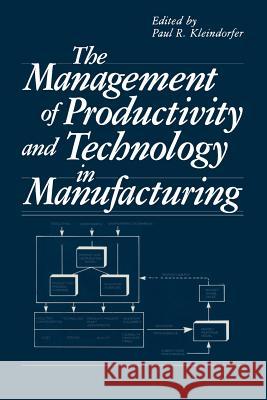
Paul R. Kleindorfer
The Management of Productivity and Technology in Manufacturing Paul R. Kleindorfer 9781461295167 Springer - książkaWidoczna okładka, to zdjęcie poglądowe, a rzeczywista szata graficzna może różnić się od prezentowanej.

The Management of Productivity and Technology in Manufacturing

ISBN-13: 9781461295167 / Angielski / Miękka / 2011 / 346 str.

Paul R. Kleindorfer
cena 201,24
(netto: 191,66 VAT:  5%)

Najniższa cena z 30 dni: 192,74
Termin realizacji zamówienia:
ok. 22 dni roboczych.

Darmowa dostawa!

This volume is concerned with the nature of new manufacturing technologies, such as CAD/CAM and robotics, as well as ap propriate methodologies for evaluating whether such technologies are financially and organizationally viable in particular contexts. The chapters included here were commissioned as papers for presen tation at The Wharton Conference on Productivity, Technology, and Organizational Innovation, which took place in Philadelphia on December 8 and 9 of 1983. The conference was sponsored by The University of Pennsylvania's Center for the Study of Organizational Innovation. There has been a surge of interest in the area of manufacturing over the past ten years as managers have come to realize that the operations function is critical to remaining competitive. New status has been given to factory and operations managers. New programs revitalizing manufacturing and distribution have been introduced in organizations. Corporate strategy is now explicitly considering operations and manufacturing functions. And the curricula of leading business schools are reflecting the rapidly advancing research on technology management and manufacturing operations. In spite of these important signs of progress, we are clearly just at the beginning of understanding the issues involved here. The present volume provides a state-of-the-art review of the realities of technology management and manufacturing strategy. As described in the Editor's Introduction, we address four topics: The Nature of New Manufacturing Technology, Innovation and Manufacturing Strategy, Productivity Management, and Technology Management and Organ ization. These issues are clearly very important themes for U.S."


Kategorie:
Nauka, Ekonomia i biznes
Kategorie BISAC:
Technology & Engineering > Automation
Computers > Computer Science
Business & Economics > Production & Operations Management
Wydawca:
Springer
Język:
Angielski
ISBN-13:
9781461295167
Rok wydania:
2011
Wydanie:
1985
Ilość stron:
346
Waga:
0.53 kg
Wymiary:
15.2 x 22.8 x 2.5
Oprawa:
Miękka
Wolumenów:
01

Editor’s Introduction.- 1. The Nature of New Manufacturing Technology.- 2. Innovation and Manufacturing Strategy.- 3. Productivity Management.- 4. Technology Management and Organization.- References.- I. The Nature of New Manufacturing Technology.- 1 Industrial Robotics and Flexible Manufacturing Systems: An Overview.- 1. Introduction.- 2. Background on Robotic Manipulators.- 2.1. The Robotic Manipulator.- 2.2. Defining Levels of Robot Technology Based on Internal vs. External Sensing.- 2.3. Limitations of Level I Robots.- 3. Extensions in the Capabilities of Insensate Robots.- 3.1. Increased Availability of High-Precision Robots for Light Manufacturing.- 3.2. Increased Availability of Computer-Controlled Robots.- 3.3. The Integration of Sensory Information Processing with Robotic Devices.- 3.4. Commercial use of Machine Vision Systems Since 1979.- 4. Flexible Manufacturing Systems.- 4.1. An Overview of Manufacturing Systems.- 4.2. Flexible Manufacturing Systems for Machining.- 4.3. Developments in Flexible Manufacturing Systems.- Notes.- References.- 2 Perspectives on Automotive Manufacturing.- 1. Introduction.- 2. Scope of Ford North American Manufacturing Operations.- 3. Vehicle Assembly Operations.- 4. Stamping Operations.- 5. Scheduling.- 6. “New” Operating Strategies in Automotive Manufacturing.- 7. Summary.- References.- 3 Impacts of Robotic and Flexible Manufacturing Technologies on Manufacturing Costs and Employment.- 1. Introduction.- 2. Metalworking Industries.- 3. The Impacts of Robotic Manipulators.- 3.1. Calculation of Payback Periods Based on Direct Labor Savings.- 3.2. The Price Elasticity Argument.- 4. The Impacts of the Fully Utilized, Flexibly Automated Factory for Batch Production.- Notes.- References.- II. Innovation and Manufacturing Strategy.- 4 Invasion of a Stable Business by Radical Innovation.- 1. Introduction.- 2. A model of Innovative Challenges and Defensive Responses.- 2.1. The New Technology Enters a Market Demanding New Performance.- 2.2. A General Pattern of Response to Radical Innovation.- 3. Application of the Model to Specific Examples.- 3.1. Product-Process Discontinuities.- 3.2. Product Discontinuities.- 3.3. Process Discontinuities.- 3.4. Process-Product Discontinuities.- 4. Some Concluding Observations.- Notes.- References.- 5 Manufacturing Strategy: Concepts and Methods.- 1. Introduction.- 2. Manufacturing Strategy: Decisions and Performance.- 2.1. Product Decisions.- 2.2. Process Decisions.- 2.3. Facility Decisions.- 2.4. Control Decisions.- 2.5. Organization Decisions.- 3. The Manufacturing Strategy Paradigm.- 4. MPSS Functions and Design.- 4.1. Segmentation Analysis.- 4.2. Cost/Performance Analysis.- 4.3. Production/Distribution Model.- 4.4. Production Process Model.- 4.5. Market Response Model.- 5. Implementation Considerations.- References.- 6 The Executive Dilemma: New Industrial Automation Systems.- III. Productivity Management.- 7 Working Smarter the Japanese Way: The X-Efficiency of Theory Z Management.- 1. Introduction.- 1.1. X-Efficiency and Productivity.- 1.2. Plan of the Chapter.- 2. Implicit Psychological Contracts, Transaction Costs, and Cooperation.- 2.1. The Implicit Psychological Contract.- 2.2. The IPC Hypothesis.- 3. The Determinants of Effort.- 3.1. The Utility-Effort Relation.- 4. Conclusion.- Notes.- References.- 8 Theory Z, Institutional Economics, and the Theory of Strategy.- 1. Introduction.- 2. Microeconomics and Type Z Management.- 3. Institutional Economics, Management, and the Theory of Strategy.- Notes.- References.- 9 Productivity Measurement and Management Control.- 1. Introduction.- 2. Congruence with Profit Maximization.- 3. A Framework for Productivity Analysis.- 4. Concluding Remarks.- References.- 10 The 1983 Global Manufacturing Futures Study Preliminary Report Synopsis.- 1. Introduction.- 2. Conclusions of the Survey.- 3. Major Observations.- 3.1. Strategies and Competitive Priorities.- 3.2. Major Concerns.- 3.3. Current Practices.- 3.4. Programs for the Future.- 4. Environmental Observations.- IV. Technology Management and Organization.- 11 Organizational Issues in the Introduction of New Technologies.- 1. Introduction.- 2. Problem Solving, Communications, and the Mobility of People.- 2.1. Problem-Solving Processes.- 2.2. Communication and Information Processing.- 2.3. Cognitive Processes.- 2.4. Mobility of People and the “Not Invented Here” Syndrome.- 3. Organizational Structures.- 4. Organizational Controls.- 4.1. Technical Understanding.- 4.2. Technical Feasibility.- 4.3. Research and Development Overlap.- 4.4. Growth Potential.- 4.5. Organizational Slack and Sponsorship.- 4.6. Organizational Rewards.- References.- 12 The Strategic Management of Technology.- 1. Technology in the 1970s.- 2. Impact of Technology on Business in the 1980s.- 3. Booz-Allen’s View of Technology Management.- 4. Booz-Allen’s Approach to Technology Strategy.- 4.1. Developing the Technology Portfolio.- 4.2. Matching Technology and Business Portfolios.- 4.3. Setting Technology Investment Priorities.- Notes.- Author Index.


Udostępnij

Facebook - konto krainaksiazek.pl


Opinie o Krainaksiazek.pl na Opineo.pl

Partner Mybenefit

Krainaksiazek.pl w programie rzetelna firma Krainaksiaze.pl - płatności przez paypal

Czytaj nas na:

Facebook - krainaksiazek.pl
  • książki na zamówienie
  • granty
  • książka na prezent
  • kontakt
  • pomoc
  • opinie
  • regulamin
  • polityka prywatności

Zobacz:

  • Księgarnia czeska

  • Wydawnictwo Książkowe Klimaty

1997-2026 DolnySlask.com Agencja Internetowa

© 1997-2022 krainaksiazek.pl
     
KONTAKT | REGULAMIN | POLITYKA PRYWATNOŚCI | USTAWIENIA PRYWATNOŚCI
Zobacz: Księgarnia Czeska | Wydawnictwo Książkowe Klimaty | Mapa strony | Lista autorów
KrainaKsiazek.PL - Księgarnia Internetowa

Polityka prywatnosci - link
Krainaksiazek.pl - płatnośc Przelewy24
Przechowalnia Przechowalnia





