• Wyszukiwanie zaawansowane
  • Kategorie
  • Kategorie BISAC
  • Książki na zamówienie
  • Promocje
  • Granty
  • Książka na prezent
  • Opinie
  • Pomoc
  • Załóż konto
  • Zaloguj się

The Logic of Essentialism: An Interpretation of Aristotle's Modal Syllogistic » książka


zaloguj się | załóż konto
Logo Krainaksiazek.pl

koszyk

konto

szukaj
topmenu
Księgarnia internetowa
Szukaj
Książki na zamówienie
Promocje
Granty
Książka na prezent
Moje konto
Pomoc
 
 
Wyszukiwanie zaawansowane
Pusty koszyk
Bezpłatna dostawa dla zamówień powyżej 20 złBezpłatna dostawa dla zamówień powyżej 20 zł

Kategorie główne

• Nauka
 [2946600]
• Literatura piękna
 [1856966]

  więcej...
• Turystyka
 [72221]
• Informatyka
 [151456]
• Komiksy
 [35826]
• Encyklopedie
 [23190]
• Dziecięca
 [619653]
• Hobby
 [140543]
• AudioBooki
 [1577]
• Literatura faktu
 [228355]
• Muzyka CD
 [410]
• Słowniki
 [2874]
• Inne
 [445822]
• Kalendarze
 [1744]
• Podręczniki
 [167141]
• Poradniki
 [482898]
• Religia
 [510455]
• Czasopisma
 [526]
• Sport
 [61590]
• Sztuka
 [243598]
• CD, DVD, Video
 [3423]
• Technologie
 [219201]
• Zdrowie
 [101638]
• Książkowe Klimaty
 [124]
• Zabawki
 [2473]
• Puzzle, gry
 [3898]
• Literatura w języku ukraińskim
 [254]
• Art. papiernicze i szkolne
 [8170]
Kategorie szczegółowe BISAC

The Logic of Essentialism: An Interpretation of Aristotle's Modal Syllogistic

ISBN-13: 9789401072441 / Angielski / Miękka / 2011 / 384 str.
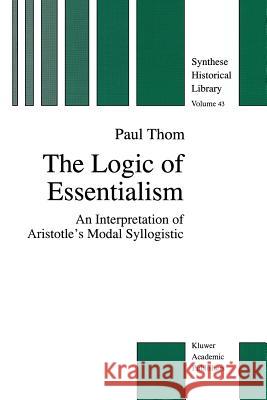
P. Thom
The Logic of Essentialism: An Interpretation of Aristotle's Modal Syllogistic Thom, P. 9789401072441 Springer - książkaWidoczna okładka, to zdjęcie poglądowe, a rzeczywista szata graficzna może różnić się od prezentowanej.

The Logic of Essentialism: An Interpretation of Aristotle's Modal Syllogistic

ISBN-13: 9789401072441 / Angielski / Miękka / 2011 / 384 str.

P. Thom
cena 605,23 zł
(netto: 576,41 VAT:  5%)

Najniższa cena z 30 dni: 578,30 zł
Termin realizacji zamówienia:
ok. 22 dni roboczych
Bez gwarancji dostawy przed świętami

Darmowa dostawa!

Aristotle's modal syllogistic has been an object of study ever since the time of Theophrastus; but these studies (apart from an intense flowering in the Middle Ages) have been somewhat desultory. Remarkably, in the 1990s several new lines of research have appeared, with series of original publications by Fred Johnson, Richard Patterson and Ulrich Nortmann. Johnson presented for the first time a formal semantics adequate to a de re reading of the apodeictic syllogistic; this was based on a simple intuition linking the modal syllogistic to Aristotelian metaphysics. Nortmann developed an ingenious de dicto analysis. Patterson articulated the links (both theoretical and genetic) between the modal syllogistic and the metaphysics, using an analysis which strictly speaking is neither de re nor de dicto. My own studies in this field date from 1976, when my colleague Peter Roeper and I jointly wrote a paper "Aristotle's apodeictic syllogisms" for the XXIInd History of Logic Conference in Krakow. This paper contained the disjunctive reading of particular affirmative apodeictic propositions, which I still favour. Nonetheless, I did not consider that paper's results decisive or comprehensive enough to publish, and my 1981 book The Syllogism contained no treatment of the modal syllogism. The paper's ideas lay dormant till 1989, when I read Johnson's and Patterson's initial articles. I began publishing on the topic in 1991. Gradually my thoughts acquired a certain comprehensiveness and systematicity, till in 1993 I was able to take a semester's sabbatical to write up a draft of this book.


Kategorie:
Nauka, Historia
Kategorie BISAC:
Philosophy > History & Surveys - Ancient & Classical
Philosophy > Logic
Philosophy > History & Surveys - Medieval
Wydawca:
Springer
Seria wydawnicza:
New Synthese Historical Library
Język:
Angielski
ISBN-13:
9789401072441
Rok wydania:
2011
Wydanie:
Softcover Repri
Ilość stron:
384
Waga:
0.64 kg
Wymiary:
24.0 x 16.0
Oprawa:
Miękka
Wolumenów:
01

§0 Entering the Realm of Darkness.- One. Elementary Synta.- §1 Elementary forms.- §2 Modal opposition.- 2.1 Necessity- and possibility-forms.- 2.2 Necessity- and contingency-forms.- §3 Transformation rules: Substitution, Permutation, Reductio and Cut.- 3.1 Substitution.- 3.2 Permutation.- 3.3 Indirect Reduction.- 3.4 Cut.- §4 Transformation rules: Contraction, Ecthesis.- 4.1 Contraction.- 4.2 Ecthesis.- §5 Transformation rules: modal reductio.- Two. Axioms.- §6 Axioms: X and L axioms.- 6.1 X axioms.- 6.2 L axioms.- 6.2.1 Pure L axioms.- 6.2.2 L-X axioms.- §7 Axioms: Q axioms.- 7.1 Pure Q axioms.- 7.2 Q-X axioms.- 7.3 Q-L axioms.- §8 Axioms: Q’, M and X’ axioms.- 8.1 Q’ axioms.- 8.2 M axioms.- 8.3 ‘Unqualified’ assertoric axioms.- Three. Theses.- §9 Necessity moods.- 9.1 Pure L theses.- 9.2 L-X theses.- §10 Unampliated contingency moods.- 10.1 Q-X theses.- 10.2 Q-L theses.- 10.2.1 First Figure.- 10.2.2 Second Figure.- 10.2.3 Third Figure.- §11 Ampliated contingency moods.- §12 Possibility moods.- 12.1 First Figure.- 12.2 Second Figure.- 12.3 Third Figure.- §13 ‘Unqualified’moods.- 13.1 First Figure.- 13.2 Second Figure.- 13.3 Third Figure.- Four. Rejections.- §14 Necessity moods.- 14.1 Rejected L-X moods: First Figure.- 14.2 Rejected L-X moods: Second Figure.- 14.3 Rejected L-X moods: Third Figure.- §15 Unampliated contingency moods.- 15.1 Rejected 1-premissed Q moods.- 15.2 Rejected 2-premissed Q-X moods.- 15.2.1 Rejected Q-X moods: First Figure.- 15.2.2 Rejected Q-X moods: Second Figure.- 15.2.3 Rejected Q-X moods: Third Figure.- 15.3 Rejected Q-L moods.- 15.3.1 Rejected Q-L moods: First Figure.- 15.3.2 Rejected Q-L moods: Second Figure.- 15.3.3 Rejected Q-L moods: Third Figure.- §16 Ampliated contingency moods.- 16.1 Rejected Q’ moods: First Figure.- 16.2 Rejected Q’ moods: Second Figure.- 16.3 Rejected Q’ moods: Third Figure.- §17 Possibility and ‘unqualified’ moods.- Five. Flaws in the Fabric.- §18 Incidental mistakes.- 18.1 Barbara XLL and the Hintikka Formulae.- 18.2 Datisi XLL, Disamis LXL and necessarily awake bipeds.- 18.3 QiLo-1, QoLo-1 and necessarily non-white men.- 18.4 QaLaLo-2, QeLaLo-2 and negative conclusions from affirmative premisses.- 18.5 QaLe-3, QeLe-3 and necessarily sleeping horses.- 18.6 Barbara X’QM and ‘unqualified’ assertorics.- §19 Substantial mistakes.- 19.1 QaLaXe-2 and negative conclusions from affirmative premises.- 19.2 Barbara XQM and ephemeral contingencies.- §20 Inconsistencies.- 20.1 Baroco XLL, Bocardo LXL and ecthesis.- 20.2 Q-opposition and Qi-conversion.- Six. System AL.- §21 Assertoric forms.- §22 Necessity forms.- 22.1 Formal semantics.- 22.2 The Sun set Theorem.- 22.3 Validity of the axioms.- 22.4 Invalidity of the axiomatic rejections.- 22.5 Corollaries.- §23 Adding C,K,U and T.- §24 Reduction to assertoric syllogistic.- §25 Alternative de re approaches: base.- 25.1 Existence assumptions.- 25.2 Sun set assumptions.- §26 Alternative de re approaches: superstructure.- 26.1 Superstructure A.- 26.2 Superstructure AA.- 26.3 Superstructure C.- 26.4 Superstructure CC.- §27 Alternative approaches: de dicto theories.- 27.1 Pure de dicto theories.- 27.2 Mixed de dicto/de re theories.- Seven. Systems AQ and AQ’.- §28 Unampliated contingency-forms.- 28.1 Formal semantics.- 28.2 Validity of the axioms.- 28.3 Invalidity of the axiomatic rejections.- 28.3.1 First Figure.- 28.3.2 Second Figure.- 28.3.3 Third Figure.- 28.4 Corollaries.- §29 Ampliated contingency-forms.- 29.1 Formal semantics.- 29.2 Validity of the axioms.- 29.3 Invalidity of the axiomatic rejections.- 29.4 Corollaries.- §30 The relation of ampliated to unampliated systems.- §31 Reduction to assertoric syllogistic.- §32 Alternative de re approaches.- 32.1 Superstructure A.- 32.2 Superstructure AA.- 32.3 Superstructure C.- 32.4 Superstructure CC.- 32.5 Comparing superstructures.- §33 Alternative approaches: de dicto theories.- Eight. System AX’.- §34 Unqualified assertorics.- §35 System AX’.- §36 Reduction to assertoric syllogistic.- §37 A reprieve for modal reductio.- Nine. Singular Modal Syllogistic.- §38 System AEL5.- 38.1 Syntactic base.- 38.2 Formal semantics.- 38.3 Provability of AL’s base.- §39 Systems AEQ5 and AEQ’5.- §40 Alternative de re approaches.- 40.1 A-style singular modal syllogistic.- 40.2 AA-style singular modal syllogistic.- 40.3 C-style singular modal syllogistic.- 40.4 CC-style singular modal syllogistic.- §41 Reduction to assertoric syllogistic.- 41.1 System EQ0.- 41.2 Alternative superstructures.- 41.3 Alternative bases.- Ten. Essentialism.- §42 Varieties of essentialism.- 42.1 Essentialism.- 42.2 Examples of essentialist theory.- 42.3 Aristotelian essentialism: generalities.- 42.4 Aristotelian essentialism: specifics.- §43 The essentialism of the modal syllogistic.- 43.1 A metaphysical interpretation of the modal syllogistic.- 43.2 Interpreting the base.- 43.3 Interpreting the superstructure.- 43.3.1 La-propositions.- 43.3.2 Le-propositions.- 43.3.3 Li-propositions.- 43.3.4 Lo-propositiions.- 43.3.5 Q-propositions.- §44 Aristotle’s static essentialism.- §45 Aristotle’s dynamic essentialism.- §46 The metaphysics of unqualified assertorics.- §47 Aristotelian vs. Platonic essentialism.- §48 Conclusions.- References and Indexes.- References.- Index locorum.- Index of axioms.- Index of rules.- Index of systems.- General index.


Udostępnij

Facebook - konto krainaksiazek.pl


Opinie o Krainaksiazek.pl na Opineo.pl

Partner Mybenefit

Krainaksiazek.pl w programie rzetelna firma Krainaksiaze.pl - płatności przez paypal

Czytaj nas na:

Facebook - krainaksiazek.pl
  • książki na zamówienie
  • granty
  • książka na prezent
  • kontakt
  • pomoc
  • opinie
  • regulamin
  • polityka prywatności

Zobacz:

  • Księgarnia czeska

  • Wydawnictwo Książkowe Klimaty

1997-2025 DolnySlask.com Agencja Internetowa

© 1997-2022 krainaksiazek.pl
     
KONTAKT | REGULAMIN | POLITYKA PRYWATNOŚCI | USTAWIENIA PRYWATNOŚCI
Zobacz: Księgarnia Czeska | Wydawnictwo Książkowe Klimaty | Mapa strony | Lista autorów
KrainaKsiazek.PL - Księgarnia Internetowa

Polityka prywatnosci - link
Krainaksiazek.pl - płatnośc Przelewy24
Przechowalnia Przechowalnia






