• Wyszukiwanie zaawansowane
  • Kategorie
  • Kategorie BISAC
  • Książki na zamówienie
  • Promocje
  • Granty
  • Książka na prezent
  • Opinie
  • Pomoc
  • Załóż konto
  • Zaloguj się

The Knowledge Acquisition and Representation Language, Karl » książka


zaloguj się | załóż konto
Logo Krainaksiazek.pl

koszyk

konto

szukaj
topmenu
Księgarnia internetowa
Szukaj
Książki na zamówienie
Promocje
Granty
Książka na prezent
Moje konto
Pomoc
 
 
Wyszukiwanie zaawansowane
Pusty koszyk
Bezpłatna dostawa dla zamówień powyżej 20 złBezpłatna dostawa dla zamówień powyżej 20 zł

Kategorie główne

• Nauka
 [2946600]
• Literatura piękna
 [1856966]

  więcej...
• Turystyka
 [72221]
• Informatyka
 [151456]
• Komiksy
 [35826]
• Encyklopedie
 [23190]
• Dziecięca
 [619653]
• Hobby
 [140543]
• AudioBooki
 [1577]
• Literatura faktu
 [228355]
• Muzyka CD
 [410]
• Słowniki
 [2874]
• Inne
 [445822]
• Kalendarze
 [1744]
• Podręczniki
 [167141]
• Poradniki
 [482898]
• Religia
 [510455]
• Czasopisma
 [526]
• Sport
 [61590]
• Sztuka
 [243598]
• CD, DVD, Video
 [3423]
• Technologie
 [219201]
• Zdrowie
 [101638]
• Książkowe Klimaty
 [124]
• Zabawki
 [2473]
• Puzzle, gry
 [3898]
• Literatura w języku ukraińskim
 [254]
• Art. papiernicze i szkolne
 [8170]
Kategorie szczegółowe BISAC

The Knowledge Acquisition and Representation Language, Karl

ISBN-13: 9780792396017 / Angielski / Twarda / 1995 / 238 str.
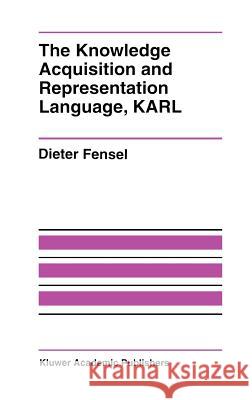
Dieter Fensel
The Knowledge Acquisition and Representation Language, Karl Fensel, Dieter 9780792396017 Kluwer Academic Publishers - książkaWidoczna okładka, to zdjęcie poglądowe, a rzeczywista szata graficzna może różnić się od prezentowanej.

The Knowledge Acquisition and Representation Language, Karl

ISBN-13: 9780792396017 / Angielski / Twarda / 1995 / 238 str.

Dieter Fensel
cena 605,23 zł
(netto: 576,41 VAT:  5%)

Najniższa cena z 30 dni: 578,30 zł
Termin realizacji zamówienia:
ok. 22 dni roboczych
Bez gwarancji dostawy przed świętami

Darmowa dostawa!

Within the framework of so-called second generation expert systems 62] knowledge modeling is one of the most important aspects. On the one hand, knowledge acquisition is no longer seen as a knowledge transfer process, rather it is now considered as model construction process which is typically a cyclic and error prone process. On the other hand, the distinction between knowledge and symbol level descriptions 166] resulted in various proposals for conceptual knowledge models describing knowledge in an implementation independent way. One of the most prominent examples of such a conceptual model is the KADS model of expertise which is characterized by its clear distinction of different know ledge types and by the usage of specific modeling primitives to describe these different knowledge types 185]. The semi formal KADS expertise model entails all the advantages and disadvantages which have been identified for semi-formal system models e.g. in the software engineering community."


Kategorie:
Informatyka, Bazy danych
Kategorie BISAC:
Computers > Artificial Intelligence - Expert Systems
Computers > Software Development & Engineering - General
Wydawca:
Kluwer Academic Publishers
Język:
Angielski
ISBN-13:
9780792396017
Rok wydania:
1995
Wydanie:
1995
Ilość stron:
238
Waga:
0.54 kg
Wymiary:
23.39 x 15.6 x 1.6
Oprawa:
Twarda
Wolumenów:
01
Dodatkowe informacje:
Bibliografia
Wydanie ilustrowane

1 Introduction.- 1.1 Model-based and Incremental Knowledge Engineering.- 1.1.1 Model-based Knowledge Engineering.- 1.1.2 Incremental Knowledge Engineering.- 1.1.3 MIKE.- 1.2 The Knowledge Acquisition and Representation Language KARL.- 1.2.1 A Model of Expertise in KARL.- 1.2.2 Why not using VDM or Z.- 1.2.3 The Formal Semantics.- 1.2.4 The Implementation.- 1.2.5 Case Studies.- 1.3 Some Arguments about Formal and Operational Specification Languages.- 1.3.1 The Knowledge of Experts Cannot or not Adequately be Described Formally.- 1.3.2 Formal Languages are Difficult to Learn.- 1.3.3 Formal Specifications are too Complex and too Difficult to Understand.- 1.3.4 Formal Specifications are too Expensive.- 1.3.5 Should a Specification Language be Executable or Not.- 2 Logical-Karl.- 2.1 Significant Ideas of Other Approaches Used for L-KARL.- 2.1.1 Object-orientation and Equality.- 2.1.2 Reasoning About Classes.- 2.1.3 Integration of Well-typing Into a Model-theoretical Semantics.- 2.1.4 Set-valued Attributes.- 2.1.5 Minimal and Perfect Models as Semantics.- 2.2 Syntax of L-KARL.- 2.3 Informal Semantics of L-KARL.- 2.3.1 ID Terms.- 2.3.2 Class and Predicate Definitions.- 2.3.3 Literals.- 2.3.4 The Difference Between Objects and Values.- 2.3.5 The Well-typing Conditions.- 2.3.6 Formulae.- 2.3.7 Constraints.- 2.4 A Comparison with F-logic and O-logic.- 3 Procedural-Karl.- 3.1 Significant Ideas of Other Approaches Used for P-KARL.- 3.2 Syntax of P-KARL.- 3.3 Informal Semantics of P-KARL.- 4 The Karl Model of Expertise.- 4.1 The Sisyphus Example.- 4.2 The Domain Layer.- 4.2.1 Terminological Knowledge: The Domain Schema.- 4.2.2 Intensional Descriptions.- 4.2.3 Factual Knowledge.- 4.2.4 Necessary Descriptions.- 4.2.5 Data.- 4.2.6 Graphical Representation.- 4.2.7 The Domain Layer of the Sisyphus Example.- 4.3 The Inference Layer.- 4.3.1 An Alphabet of an Inference Layer.- 4.3.2 Roles.- 4.3.3 Elementary Inference Actions.- 4.3.4 Inference Structure.- 4.3.5 Graphical Representation.- 4.3.6 Inference Structures versus Dataflow Diagrams.- 4.3.7 The Inference Layer of the Sisyphus Example.- 4.4 The Task Layer.- 4.4.1 Language Primitives at the Task Layer.- 4.4.2 Graphical Representation.- 4.4.3 The Task Layer of the Sisyphus Example.- 4.5 The Model of Cooperation.- 4.5.1 Data.- 4.5.2 Control Information.- 5 The Formal Semantics of Karl.- 5.1 The Formal Semantics of L-KARL.- 5.1.1 Model Theory of L-KARL.- 5.1.2 Herbrand Models.- 5.1.3 Minimal Model Semantics.- 5.1.4 Perfect Model Semantics.- 5.1.5 Constraints.- 5.1.6 Built-in Predicates.- 5.2 The Formal Semantics of P-KARL.- 5.3 The Formal Semantics of a Domain Layer.- 5.4 The Formal Semantics of an Inference Layer.- 5.5 The Formal Semantics of a Task Layer.- 6 Conclusion.- 6.1 Highlights of KARL.- 6.2 Related Work.- 6.2.1 A Comparison with (ML)2.- 6.2.2 KARL and Structured Analysis.- 6.3 Shortcomings of KARL.- 6.3.1 Current Limitations of KARL.- 6.3.2 Actual Limitations of KARL.- 6.4 Future Work.- 6.4.1 Validation of Conceptual Models.- 6.4.2 Formal Specifications of Reusable Problem-Solving Methods.- References.

Fensel, Dieter Dieter Fensel is Professor of Mathematics and Comp... więcej >


Udostępnij

Facebook - konto krainaksiazek.pl


Opinie o Krainaksiazek.pl na Opineo.pl

Partner Mybenefit

Krainaksiazek.pl w programie rzetelna firma Krainaksiaze.pl - płatności przez paypal

Czytaj nas na:

Facebook - krainaksiazek.pl
  • książki na zamówienie
  • granty
  • książka na prezent
  • kontakt
  • pomoc
  • opinie
  • regulamin
  • polityka prywatności

Zobacz:

  • Księgarnia czeska

  • Wydawnictwo Książkowe Klimaty

1997-2025 DolnySlask.com Agencja Internetowa

© 1997-2022 krainaksiazek.pl
     
KONTAKT | REGULAMIN | POLITYKA PRYWATNOŚCI | USTAWIENIA PRYWATNOŚCI
Zobacz: Księgarnia Czeska | Wydawnictwo Książkowe Klimaty | Mapa strony | Lista autorów
KrainaKsiazek.PL - Księgarnia Internetowa

Polityka prywatnosci - link
Krainaksiazek.pl - płatnośc Przelewy24
Przechowalnia Przechowalnia





