• Wyszukiwanie zaawansowane
  • Kategorie
  • Kategorie BISAC
  • Książki na zamówienie
  • Promocje
  • Granty
  • Książka na prezent
  • Opinie
  • Pomoc
  • Załóż konto
  • Zaloguj się

The Interactional Architecture of the Language Classroom: A Conversation Analysis Perspective » książka

zaloguj się | załóż konto
Logo Krainaksiazek.pl

koszyk

konto

szukaj
topmenu
Księgarnia internetowa
Szukaj
Książki na zamówienie
Promocje
Granty
Książka na prezent
Moje konto
Pomoc
 
 
Wyszukiwanie zaawansowane
Pusty koszyk
Bezpłatna dostawa dla zamówień powyżej 20 złBezpłatna dostawa dla zamówień powyżej 20 zł

Kategorie główne

• Nauka
 [2946912]
• Literatura piękna
 [1852311]

  więcej...
• Turystyka
 [71421]
• Informatyka
 [150889]
• Komiksy
 [35717]
• Encyklopedie
 [23177]
• Dziecięca
 [617324]
• Hobby
 [138808]
• AudioBooki
 [1671]
• Literatura faktu
 [228371]
• Muzyka CD
 [400]
• Słowniki
 [2841]
• Inne
 [445428]
• Kalendarze
 [1545]
• Podręczniki
 [166819]
• Poradniki
 [480180]
• Religia
 [510412]
• Czasopisma
 [525]
• Sport
 [61271]
• Sztuka
 [242929]
• CD, DVD, Video
 [3371]
• Technologie
 [219258]
• Zdrowie
 [100961]
• Książkowe Klimaty
 [124]
• Zabawki
 [2341]
• Puzzle, gry
 [3766]
• Literatura w języku ukraińskim
 [255]
• Art. papiernicze i szkolne
 [7810]
Kategorie szczegółowe BISAC

The Interactional Architecture of the Language Classroom: A Conversation Analysis Perspective

ISBN-13: 9781405120098 / Angielski / Miękka / 2004 / 280 str.
Paul Seedhouse
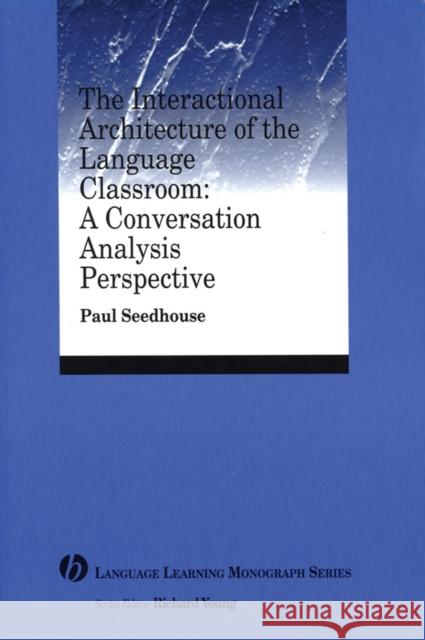
The Interactional Architecture of the Language Classroom: A Conversation Analysis Perspective Seedhouse, Paul 9781405120098 Blackwell Publishers - książkaWidoczna okładka, to zdjęcie poglądowe, a rzeczywista szata graficzna może różnić się od prezentowanej.

The Interactional Architecture of the Language Classroom: A Conversation Analysis Perspective

ISBN-13: 9781405120098 / Angielski / Miękka / 2004 / 280 str.

Paul Seedhouse
cena 198,77
(netto: 189,30 VAT:  5%)

Najniższa cena z 30 dni: 197,95
Termin realizacji zamówienia:
ok. 30 dni roboczych
Bez gwarancji dostawy przed świętami

Darmowa dostawa!

Winner of the MLA Kenneth W. Mildenberger Prize 2005 This monograph provides a model of the organisation of L2 classroom interaction and a practical methodology for its analysis. The main thesis is that there is a reflexive relationship between pedagogy and interaction in the L2 classroom; this relationship is the foundation of its context-free architecture.

  • Explains the basic principles of Conversation Analysis and reviews the literature on L2 classroom interaction.
  • Portrays the reflexive relationship between the pedagogical focus of the interaction and the organisation of turn-taking, sequence and repair.
  • Describes the overall organisation of L2 classroom interaction and illustrates the use of the analytical methodology.
  • Considers how Conversation Analysis can contribute to the research agendas of Applied Linguistics and Second Language Acquisition.


Kategorie:
Nauka, Językoznawstwo
Kategorie BISAC:
Language Arts & Disciplines > Communication Studies
Language Arts & Disciplines > Linguistics - General
Education > General
Wydawca:
Blackwell Publishers
Seria wydawnicza:
Language Learning Monograph
Język:
Angielski
ISBN-13:
9781405120098
Rok wydania:
2004
Numer serii:
000326961
Ilość stron:
280
Waga:
0.44 kg
Wymiary:
22.91 x 15.9 x 1.75
Oprawa:
Miękka
Wolumenów:
01
Dodatkowe informacje:
Bibliografia
Wydanie ilustrowane

 “The book has important implications for understanding what is possible in language classrooms as a part of educational institutions, and is particularly illuminating in challenging some of the tenets of communicative methodology. Given that CA attempts to describe the uniqueness of specific interactions, but uses what it claims is a ‘context–free’ machinery, and the fact that the database is wide–ranging, the book is likely to have relevance for second and foreign language teaching across a wide range of contexts.”  – Thomas Morton, University of Leeds – Applied Linguistics

Series Editor’s Foreword.

Acknowledgments.

Chapter 1 Conversation Analysis Methodology.

1.1 History and Development of Conversation Analysis.

1.2 Ethnomethodology.

1.3 The Principles of Ethnomethodology.

1.4 Aims of Conversation Analysis.

1.5 Principles of Conversation Analysis.

1.6 Types of Interactional Organization.

1.7 Conversation Analysis Procedures.

1.8 Attitude Toward Context.

1.9 Ethnomethodological Conversation.

1.10 Chapter Summary.

Notes.

Chapter 2 Different Perspectives on Language Classroom Interaction.

2.1 Discourse Analysis Approaches.

2.2 The Communicative Approach to Second Language Classroom Interaction.

2.3 Dynamic and Variable Approaches to Classroom Interaction.

2.4 Database Issues.

2.5 Adequacy of Database for the Study of Second Language Classroom Interaction.

2.6 Ethnography.

2.7 The Pedagogical Landing–Ground Perspective.

2.8 A Conversation Analysis Institutional–Discourse Perspective.

2.9 Chapter Summary.

Notes.

Chapter 3 The Organization of Turn Taking and Sequence in Language Classrooms.

3.1 Turn Taking and Sequence in Form–and–Accuracy Contexts.

3.2 Turn Taking and Sequence in Meaning–and–Fluency Contexts.

3.3 Turn Taking and Sequence in Task–Oriented Contexts.

3.4 Turn Taking and Sequence in Procedural Contexts.

3.5 Methodological Issues.

3.6 Chapter Summary.

Notes.

Chapter 4 The Organization of Repair in Language Classrooms.

4.1 Repair in Form–and–Accuracy Contexts.

4.2 Repair in Meaning–and–Fluency Contexts.

4.3 Repair in Task–Oriented Contexts.

4.4 Discussion.

4.5 Practical Applications of a Contextual Approach to Repair.

4.6 The Preference Organization of Repair: The Case of the Missing “No.”

4.7 Strategies for Conducting Repair Without Using Direct Negative Evaluation.

4.8 Examples of the Use of Mitigated Negative Evaluation.

4.9 Why Is There a Dispreference for Direct and Unmitigated Negative Evaluation?

4.10 A Different Preference Structure in Relation to Procedural Trouble.

4.11 The Paradox: Pedagogy and Interaction in Opposition.

4.12 Conclusions.

4.13 Chapter Summary.

Notes.

Chapter 5 The Organization of Language Classroom Interaction.

5.1 A Sketch of the Interactional Architecture of the Second Language Classroom.

5.2 The Basic Sequence Organization.

5.3 A Methodology for the Analysis of Second Language Classroom Interaction.

5.4 Talking the Institution of the Second Language Classroom In and Out of Being.

5.5 The Concept of Second Language Classroom Contexts.

5.6 A Three–Way View of Context.

5.7 Creating a Second Language Classroom.

5.8 Managing Context Shift.

5.9 Chapter Summary.

Notes.

Chapter 6 Conversation Analysis, Applied Linguistics, and Second Language Acquisition.

6.1 Conversation Analysis and Applied Linguistics.

6.2 Conversation Analysis and Second Language Acquisition.

6.3 Recasts.

6.4 Focus–on–Form Instruction.

6.5 Conversation Analysis as a Social Science Research Methodology.

6.6 Chapter Summary.

Notes.

Chapter 7 Epilogue.

Appendix 1 Transcription Conventions.

Appendix 2 Resources for Conversation Analysis Research in Applied Linguistics and Second Language Acquisition.

References.

Index.

Dr. Paul Seedhouse is Postgraduate Research Director in the School of Education, communication and Language Sciences at the University of Newcastle upon Tyne, UK. After teaching ESOL, German and French in five different countries, he has published widely in journals of applied linguistics, language teaching and pragmatics and has edited the forthcoming collection Applying Conversation Analysis.

Winner of the MLA Kenneth W. Mildenberger Prize 2005

This monograph provides a model of the organisation of L2 classroom interaction and a practical methodology for its analysis. The main thesis is that there is a reflexive relationship between pedagogy and interaction in the L2 classroom; this relationship is the foundation of its context–free architecture.

Chapter 1 explains the basic principles of Conversation Analysis (CA), while Chapter 2 reviews the literature on L2 classroom interaction. Chapters 3 and 4 portray the reflexive relationship between the pedagogical focus of the interaction and the organisation of turn–taking, sequence and repair. As the pedagogical focus varies, so the organisation of turn, sequence and repair varies. Chapter 5 describes the overall organisation of L2 classroom interaction and Chapter 6 illustrates the use of the analytical methodology. Chapter 7 considers how CA can contribute to the research agendas of Applied Linguistics and Second Language Acquisition. The discussion is illustrated by numerous extracts from an extensive database of language lessons from around the world.

Seedhouse, Paul Dr. Paul Seedhouse is Postgraduate Research Direct... więcej >


Udostępnij

Facebook - konto krainaksiazek.pl


Opinie o Krainaksiazek.pl na Opineo.pl

Partner Mybenefit

Krainaksiazek.pl w programie rzetelna firma Krainaksiaze.pl - płatności przez paypal

Czytaj nas na:

Facebook - krainaksiazek.pl
  • książki na zamówienie
  • granty
  • książka na prezent
  • kontakt
  • pomoc
  • opinie
  • regulamin
  • polityka prywatności

Zobacz:

  • Księgarnia czeska

  • Wydawnictwo Książkowe Klimaty

1997-2025 DolnySlask.com Agencja Internetowa

© 1997-2022 krainaksiazek.pl
     
KONTAKT | REGULAMIN | POLITYKA PRYWATNOŚCI | USTAWIENIA PRYWATNOŚCI
Zobacz: Księgarnia Czeska | Wydawnictwo Książkowe Klimaty | Mapa strony | Lista autorów
KrainaKsiazek.PL - Księgarnia Internetowa

Polityka prywatnosci - link
Krainaksiazek.pl - płatnośc Przelewy24
Przechowalnia Przechowalnia




