• Wyszukiwanie zaawansowane
  • Kategorie
  • Kategorie BISAC
  • Książki na zamówienie
  • Promocje
  • Granty
  • Książka na prezent
  • Opinie
  • Pomoc
  • Załóż konto
  • Zaloguj się

The Future of Work: Challenges and Prospects for Organisations, Jobs and Workers » książka


zaloguj się | załóż konto
Logo Krainaksiazek.pl

koszyk

konto

szukaj
topmenu
Księgarnia internetowa
Szukaj
Książki na zamówienie
Promocje
Granty
Książka na prezent
Moje konto
Pomoc
 
 
Wyszukiwanie zaawansowane
Pusty koszyk
Bezpłatna dostawa dla zamówień powyżej 20 złBezpłatna dostawa dla zamówień powyżej 20 zł

Kategorie główne

• Nauka
 [2949965]
• Literatura piękna
 [1857847]

  więcej...
• Turystyka
 [70818]
• Informatyka
 [151303]
• Komiksy
 [35733]
• Encyklopedie
 [23180]
• Dziecięca
 [617748]
• Hobby
 [139972]
• AudioBooki
 [1650]
• Literatura faktu
 [228361]
• Muzyka CD
 [398]
• Słowniki
 [2862]
• Inne
 [444732]
• Kalendarze
 [1620]
• Podręczniki
 [167233]
• Poradniki
 [482388]
• Religia
 [509867]
• Czasopisma
 [533]
• Sport
 [61361]
• Sztuka
 [243125]
• CD, DVD, Video
 [3451]
• Technologie
 [219309]
• Zdrowie
 [101347]
• Książkowe Klimaty
 [123]
• Zabawki
 [2362]
• Puzzle, gry
 [3791]
• Literatura w języku ukraińskim
 [253]
• Art. papiernicze i szkolne
 [7933]
Kategorie szczegółowe BISAC

The Future of Work: Challenges and Prospects for Organisations, Jobs and Workers

ISBN-13: 9783031314933 / Angielski
Theo Lynn; Pierangelo Rosati; Edel Conway
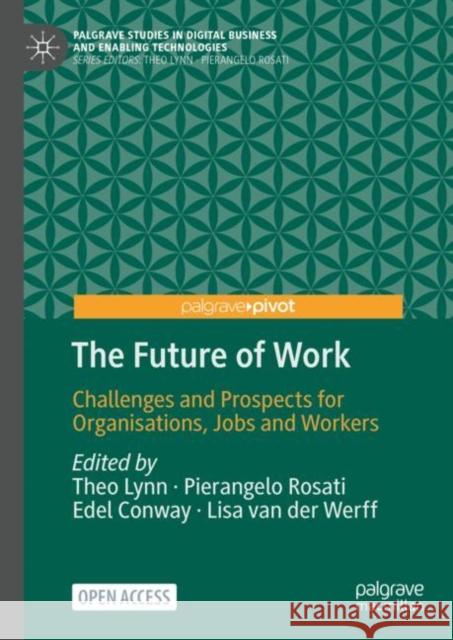
The Future of Work: Challenges and Prospects for Organisations, Jobs and Workers Theo Lynn Pierangelo Rosati Edel Conway 9783031314933 Palgrave MacMillan - książkaWidoczna okładka, to zdjęcie poglądowe, a rzeczywista szata graficzna może różnić się od prezentowanej.

The Future of Work: Challenges and Prospects for Organisations, Jobs and Workers

ISBN-13: 9783031314933 / Angielski

Theo Lynn; Pierangelo Rosati; Edel Conway
cena 201,72
(netto: 192,11 VAT:  5%)

Najniższa cena z 30 dni: 192,74
Termin realizacji zamówienia:
ok. 22 dni roboczych
Bez gwarancji dostawy przed świętami

Darmowa dostawa!

The COVID-19 pandemic accelerated the adoption of new forms of working and new working arrangements largely enabled by technology. The Future of Work is a projection of how work, working, workers and the workplace will evolve in the years ahead from the perspective of different actors in society, influenced by technological, socio-economic, political, and demographic changes.This open access Pivot is a timely exploration of some of the challenges and prospects for the future of work from two main perspectives: how work is changing and how to prepare for work in the future.  An evidence-based assessment of these topics offers some critical perspectives that challenge old assumptions and opens up emerging trends and possibilities for work in the future. As part of the Palgrave Studies in Digital Business & Enabling Technologies series, this book is an essential resource for academics of Business, Human Resource Management, Organisational Psychology and Industrial Relations, as well as practitioners and policy makers.


The COVID-19 pandemic accelerated the adoption of new forms of working and new working arrangements largely enabled by technology. The Future of Work is a projection of how work, working, workers and the workplace will evolve in the years ahead from the perspective of different actors in society, influenced by technological, socio-economic, political, and demographic changes.This open access Pivot is a timely exploration of some of the challenges and prospects for the future of work from two main perspectives: how work is changing and how to prepare for work in the future.  An evidence-based assessment of these topics offers some critical perspectives that challenge old assumptions and opens up emerging trends and possibilities for work in the future. As part of the Palgrave Studies in Digital Business & Enabling Technologies series, this book is an essential resource for academics of Business, Human Resource Management, Organisational Psychology and Industrial Relations, as well as practitioners and policy makers.

Kategorie:
Nauka, Ekonomia i biznes
Kategorie BISAC:
Business & Economics > Management Science
Business & Economics > Information Management
Computers > Computer Science
Wydawca:
Palgrave MacMillan
Seria wydawnicza:
Palgrave Studies in Digital Business & Enabling Technologies
Język:
Angielski
ISBN-13:
9783031314933

Chapter 1 – The Future of Work for Organisations, Jobs and Workers (Introduction)

This chapter summarises many of the main challenges and prospects for the future of work. It establishes and summarises the themes to be addressed in the remainder of the book.

Prof Edel Conway, Dr Lisa van der Werff

(Dublin City University)


Part One: The Challenges and Prospects for the Future of Work and Jobs

Chapter 2 – Disrupted or Enhanced? The impact of new ways of working on individual and organizational well-being

The COVID-19 pandemic has represented a catalyst for new ways of working.  This has opened a wide range opportunities such as remote, hybrid, co-working, flexible working and work from anywhere (WFA) approaches.  This chapter will consider the range of opportunities and challenges for both workers and organisations in terms of well-being and performance that are created by these new ways of working.

Prof Kathy Monks, Prof Yseult Freeney and Prof Edel Conway (Dublin City University)

Chapter 3 – Theorizing the Future of Work in Professional Services: An Institutional Perspective


This chapter will use a theoretical lens framed in institutional theory to better understand the challenges facing professional services, specifically accounting, law and architecture from digital technologies and specifically machine learning and artificial intelligence. This theoretical exploration will provide a basis for re-imagining the future of work in these professions in the context of digital trends.

Dr Brid Murphy and Dr Orla Feeney (Dublin City University)

Chapter 4 –  Algorithms, Apps & Uncertainty: Navigating Work in the Gig Economy

Although some critics consider gig working as simply the latest development in non-standard labour arrangements, its most novel and distinguishing feature, ‘algorithmic management’, disrupts and challenges the most enduring contours of work and people management. This chapter traces the role of digitalisation in creating the gig economy by exploring how algorithmic technologies have replaced human managers in this novel, yet heavily fragmented working arrangement.

Dr James Duggan and Dr Stefan Jooss (University College Cork)

Chapter 5 – Trust juggling effects of datafication of work: Where are we at and where do we go?

Datafication of work fundamentally changes the processes underlying workplace relationships. Our chapter takes perspective of both the technology and human on how datafication helps and hinders trust and collaboration in the workplace.

Dr Xuchang Zheng (Dublin City University),

Dr Simon Schafheitle (University of St Gallen)

Lisa van der Werff (Dublin City University),

Part Two: Looking to the Future

Chapter 6 – Leadership in digital workplaces

This chapter will provide an overview of research (its intellectual structure/past and current trends using bibliometrics) at the intersection of leadership and future of work. It will propose an integrative framework and future outlooks for research and practice.

Prof Matej Černe, Amadeja Lamovšek (University of Ljubliana), Prof Irina Nikolova, Prof Sut I Wong (BI Norwegian Business School)

Chapter 7 – Diversity and Inclusion in the future of work

This chapter will present an overview of extant knowledge about diversity and inclusion at work, with a specific focus on age, gender and race. The chapter will discuss these issues by first explicating how demographic, economic, social, and technological projections will impact the workplace and, second, by examining what specific interventions may promote real change, beyond the rhetoric, toward a more diverse and inclusive future of work. 

Dr Jean McCarthy (University of Limerick), Prof Janine Bosak (Dublin City University), Prof Emma Parry (Cranfield University) and Prof Jeanette Cleveland (Colorado State University)

Chapter 8 – Education and skills for the future of work


The chapter will explore a macro-level emphasis on skills required for the future of work as detailed by global policy reports. Specifically, it will explore how these both impact on, and can be fostered/co-created, through education.  Our focus is purposefully on skills for the future (not of the future) and on futures (plural). A key underpinning to our argument is the need for a narrative that moves away from an economic focus on skill development to a broader holistic view of human centered development. This is also reflected in the increase realization by organizations that human capital development (HCD) in FoW is linked to positive societal impacts.

Dr Shirley Davey (Ulster University), Prof Brian Harney (Dublin City University)

Chapter 9 -  Learning and Development

This chapter draws on the principles of congruence and adaptation in open systems theory to discuss the future of organizational learning and development and argue where the emphasis should be placed. We argue that the emphasis needs to be on learning and development processes at the individual level which are more learner-driven, informal, continuous and social; a focus on knowledge pull as opposed to knowledge push. In tandem at the organizational level this emphasis needs to position the learning and development function as focusing on processes to enable an environment for learner-driven learning and to focus on why and where and how learning enables a fluid business strategy as opposed to driving learning for learning sake.

Prof Claire Gubbins (Dublin City University), Prof Thomas Garavan (University College Cork)

Chapter 10 – Ethics in the Future of Work

A general misunderstanding regarding the essence of the ethical analysis lead to a misconception of ethics as a set of principles that need to be integrated in the way machines are designed. This chapter reviews existing literature on the topic, highlighting the shortcomings of unclear definitions of ethics, and suggests a framework to analyze the emerging areas of research in the future of work in light of a holistic approach to ethics.

Dr Marta Rocci (Dublin City University) and Dr  Caleb M. Bernacchio, California State University Monterey Bay

Chapter 11 – Outlook for Work in the Future

Conclusion: This chapter provides a summary of some of the main issues raised, key learning points, and further avenues for research.

Prof Theo Lynn and Dr Pierangelo Rosati (Dublin City University)

Theo Lynn is Full Professor of Digital Business at DCU Business School, Ireland. He is Series Editor on the Palgrave Studies in Digital Business & Enabling Technologies.

Pierangelo Rosati is Associate Professor of Digital Business & Society at the University of Galway, Ireland and is Series Editor on the Palgrave Studies in Digital Business & Enabling Technologies.

Edel Conway is Full Professor of HRM and Organisational Psychology and Associate Dean of Research at DCU Business School, Ireland. She is an organisational psychologist with expertise in the areas of Human Resource Management and Organisational Change.

Lisa van der Werff is Associate Professor of Organisational Psychology at DCU Business School, Ireland and Co-Director of the Irish Institute of Digital Business.She is an organisational psychologist and specialises in trust research.

The COVID-19 pandemic accelerated the adoption of new forms of working and new working arrangements largely enabled by technology. The Future of Work is a projection of how work, working, workers and the workplace will evolve in the years ahead from the perspective of different actors in society, influenced by technological, socio-economic, political, and demographic changes.


This open access book is a timely exploration of some of the challenges and prospects for the future of work from two main perspectives: how work is changing and how to prepare for work in the future. An evidence-based assessment of these topics offers some critical perspectives that challenge old assumptions and opens up emerging trends and possibilities for work in the future. As part of the Palgrave Studies in Digital Business & Enabling Technologies series, this book is an essential resource for academics of Business, Human Resource Management, Organisational Psychology and Industrial Relations, as well as practitioners and policy makers.

Theo Lynn is Full Professor of Digital Business at DCU Business School, Ireland. He is Series Editor on the Palgrave Studies in Digital Business & Enabling Technologies.

Pierangelo Rosati is Associate Professor of Digital Business & Society at the University of Galway, Ireland and is Series Editor on the Palgrave Studies in Digital Business & Enabling Technologies.

Edel Conway is Full Professor of HRM and Organisational Psychology and Associate Dean of Research at DCU Business School, Ireland. She is an organisational psychologist with expertise in the areas of Human Resource Management and Organisational Change.

Lisa van der Werff is Associate Professor of Organisational Psychology at DCU Business School, Ireland and Co-Director of the Irish Institute of Digital Business.She is an organisational psychologist and specialises in trust research.


Udostępnij

Facebook - konto krainaksiazek.pl


Opinie o Krainaksiazek.pl na Opineo.pl

Partner Mybenefit

Krainaksiazek.pl w programie rzetelna firma Krainaksiaze.pl - płatności przez paypal

Czytaj nas na:

Facebook - krainaksiazek.pl
  • książki na zamówienie
  • granty
  • książka na prezent
  • kontakt
  • pomoc
  • opinie
  • regulamin
  • polityka prywatności

Zobacz:

  • Księgarnia czeska

  • Wydawnictwo Książkowe Klimaty

1997-2025 DolnySlask.com Agencja Internetowa

© 1997-2022 krainaksiazek.pl
     
KONTAKT | REGULAMIN | POLITYKA PRYWATNOŚCI | USTAWIENIA PRYWATNOŚCI
Zobacz: Księgarnia Czeska | Wydawnictwo Książkowe Klimaty | Mapa strony | Lista autorów
KrainaKsiazek.PL - Księgarnia Internetowa

Polityka prywatnosci - link
Krainaksiazek.pl - płatnośc Przelewy24
Przechowalnia Przechowalnia



