• Wyszukiwanie zaawansowane
  • Kategorie
  • Kategorie BISAC
  • Książki na zamówienie
  • Promocje
  • Granty
  • Książka na prezent
  • Opinie
  • Pomoc
  • Załóż konto
  • Zaloguj się

The Future of Arid Lands - Revisited: A Review of 50 Years of Drylands Research » książka


zaloguj się | załóż konto
Logo Krainaksiazek.pl

koszyk

konto

szukaj
topmenu
Księgarnia internetowa
Szukaj
Książki na zamówienie
Promocje
Granty
Książka na prezent
Moje konto
Pomoc
 
 
Wyszukiwanie zaawansowane
Pusty koszyk
Bezpłatna dostawa dla zamówień powyżej 20 złBezpłatna dostawa dla zamówień powyżej 20 zł

Kategorie główne

• Nauka
 [2949965]
• Literatura piękna
 [1857847]

  więcej...
• Turystyka
 [70818]
• Informatyka
 [151303]
• Komiksy
 [35733]
• Encyklopedie
 [23180]
• Dziecięca
 [617748]
• Hobby
 [139972]
• AudioBooki
 [1650]
• Literatura faktu
 [228361]
• Muzyka CD
 [398]
• Słowniki
 [2862]
• Inne
 [444732]
• Kalendarze
 [1620]
• Podręczniki
 [167233]
• Poradniki
 [482388]
• Religia
 [509867]
• Czasopisma
 [533]
• Sport
 [61361]
• Sztuka
 [243125]
• CD, DVD, Video
 [3451]
• Technologie
 [219309]
• Zdrowie
 [101347]
• Książkowe Klimaty
 [123]
• Zabawki
 [2362]
• Puzzle, gry
 [3791]
• Literatura w języku ukraińskim
 [253]
• Art. papiernicze i szkolne
 [7933]
Kategorie szczegółowe BISAC

The Future of Arid Lands - Revisited: A Review of 50 Years of Drylands Research

ISBN-13: 9781402066887 / Angielski / Twarda / 2007 / 228 str.
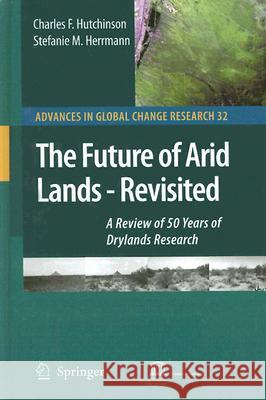
Charles Hutchinson; Stefanie M. Herrmann
The Future of Arid Lands - Revisited: A Review of 50 Years of Drylands Research Hutchinson, Charles F. 9781402066887 Springer - książkaWidoczna okładka, to zdjęcie poglądowe, a rzeczywista szata graficzna może różnić się od prezentowanej.

The Future of Arid Lands - Revisited: A Review of 50 Years of Drylands Research

ISBN-13: 9781402066887 / Angielski / Twarda / 2007 / 228 str.

Charles Hutchinson; Stefanie M. Herrmann
cena 605,23 zł
(netto: 576,41 VAT:  5%)

Najniższa cena z 30 dni: 578,30 zł
Termin realizacji zamówienia:
ok. 22 dni roboczych
Bez gwarancji dostawy przed świętami

Darmowa dostawa!

UNESCO commemorated its sixtieth anniversary in 2005. It was a year for refl- tion a time to look back on the progress made and the achievements accomplished over the last 60 years. To celebrate the importance and relevance of science at UNESCO a publication entitled Sixty Years of Science at UNESCO: 1945 2005 was launched in 2006, which offers an insight into the organization s commitment towards and endeavors in science from the past through to the present day. Within the United Nations System, UNESCO has one of the longest traditions in addressing dryland problems from a scientific point of view. As it happened, arid zones were precisely at the centre of UNESCO s earliest efforts at international scientific collaboration in the study of natural resources. The first international research program dealing with these zones was launched back in 1951 under the direction of an International Advisory Committee. It was continued until 1964, after being raised to the status of a Major Project of the Organization in 1957. This Major Project was a pioneer program in many respects. One of its merits, and not the least, was that it blazed a trail in its interdisciplinary approach to the study of natural resources and its holistic view of the problems of arid and semiarid zones."


Kategorie:
Nauka, Geografia
Kategorie BISAC:
Science > Environmental Science (see also Chemistry - Environmental)
Science > Life Sciences - Ecology
Science > Earth Sciences - Geography
Wydawca:
Springer
Seria wydawnicza:
Advances in Global Change Research (Paperback)
Język:
Angielski
ISBN-13:
9781402066887
Rok wydania:
2007
Wydanie:
2008
Ilość stron:
228
Waga:
0.54 kg
Wymiary:
23.93 x 16.31 x 1.5
Oprawa:
Twarda
Wolumenów:
01
Dodatkowe informacje:
Bibliografia
Wydanie ilustrowane

Foreword.- Chapter 1: Introduction: the future is now.- 1.1. The Future of Arid Lands.- 1.2 The Future of Arid Lands – Revisited .- 1.2.1. Scope.- 1.2.2. Audience.- 1.2.3. Objective. Chapter 2. Contexts.- 2.1. The situation in the 1950s.- 2.1.1 Ambience: the post-World War II years.- 2.1.2. Science: belief in technology.- 2.1.3. Policy: focus on growth .- 2.2 The situation today.- 2.2.1. Ambience: towards a globalized world Globalization: Developing countries, Globalization: Industrialized countries.- 2.2.2. Science: complexity and uncertainty.- 2.2.3. Policy: focus on sustainability .- Box 2.1: Drought follows the plow – boom and bust in drylands. Chapter 3: The search for water.- 3.1 The situation in the 1950s.- 3.1.1. Surface water development .- 3.1.2. Groundwater development.- 3.1.3. Water harvesting.- 3.1.4. Desalination .- 3.1.5 Water reuse.- 3.1.6 Water use efficiency.- 3.2 The situation today.- 3.2.1. Surface water development.- 3.2.2 Groundwater .- 3.2.3 Water harvesting.- 3.2.4 Desalination .- 3.2.5 Wastewater .- 3.2.6 Stormwater.- 3.2.7 Conservation.- 3.2.8 Integrated water resource management.- Box 3.1: The Aral Sea.- Box 3.2: The Salton Sea. Chapter 4. Weather modification – more than bargained for?.- 4.1 The situation in the 1950s .- 4.1.1 Understanding climate variability .- 4.1.2 Weather modification: making it rain .- 4.2 The situation today .- 4.2.1 Advances in understanding climate variability .- 4.2.2 Revisiting weather modification .- 4.2.3 Global climate change and drylands .- Box 4.1: Project Cirrus (1947-1952).- Box 4.2: Use of ENSO information for southern Africa.- Box 4.3: No Snows of Kilimanjaro – a threat to water resources in the adjacent drylands?. Chapter 5. Plant and animal alternatives.- 5.1. The situation in the 1950s .- 5.1.1 Exploiting what is there.- 5.1.2 Developing new crops from dryland plants.- 5.1.3 Importing new resources from other drylands.- 5.1.4 Improving crops for dryland environments.- 5.2 Thesituation today.- 5.2.1. Exploiting what is there.- 5.2.2. Developing new crops from dryland plants.- 5.2.3 Importing new resources from other drylands.- 5.2.4 Improving crops for dryland environments.- 5.2.5 Livestock.- 5.2.6 Changes in the scope of research .- Box 5.1: Guayule: A 'new' drylands crop.- Box 5.2: The prickly pear menace in Australia.- Box 5.3: Buffelgrass: Boon or bane?. Chapter 6: Ecosystems .- 6.1 The situation in the 1950s.- 6.1.1 Ecological balance as guiding principle .- 6.1.2 Systems thinking in its infancy .- 6.2 The situation today.- 6.2.1 'New Ecology' and the non-equilibrium paradigm .- 6.2.2 Complex systems science.- Ecosystems ecology.- Biogeochemistry.- 6.2.3 Panarchy.- Box 6.1: Succession and the classification of range condition .- Box 6.2: Santa Rita Experimental Range (SRER).- Box 6.3: The elephant question in Tsavo. Chapter 7: Land Use and Management .- 7.1 The situation in the 1950s.- 7.1.1 Drylands as a source of food: The Malthusian argument.- 7.1.2 Concerns about 'overuse'.- 7.2 The situation today.- 7.2.1 Multiple land use alternatives .- Agriculture.- Urbanization.- Recreation and tourism.- Climate change mitigation .- 7.2.2 Systems approaches in land management.- Gestion de terroirs.- Integrated watershed management.- 7.2.3 Dryland management in the context of global debates.- Sustainability and sustainable development.- The desertification debate.- Box 7.1: The Virgin Lands Programme in the Soviet Union .- Box 7.2: Integrated river basin management: The Nile Basin Initiative. Chapter 8: Policy in and for drylands.- 8.1 The situation in the 1950s.- 8.1.1 Development through 'modernization' .- 8.1.2 National governments as key political actors .- 8.1.3 Global institutions in their beginning.- 8.2 The situation today.- 8.2.1 New views on development .- 8.2.2 Global environmental governance.- Desertification.- Climate change.- 8.2.3 Inter-sectoral and inter-institutional coordination and cooperation.- 8.2.4 Civil society, parti

The Future of Arid Lands, edited by Gilbert White and published in 1956, comprised papers delivered at the "International Arid Lands Meetings" held in New Mexico in 1955. At these meetings, sponsored by UNESCO and the American Association for the

Advancement of Science, experts considered the major issues then confronting the world’s arid lands and developed a research agenda to address these issues.

The Future of Arid Lands – Revisited, commissioned by UNESCO in 2005, reexamines this earlier work. Written by researchers from the University of Arizona, this volume first looks at the state of science in 1956 and attendant contemporary views of arid lands development. It then considers how scientific understanding of the processes governing arid lands has since evolved, before extracting lessons from these comparisons that might guide current and future arid land managers and speculating on what the future might hold for arid lands.

Reflecting the shift in drylands thinking from a piecemeal or a ‘magic bullet’ approach to a systems-based approach that considers people as integral to solving problems, this volume will appeal not just to land managers, but to everyone involved in environmental issues who wishes to gain a better understanding of the state of arid lands science today.


Udostępnij

Facebook - konto krainaksiazek.pl


Opinie o Krainaksiazek.pl na Opineo.pl

Partner Mybenefit

Krainaksiazek.pl w programie rzetelna firma Krainaksiaze.pl - płatności przez paypal

Czytaj nas na:

Facebook - krainaksiazek.pl
  • książki na zamówienie
  • granty
  • książka na prezent
  • kontakt
  • pomoc
  • opinie
  • regulamin
  • polityka prywatności

Zobacz:

  • Księgarnia czeska

  • Wydawnictwo Książkowe Klimaty

1997-2025 DolnySlask.com Agencja Internetowa

© 1997-2022 krainaksiazek.pl
     
KONTAKT | REGULAMIN | POLITYKA PRYWATNOŚCI | USTAWIENIA PRYWATNOŚCI
Zobacz: Księgarnia Czeska | Wydawnictwo Książkowe Klimaty | Mapa strony | Lista autorów
KrainaKsiazek.PL - Księgarnia Internetowa

Polityka prywatnosci - link
Krainaksiazek.pl - płatnośc Przelewy24
Przechowalnia Przechowalnia






