• Wyszukiwanie zaawansowane
  • Kategorie
  • Kategorie BISAC
  • Książki na zamówienie
  • Promocje
  • Granty
  • Książka na prezent
  • Opinie
  • Pomoc
  • Załóż konto
  • Zaloguj się

The Fokker-Planck Equation: Methods of Solution and Applications » książka


zaloguj się | załóż konto
Logo Krainaksiazek.pl

koszyk

konto

szukaj
topmenu
Księgarnia internetowa
Szukaj
Książki na zamówienie
Promocje
Granty
Książka na prezent
Moje konto
Pomoc
 
 
Wyszukiwanie zaawansowane
Pusty koszyk
Bezpłatna dostawa dla zamówień powyżej 20 złBezpłatna dostawa dla zamówień powyżej 20 zł

Kategorie główne

• Nauka
 [2946600]
• Literatura piękna
 [1856966]

  więcej...
• Turystyka
 [72221]
• Informatyka
 [151456]
• Komiksy
 [35826]
• Encyklopedie
 [23190]
• Dziecięca
 [619653]
• Hobby
 [140543]
• AudioBooki
 [1577]
• Literatura faktu
 [228355]
• Muzyka CD
 [410]
• Słowniki
 [2874]
• Inne
 [445822]
• Kalendarze
 [1744]
• Podręczniki
 [167141]
• Poradniki
 [482898]
• Religia
 [510455]
• Czasopisma
 [526]
• Sport
 [61590]
• Sztuka
 [243598]
• CD, DVD, Video
 [3423]
• Technologie
 [219201]
• Zdrowie
 [101638]
• Książkowe Klimaty
 [124]
• Zabawki
 [2473]
• Puzzle, gry
 [3898]
• Literatura w języku ukraińskim
 [254]
• Art. papiernicze i szkolne
 [8170]
Kategorie szczegółowe BISAC

The Fokker-Planck Equation: Methods of Solution and Applications

ISBN-13: 9783540615309 / Angielski / Miękka / 1996 / 472 str.
H. Risken; Hannes Risken; Till Frank
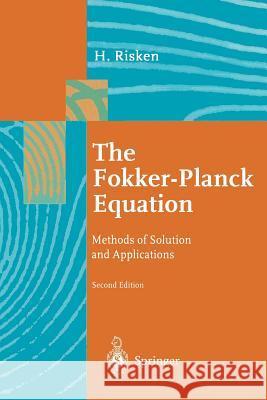
The Fokker-Planck Equation: Methods of Solution and Applications Risken, Hannes 9783540615309 Springer - książkaWidoczna okładka, to zdjęcie poglądowe, a rzeczywista szata graficzna może różnić się od prezentowanej.

The Fokker-Planck Equation: Methods of Solution and Applications

ISBN-13: 9783540615309 / Angielski / Miękka / 1996 / 472 str.

H. Risken; Hannes Risken; Till Frank
cena 322,77 zł
(netto: 307,40 VAT:  5%)

Najniższa cena z 30 dni: 308,41 zł
Termin realizacji zamówienia:
ok. 22 dni roboczych
Bez gwarancji dostawy przed świętami

Darmowa dostawa!

One of the central problems synergetics is concerned with consists in the study of macroscopic qualitative changes of systems belonging to various disciplines such as physics, chemistry, or electrical engineering. When such transitions from one state to another take place, fluctuations, i.e., random processes, may play an im- portant role. Over the past decades it has turned out that the Fokker-Planck equation pro- vides a powerful tool with which the effects of fluctuations close to transition points can be adequately treated and that the approaches based on the Fokker- Planck equation are superior to other approaches, e.g., based on Langevin equa- tions. Quite generally, the Fokker-Planck equation plays an important role in problems which involve noise, e.g., in electrical circuits. For these reasons I am sure that this book will find a broad audience. It pro- vides the reader with a sound basis for the study of the Fokker-Planck equation and gives an excellent survey of the methods of its solution. The author of this book, Hannes Risken, has made substantial contributions to the development and application of such methods, e.g., to laser physics, diffusion in periodic potentials, and other problems. Therefore this book is written by an experienced practitioner, who has had in mind explicit applications to important problems in the natural sciences and electrical engineering.


Kategorie:
Nauka, Fizyka
Kategorie BISAC:
Mathematics > Matematyka stosowana
Science > Termodynamika
Science > Fizyka matematyczna
Wydawca:
Springer
Seria wydawnicza:
Lecture Notes in Mathematics,
Język:
Angielski
ISBN-13:
9783540615309
Rok wydania:
1996
Wydanie:
1996
Numer serii:
000013117
Ilość stron:
472
Waga:
0.70 kg
Wymiary:
22.86 x 15.24 x 2.77
Oprawa:
Miękka
Wolumenów:
01
Dodatkowe informacje:
Wydanie ilustrowane

1. Introduction.- 1.1 Brownian Motion.- 1.1.1 Deterministic Differential Equation.- 1.1.2 Stochastic Differential Equation.- 1.1.3 Equation of Motion for the Distribution Function.- 1.2 Fokker-Planck Equation.- 1.2.1 Fokker-Planck Equation for One Variable.- 1.2.2 Fokker-Planck Equation for N Variables.- 1.2.3 How Does a Fokker-Planck Equation Arise?.- 1.2.4 Purpose of the Fokker-Planck Equation.- 1.2.5 Solutions of the Fokker-Planck Equation.- 1.2.6 Kramers and Smoluchowski Equations.- 1.2.7 Generalizations of the Fokker-Planck Equation.- 1.3 Boltzmann Equation.- 1.4 Master Equation.- 2. Probability Theory.- 2.1 Random Variable and Probability Density.- 2.2 Characteristic Function and Cumulants.- 2.3 Generalization to Several Random Variables.- 2.3.1 Conditional Probability Density.- 2.3.2 Cross Correlation.- 2.3.3 Gaussian Distribution.- 2.4 Time-Dependent Random Variables.- 2.4.1 Classification of Stochastic Processes.- 2.4.2 Chapman-Kolmogorov Equation.- 2.4.3 Wiener-Khintchine Theorem.- 2.5 Several Time-Dependent Random Variables.- 3. Langevin Equations.- 3.1 Langevin Equation for Brownian Motion.- 3.1.1 Mean-Squared Displacement.- 3.1.2 Three-Dimensional Case.- 3.1.3 Calculation of the Stationary Velocity Distribution Function.- 3.2 Ornstein-Uhlenbeck Process.- 3.2.1 Calculation of Moments.- 3.2.2 Correlation Function.- 3.2.3 Solution by Fourier Transformation.- 3.3 Nonlinear Langevin Equation, One Variable.- 3.3.1 Example.- 3.3.2 Kramers-Moyal Expansion Coefficients.- 3.3.3 Itô’s and Stratonovich’s Definitions.- 3.4 Nonlinear Langevin Equations, Several Variables.- 3.4.1 Determination of the Langevin Equation from Drift and Diffusion Coefficients.- 3.4.2 Transformation of Variables.- 3.4.3 How to Obtain Drift and Diffusion Coefficients for Systems.- 3.5 Markov Property.- 3.6 Solutions of the Langevin Equation by Computer Simulation.- 4. Fokker-Planck Equation.- 4.1 Kramers-Moyal Forward Expansion.- 4.1.1 Formal Solution.- 4.2 Kramers-Moyal Backward Expansion.- 4.2.1 Formal Solution.- 4.2.2 Equivalence of the Solutions of the Forward and Backward Equations.- 4.3 Pawula Theorem.- 4.4 Fokker-Planck Equation for One Variable.- 4.4.1 Transition Probability Density for Small Times.- 4.4.2 Path Integral Solutions.- 4.5 Generation and Recombination Processes.- 4.6 Application of Truncated Kramers-Moyal Expansions.- 4.7 Fokker-Planck Equation for N Variables.- 4.7.1 Probability Current.- 4.7.2 Joint Probability Distribution.- 4.7.3 Transition Probability Density for Small Times.- 4.8 Examples for Fokker-Planck Equations with Several Variables.- 4.8.1 Three-Dimensional Brownian Motion without Position Variable.- 4.8.2 One-Dimensional Brownian Motion in a Potential.- 4.8.3 Three-Dimensional Brownian Motion in an External Force.- 4.8.4 Brownian Motion of Two Interacting Particles in an External Potential.- 4.9 Transformation of Variables.- 4.10 Covariant Form of the Fokker-Planck Equation.- 5. Fokker-Planck Equation for One Variable; Methods of Solution.- 5.1 Normalization.- 5.2 Stationary Solution.- 5.3 Ornstein-Uhlenbeck Process.- 5.4 Eigenfunction Expansion.- 5.5 Examples.- 5.5.1 Parabolic Potential.- 5.5.2 Inverted Parabolic Potential.- 5.5.3 Infinite Square Well for the Schrüdinger Potential.- 5.5.4 V-Shaped Potential for the Fokker-Planck Equation.- 5.6 Jump Conditions.- 5.7 A Bistable Model Potential.- 5.8 Eigenfunctions and Eigenvalues of Inverted Potentials.- 5.9 Approximate and Numerical Methods for Determining Eigenvalues and Eigenfunctions.- 5.9.1 Variational Method.- 5.9.2 Numerical Integration.- 5.9.3 Expansion into a Complete Set.- 5.10 Diffusion Over a Barrier.- 5.10.1 Kramers’ Escape Rate.- 5.10.2 Bistable and Metastable Potential.- 6. Fokker-Planck Equation for Several Variables; Methods of Solution.- 6.1 Approach of the Solutions to a Limit Solution.- 6.2 Expansion into a Biorthogonal Set.- 6.3 Transformation of the Fokker-Planck Operator, Eigenfunction Expansions.- 6.4 Detailed Balance.- 6.5 Ornstein-Uhlenbeck Process.- 6.6 Further Methods for Solving the Fokker-Planck Equation.- 6.6.1 Transformation of Variables.- 6.6.2 Variational Method.- 6.6.3 Reduction to an Hermitian Problem.- 6.6.4 Numerical Integration.- 6.6.5 Expansion into Complete Sets.- 6.6.6 Matrix Continued-Fraction Method.- 6.6.7 WKB Method.- 7. Linear Response and Correlation Functions.- 7.1 Linear Response Function.- 7.2 Correlation Functions.- 7.3 Susceptibility.- 8. Reduction of the Number of Variables.- 8.1 First-Passage Time Problems.- 8.2 Drift and Diffusion Coefficients Independent of Some Variables.- 8.2.1 Time Integrals of Markovian Variables.- 8.3 Adiabatic Elimination of Fast Variables.- 8.3.1 Linear Process with Respect to the Fast Variable.- 8.3.2 Connection to the Nakajima-Zwanzig Projector Formalism.- 9. Solutions of Tridiagonal Recurrence Relations, Application to Ordinary and Partial Differential Equations.- 9.1 Applications and Forms of Tridiagonal Recurrence Relations.- 9.1.1 Scalar Recurrence Relation.- 9.1.2 Vector Recurrence Relation.- 9.2 Solutions of Scalar Recurrence Relations.- 9.2.1 Stationary Solution.- 9.2.2 Initial Value Problem.- 9.2.3 Eigenvalue Problem.- 9.3 Solutions of Vector Recurrence Relations.- 9.3.1 Initial Value Problem.- 9.3.2 Eigenvalue Problem.- 9.4 Ordinary and Partial Differential Equations with Multiplicative Harmonic Time-Dependent Parameters.- 9.4.1 Ordinary Differential Equations.- 9.4.2 Partial Differential Equations.- 9.5 Methods for Calculating Continued Fractions.- 9.5.1 Ordinary Continued Fractions.- 9.5.2 Matrix Continued Fractions.- 10. Solutions of the Kramers Equation.- 10.1 Forms of the Kramers Equation.- 10.1.1 Normalization of Variables.- 10.1.2 Reversible and Irreversible Operators.- 10.1.3 Transformation of the Operators.- 10.1.4 Expansion into Hermite Functions.- 10.2 Solutions for a Linear Force.- 10.2.1 Transition Probability.- 10.2.2 Eigenvalues and Eigenfunctions.- 10.3 Matrix Continued-Fraction Solutions of the Kramers Equation.- 10.3.1 Initial Value Problem.- 10.3.2 Eigenvalue Problem.- 10.4 Inverse Friction Expansion.- 10.4.1 Inverse Friction Expansion for K0(t), G0,0(t) and L0(t).- 10.4.2 Determination of Eigenvalues and Eigenvectors.- 10.4.3 Expansion for the Green’s Function Gn,m(t).- 10.4.4 Position-Dependent Friction.- 11. Brownian Motion in Periodic Potentials.- 11.1 Applications.- 11.1.1 Pendulum.- 11.1.2 Superionic Conductor.- 11.1.3 Josephson Tunneling Junction.- 11.1.4 Rotation of Dipoles in a Constant Field.- 11.1.5 Phase-Locked Loop.- 11.1.6 Connection to the Sine-Gordon Equation.- 11.2 Normalization of the Langevin and Fokker-Planck Equations.- 11.3 High-Friction Limit.- 11.3.1 Stationary Solution.- 11.3.2 Time-Dependent Solution.- 11.4 Low-Friction Limit.- 11.4.1 Transformation to E and x Variables.- 11.4.2 ‘Ansatz’ for the Stationary Distribution Functions.- 11.4.3 x-Independent Functions.- 11.4.4 x-Dependent Functions.- 11.4.5 Corrected x-Independent Functions and Mobility.- 11.5 Stationary Solutions for Arbitrary Friction.- 11.5.1 Periodicity of the Stationary Distribution Function.- 11.5.2 Matrix Continued-Fraction Method.- 11.5.3 Calculation of the Stationary Distribution Function.- 11.5.4 Alternative Matrix Continued Fraction for the Cosine Potential.- 11.6 Bistability between Running and Locked Solution.- 11.6.1 Solutions Without Noise.- 11.6.2 Solutions With Noise.- 11.6.3 Low-Friction Mobility With Noise.- 11.7 Instationary Solutions.- 11.7.1 Diffusion Constant.- 11.7.2 Transition Probability for Large Times.- 11.8 Susceptibilities.- 11.8.1 Zero-Friction Limit.- 11.9 Eigenvalues and Eigenfunctions.- 11.9.1 Eigenvalues and Eigenfunctions in the Low-Friction Limit.- 12. Statistical Properties of Laser Light.- 12.1 Semiclassical Laser Equations.- 12.1.1 Equations Without Noise.- 12.1.2 Langevin Equation.- 12.1.3 Laser Fokker-Planck Equation.- 12.2 Stationary Solution and Its Expectation Values.- 12.3 Expansion in Eigenmodes.- 12.4 Expansion into a Complete Set; Solution by Matrix Continued Fractions.- 12.4.1 Determination of Eigenvalues.- 12.5 Transient Solution.- 12.5.1 Eigenfunction Method.- 12.5.2 Expansion into a Complete Set.- 12.5.3 Solution for Large Pump Parameters.- 12.6 Photoelectron Counting Distribution.- 12.6.1 Counting Distribution for Short Intervals.- 12.6.2 Expectation Values for Arbitrary Intervals.- Appendices.- A1 Stochastic Differential Equations with Colored Gaussian Noise.- A2 Boltzmann Equation with BGK and SW Collision Operators.- A3 Evaluation of a Matrix Continued Fraction for the Harmonic Oscillator.- A4 Damped Quantum-Mechanical Harmonic Oscillator.- A5 Alternative Derivation of the Fokker-Planck Equation.- A6 Fluctuating Control Parameter.- S. Supplement to the Second Edition.- S.1 Solutions of the Fokker-Planck Equation by Computer Simulation (Sect. 3.6).- S.2 Kramers-Moyal Expansion (Sect. 4.6).- S.3 Example for the Covariant Form of the Fokker-Planck Equation (Sect. 4.10).- S.4 Connection to Supersymmetry and Exact Solutions of the One Variable Fokker-Planck Equation (Chap. 5).- S.5 Nondifferentiability of the Potential for the Weak Noise Expansion (Sects. 6.6 and 6.7).- S.6 Further Applications of Matrix Continued-Fractions (Chap. 9).- S.7 Brownian Motion in a Double-Well Potential (Chaps. 10 and 11).- S.8 Boundary Layer Theory (Sect. 11.4).- S.9 Calculation of Correlation Times (Sect. 7.12).- S.10 Colored Noise (Appendix A1).- S.11 Fokker-Planck Equation with a Non-Positive-Definite Diffusion Matrix and Fokker-Planck Equation with Additional Third-Order-Derivative Terms.- References.

This book deals with the derivation of the Fokker-Planck equation, methods of solving it and some of its applications. Various methods such as the simulation method, the eigenfunction expansion, numerical integration, the variational method, and the matrix continued-fraction method are discussed. This is the first time that this last method, which is very effective in dealing with simple Fokker-Planck equations having two variables, appears in a textbook. The methods of solution are applied to the statistics of a simple laser model and to Brownian motion in potentials. Such Brownian motion is important in solid-state physics, chemical physics and electric circuit theory. This new study edition is meant as a text for graduate students in physics, chemical physics, and electrical engineering.


Udostępnij

Facebook - konto krainaksiazek.pl


Opinie o Krainaksiazek.pl na Opineo.pl

Partner Mybenefit

Krainaksiazek.pl w programie rzetelna firma Krainaksiaze.pl - płatności przez paypal

Czytaj nas na:

Facebook - krainaksiazek.pl
  • książki na zamówienie
  • granty
  • książka na prezent
  • kontakt
  • pomoc
  • opinie
  • regulamin
  • polityka prywatności

Zobacz:

  • Księgarnia czeska

  • Wydawnictwo Książkowe Klimaty

1997-2025 DolnySlask.com Agencja Internetowa

© 1997-2022 krainaksiazek.pl
     
KONTAKT | REGULAMIN | POLITYKA PRYWATNOŚCI | USTAWIENIA PRYWATNOŚCI
Zobacz: Księgarnia Czeska | Wydawnictwo Książkowe Klimaty | Mapa strony | Lista autorów
KrainaKsiazek.PL - Księgarnia Internetowa

Polityka prywatnosci - link
Krainaksiazek.pl - płatnośc Przelewy24
Przechowalnia Przechowalnia





