• Wyszukiwanie zaawansowane
  • Kategorie
  • Kategorie BISAC
  • Książki na zamówienie
  • Promocje
  • Granty
  • Książka na prezent
  • Opinie
  • Pomoc
  • Załóż konto
  • Zaloguj się

The Family System of the Paramaribo Creoles » książka


zaloguj się | załóż konto
Logo Krainaksiazek.pl

koszyk

konto

szukaj
topmenu
Księgarnia internetowa
Szukaj
Książki na zamówienie
Promocje
Granty
Książka na prezent
Moje konto
Pomoc
 
 
Wyszukiwanie zaawansowane
Pusty koszyk
Bezpłatna dostawa dla zamówień powyżej 20 złBezpłatna dostawa dla zamówień powyżej 20 zł

Kategorie główne

• Nauka
 [2946600]
• Literatura piękna
 [1856966]

  więcej...
• Turystyka
 [72221]
• Informatyka
 [151456]
• Komiksy
 [35826]
• Encyklopedie
 [23190]
• Dziecięca
 [619653]
• Hobby
 [140543]
• AudioBooki
 [1577]
• Literatura faktu
 [228355]
• Muzyka CD
 [410]
• Słowniki
 [2874]
• Inne
 [445822]
• Kalendarze
 [1744]
• Podręczniki
 [167141]
• Poradniki
 [482898]
• Religia
 [510455]
• Czasopisma
 [526]
• Sport
 [61590]
• Sztuka
 [243598]
• CD, DVD, Video
 [3423]
• Technologie
 [219201]
• Zdrowie
 [101638]
• Książkowe Klimaty
 [124]
• Zabawki
 [2473]
• Puzzle, gry
 [3898]
• Literatura w języku ukraińskim
 [254]
• Art. papiernicze i szkolne
 [8170]
Kategorie szczegółowe BISAC

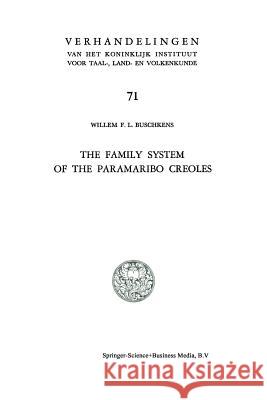
The Family System of the Paramaribo Creoles

ISBN-13: 9789401177863 / Angielski / Miękka / 2012 / 325 str.
Willem F. L. Buschkens; Willem F. L. Buschkens
The Family System of the Paramaribo Creoles Willem F Willem F. L. Buschkens 9789401177863 Springer - książkaWidoczna okładka, to zdjęcie poglądowe, a rzeczywista szata graficzna może różnić się od prezentowanej.

The Family System of the Paramaribo Creoles

ISBN-13: 9789401177863 / Angielski / Miękka / 2012 / 325 str.

Willem F. L. Buschkens; Willem F. L. Buschkens
cena 201,72 zł
(netto: 192,11 VAT:  5%)

Najniższa cena z 30 dni: 192,74 zł
Termin realizacji zamówienia:
ok. 22 dni roboczych
Bez gwarancji dostawy przed świętami

Darmowa dostawa!

1.1. General In this book the family life of the lower-class Creole population of 1 Paramaribo will be discussed. This group, which will henceforward be referred to as "the lower-class Creoles", possesses a "West Indian" family system, implying that the latter display all the main characteristics of the Caribbean Afro-American family. The Creoles constitute a numerically important ethnic segment of the society of Surinam. This society is composed of different ethnic groups, comprising, besides a handful of Amerindians, an "immigrant population" including people from many different parts of the world. It is made up of Creoles, Indians (or Hindustanis, as they are called in Surinam), Indonesians (Javanese), Chinese, Europeans, Lebanese and Bush Negroes, the latter of whom still live predominantly in tribes. The Creoles are the descendants of those Negro slaves brought to Surinam from Africa who did not escape from bondage by running away from the plantations into the Bush, as their brothers the Bush Negroes did. The circumstances under which the bulk of the slaves lived were appalling. Nor were they - or are they still in p~ at present - much better for their descendants the lower-class Creoles.


Kategorie:
Nauka, Socjologia i społeczeństwo
Kategorie BISAC:
Science > General
Social Science > Antropologia
Social Science > Rodzina w teorii socjologicznej
Wydawca:
Springer
Seria wydawnicza:
Verhandelingen Van Het Koninklijk Instituut Voor Taal-, Land
Język:
Angielski
ISBN-13:
9789401177863
Rok wydania:
2012
Wydanie:
Softcover Repri
Numer serii:
000404203
Ilość stron:
325
Waga:
0.53 kg
Wymiary:
23.5 x 15.5
Oprawa:
Miękka
Wolumenów:
01
Dodatkowe informacje:
Wydanie ilustrowane

1. Introduction.- 1.1. General.- 1.2. Social Research in Surinam.- 1.3. The West Indian Family System.- 1.3.1. Alternative Unions between Men and Women.- 1.3.2. Female-headed Households and Matrifocality.- 1.3.3. Theories of the Origin of the West Indian Family System.- 1.3.3.1. Poverty and the “West Indian” Family System.- 1.4. The Situation in Surinam.- 2. Surinam.- 2.1. Geography.- 2.2. Political Development.- 2.3. History of Agriculture.- 2.3.1. Plantation Agriculture.- 2.3.2. Small-scale Agriculture.- 2.4. Other Sectors of the Economy.- 2.5. The Demographic Situation.- 2.5.1. Religious distribution of the population.- 2.6. The Creoles.- 2.6.1. The Lower-Class Creoles.- 3. The Research.- 3.1. The Place of Research.- 3.2. The Method of Research.- 3.2.1. Observation and the Interview.- 3.2.2. The Survey.- 3.2.3. The Investigation into the Desired Number of Children.- 3.2.4. The Investigation of the Archives.- 4. The Initial Period of Settlement of the Plantation Colony Up to the Abolition of the Slave Trade in 1808.- 4.1. Population.- 4.2. The Organization of Slavery.- 4.3. The Family Life of the Slaves.- 4.3.1. Alternative unions between men and women.- 4.3.2. The Instability of Relationships.- 4.3.3. The Slave Household.- 4.4. Government, Private and Church Interference in the Family Life of Slaves.- 4.5. The Family Life of the Masters and the free Mulattoes and free Negroes.- 5. The Period from 1808 Up to Emancipation in 1863.- 5.1. General.- 5.2. The Dwindling Slave Force.- 5.2.1. The Unequal Sex Ratio.- 5.2.2. Malnutrition, Disease and Poor Housing among the Slave Population.- 5.3. Measures for the Improvement of the Slaves’ Family Life and Reproductive Capacity.- 5.3.1. Private Measures.- 5.3.2. The Activities of the Missions of the Various Churches.- 5.3.2.1. The Moravian Mission and the Slaves’ Family Life.- 5.3.2.1.1. The Institution of the “Verbond” or “Alliance”.- 5.3.2.2. The Roman Catholic Mission and the Slaves’ Family Life.- 5.3.3. State Interference in Respect of the Family Life of the Slaves.- 5.4. Man-Woman Relationships among the Slaves.- 5.5. The Family Life of the Free Population.- 5.5.1. The Family Life of the Europeans.- 5.5.2. The Family Life of the Free Mulattoes and Free Negroes.- 6. The Post-Emancipation Period.- 6.1. General.- 6.2. The Rural Exodus of the Creole Population.- 6.2.1. The State Supervision of Ex-Slaves (1863–1873).- 6.2.2. The Period after State Supervision.- 6.3. The Creole as Gold Digger and Balata Bleeder.- 6.3.1. The Gold Industry.- 6.3.2. The Balata Industry.- 6.4. Other Creole Occupations.- 6.4.1. The Crafts.- 6.4.2. Bauxite.- 6.4.3. The Timber Industry.- 6.4.4. Other Occupations.- 6.4.4.1. Women’s Occupations.- 6.5. Unemployment.- 6.5.1. Emigration to the Antilles and the Netherlands.- 6.6. The post-Emancipation Family System.- 6.6.1. The Period of State Supervision.- 6.6.2. The Period following State Supervision.- 6.6.2.1. The Issue of the Abolition of the Alliance.- 6.6.2.2. Discrimination in Civil Marriages.- 7. The Situation after World War II.- 7.1. General.- 7.2. Characteristic Features of the Sample Population.- 7.2.1. West Indian Traits of the Households included in the Sample.- 7.3. The Present Socio-Economic Conditions.- 7.3.1. Housing.- 7.3.1.1. Ownership of Houses.- 7.3.2. Economic Aspects of the Household.- 7.3.2.1. Unemployment, Unemployment Relief and Poor Relief.- 7.3.2.2. The Occupational Structure.- 7.3.3. The Family Income.- 7.3.4. The Pattern of Spending of the Household.- 7.3.4.1. Expenditure on Food and Drinks.- 7.3.4.2. Expenditure on Rent, Electricity, Gas and Water.- 7.3.4.3. Expenditure on Clothing and Shoes.- 7.3.4.4. Costs of Illness and Funerals.- 7.3.4.5. Other Expenses.- 7.3.5. The Degree of Poverty.- 8. The Nature of Unions and the Household Structure.- 8.1. General.- 8.2. Alternative Unions between Men and Women.- 8.2.1. The Choice of one or other of the Alternative Unions.- 8.2.1.1. Age of the Partners and Nature of the Union.- 8.2.1.2. Socio-economic Status of Married Persons and of Persons living in Concubinage.- 8.2.1.3. The Way in which Unions are Realized.- 8.2.1.4. Views on Marriage.- 8.2.2. The Stability of Unions.- 8.2.2.1. The Duration of the dissolved Marriages and Concubinages.- 8.2.2.2. Reasons for terminating Unions.- 8.2.3. Illegitimacy of Births.- 8.2.3.1. The Marriage Act for Asians and the Creoles.- 8.2.3.2. Aspects of Illegitimacy among the Lower-class Creoles.- 8.3. The Structure of Households.- 8.3.1. The Prevalent Types of Household.- 8.3.1.1. Type A: Male Head with Legal Wife.- 8.3.1.2. Type B: Male Head with Common Law Wife.- 8.3.1.3. Type C: Male Head without Legal or Common Law Wife.- 8.3.1.4. Type D: the Single Man.- 8.3.1.5. Type E: the Female Head with Legal Husband.- 8.3.1.6. Type F: Female Head with Common Law Husband.- 8.3.1.7. Type G: Female Head without Legal or Common Law Husband.- 8.3.1.8. Type H: the Single Woman.- 8.3.2. The Inter-connectedness of the Different Household Types.- 8.3.2.1. Smith’s Cycle Theory.- 8.3.2.2. The First Phase of the Household.- 8.3.2.3. The Second Phase of the Household.- 8.4. Unmarried Women and Women not Living in Concubinage and their Children.- 9. The Functioning of the Family System.- 9.1. General.- 9.2. The Desire for Children.- 9.3. Birth Control.- 9.4. Traditional Practices in Connection with Pregnancy and Childbirth.- 9.5. Childhood.- 9.5.1. Social Relations During Childhood.- 9.5.1.1. With the Parents.- 9.5.1.2. With Brothers and Sisters.- 9.5.1.3. With Other Persons.- 9.6. Adulthood.- 9.6.1. Man-Woman Relationships.- 9.6.2. Homosexual Relations between Women.- 9.6.3. Contacts with Other Persons.- 9.7. Old Age.- 9.8. Death.- 9.8.1. Description of the Customs observed in Connection with Death.- 9.8.2. The Memorial Gathering on the Eighth Day.- 10. Final Remarks.- 10.1. General.- 10.2. The West Indian Family System of Paramaribo as an Adaptation Model.- Appendix 1. Letter of Introduction explaining the Nature of the Research.- Appendix 2. The Questionnaire.- Appendix 3. Tables A–R not inserted in the text.- Appendix 4. Interview Scheme B.O.G. Sample.- Biblography.


Udostępnij

Facebook - konto krainaksiazek.pl


Opinie o Krainaksiazek.pl na Opineo.pl

Partner Mybenefit

Krainaksiazek.pl w programie rzetelna firma Krainaksiaze.pl - płatności przez paypal

Czytaj nas na:

Facebook - krainaksiazek.pl
  • książki na zamówienie
  • granty
  • książka na prezent
  • kontakt
  • pomoc
  • opinie
  • regulamin
  • polityka prywatności

Zobacz:

  • Księgarnia czeska

  • Wydawnictwo Książkowe Klimaty

1997-2025 DolnySlask.com Agencja Internetowa

© 1997-2022 krainaksiazek.pl
     
KONTAKT | REGULAMIN | POLITYKA PRYWATNOŚCI | USTAWIENIA PRYWATNOŚCI
Zobacz: Księgarnia Czeska | Wydawnictwo Książkowe Klimaty | Mapa strony | Lista autorów
KrainaKsiazek.PL - Księgarnia Internetowa

Polityka prywatnosci - link
Krainaksiazek.pl - płatnośc Przelewy24
Przechowalnia Przechowalnia






