The Euroschool on Exotic Beams, Vol. VI » książka





The Euroschool on Exotic Beams, Vol. VI
ISBN-13: 9783031107504 / Angielski / Miękka / 2022
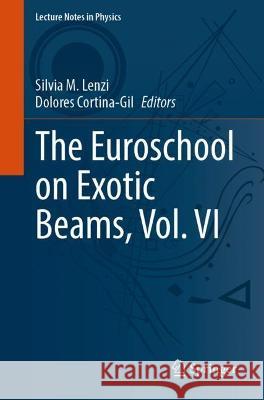
This book is based on the lectures given at the “Euroschool on Exotic Beams” and collects contributions which address topics from the traditional core of the field of exotic nuclei like nuclear structure far from stability, discussing recent theoretical developments and state-of-the-art experimental methods. It provides also new perspectives in nuclear astrophysics and in applied areas such as gamma-ray emission imaging. The contributions are written with a pedagogical approach and carefully edited in order to provide the readership with a clear and fluent reading.The book is intended for PhD students and young researchers who are approaching the new research lines in nuclear physics with exotic nuclei. Only basics concepts on quantum mechanics and nuclear physics are requested to follow and master the covered arguments.
Chapter 1: Nuclear structure at the limits of stability. The theory view.
Authors: Frederic Nowacki and Alfredo Poves
- Introduction
- The Shell Model as Unified View of Nuclear Structure; A primer
- Shell Evolution and Correlations
- N=40: from 68Ni to 80Zr
- N=50: from 78Ni to 100Sn
- Islands of inversion and their mergings
- Conclusions
Chapter 2: Low-energy Coulomb excitation and nuclear deformation
Author: Magda Zielinska
Abstract: Coulomb excitation is one of the rare methods available to obtain information on static electromagnetic moments of short-lived exited nuclear states. In the scattering of two nuclei, the electromagnetic field that acts between them causes their excitation. The process selectively populates low-lying collective states and is therefore ideally suited to study nuclear collectivity. While these experiments used to be restricted to stable isotopes, the advent of new facilities, providing intense beams of short-lived radioactive species has opened the possibility to apply this powerful technique to a much wider range of nuclei. In this chapter, we will discuss observables that can be measured in a Coulomb-excitation experiment, and their relation to nuclear structure parameters and, in particular, nuclear shape. Selected examples of recent low-energy Coulomb excitation studies will be presented to illustrate the potential of this technique to investigate phenomena such as shape coexistence and octupole collectivity.
- Introduction
- Semiclassical approximation of low-energy Coulomb excitation
- Nuclear deformation and quadrupole sum rules
- Reorientation effect
- Relative signs of electromagnetic matrix elements
- Experimental considerations
- Beam and target requirements
- Particle detectors for stable and radioactive beam experiments
- Normalization of experimental Coulomb-excitation cross sections
- Recent results
- Shape coexistence
- Octupole collectivity
- Summary and outlook
Chapter 3: Ab Initio Approaches to Nuclear Structure
Author: Robert Roth
Abstract: I will present an overview of modern ab initio approaches to nuclear structure, focusing on basis expansion methods, such as the no-core shell model. Starting from interactions derived within chiral effective field theory, the individual stages on an ab initio calculation will be discussed, starting from a pre-processing stage based on the similarity renormalization group, followed by the solution of the many-body Schrödinger equation in a finite model space, and completed by a post-processing stage including the quantification of theory uncertainties using Bayesian methods. I will put particular emphasis on the recent advances in the context of hybrid methods that use another many-body scheme, such as many-body perturbation theory or the in-medium similarity renormalization group to accelerate the convergence of the no-core shell model. In order to demonstrate the potential and the perspectives of such ab initio approaches, I will highlight several recent applications.- Introduction
- Nuclear Hamiltonian
- Pre-Processing: Similarity Renormalization Group
- Many-Body Solution: No-Core Shell Model
- Hybrid Methods: In-Medium No-Core Shell Model
- Post-Processing: Theory Uncertainties
- Recent Applications
- Conclusion & Outlook
Chapter 4: Nuclear data and experiments for astrophysics
Authors: Stephan Goriely and Anu Kankainen
Abstract: Nuclear astrophysics aims to understand the origin of elements and the role of astrophysical processes in astrophysical events. Nuclear reactions and reaction rates depend strongly on nuclear properties and on the astrophysical environment. Nuclear inputs for stellar reaction rates involve a variety of nuclear properties, theoretical models and experimental data. Experiments providing data for nuclear astrophysics range from stable ion beam direct measurements to radioactive beam experiments employing inverse kinematics or indirect methods. Many properties relevant for astrophysical calculations, such as nuclear masses and beta decays, have also been intensively studied. This contribution shortly introduces selected astrophysical processes, discusses the related nuclear data needs and gives examples of recent experimental efforts in the field.
- Introduction: Origin of elements and astrophysical processes
- Nuclear reactions of astrophysical interest
- Data needed for various nucleosynthesis processes
- Experiments for nuclear astrophysics
- Nuclear reactions
- Nuclear properties (focus on masses and beta-decay studies)
- Summary and Outlook
Chapter 5: State-of-the-art gamma-ray spectrometers for in-beam measurements
Authors: Caterina Michelagnoli and Francesco Recchia Abstract: The nuclear structure of nuclei in different regions of the nuclear chart is a still unresolved puzzle for nuclear theory. The quest for a comprehensive understanding of the structure of all nuclei as well as for precise observables important for nuclear astrophysics needs precise observables. Those have been obtained in the last decades by using the resolution and efficiency of arrays of HPGe detectors. In those Notes a review of the main spectroscopy techniques will be reported. After an historical overview of the main spectrometers that contributed to our nowadays knowledge in nuclear structure, the principles of advanced gamma-ray tracking will be described. The setup and functioning of array based on this technique will be thus reported and some first results introduced.- Introduction
- Generalities
- History
- Advanced gamma-ray tracking
- General Idea
- Digital signal processing
- Count-rate capabilities
- Position resolution and pulse shape analysis
- Gamma-ray tracking
- Selected highlights from instrumental point of view
- Doppler correction capabilities
- Lifetime measurements with Doppler techniques
Chapter 6: Nuclear structure studies with active targets
Author: Riccardo Raabe
Abstract: The use of gaseous detectors in nuclear structure studies presents several challenges and interesting opportunities. In the last twenty years, active targets have been developed to address those challenges. In this paper we will review the characteristics of these instruments and how they can be used to great effect in a wide range of physics cases.
- Introduction
- Principles of active targets
- Physics cases and examples
Chapter 7: Gamma ray emission imaging in the medical and nuclear safeguards fields
Author: Peter Dendooven
Abstract: Gamma rays can penetrate through a substantial amount of material. Therefore, the locations within an object from where gamma rays originate can be imaged by measuring the gamma rays escaping from the object. This technique of gamma ray emission imaging is introduced on the basis of its application in three different fields: nuclear medicine, particle beam radiotherapy and nuclear safeguards. To set the stage, the role and power of gamma ray emission imaging in these fields is demonstrated. Next, the principles of gamma ray emission imaging are reviewed. It will become clear how the basic principles lead to the essential instrument design considerations. Iterative image reconstruction will be explained in a non-mathematical way. Implementation of gamma ray emission imaging will be illustrated by discussing in some detail its state-of-the-art application in the three fields considered here.- Applications of gamma ray emission imaging
- Nuclear medicine
- Particle beam radiotherapy
- Nuclear safeguards
- Principles of gamma ray emission imaging
- Basic principles
- Essential instrument design considerations
- Iterative image reconstruction
- Examples of gamma ray emission imaging
- Nuclear medicine
- Particle beam radiotherapy
- Nuclear safeguards
- Conclusions
Silvia M. Lenzi received the PhD in Physics from the University of Buenos Aires, Argentina, in 1987. She is Professor at the Department of Physics and Astronomy of the University of Padova, Italy. Her research activity covers different theoretical and experimental aspects of the structure of atomic nuclei. The main research line involves the structure of nuclei far from the valley of stability and, in particular, proton-rich and neutron-rich nuclei. The experimental research consists on high-resolution gamma-ray spectroscopy. This is complemented with theoretical developments in the framework of the nuclear shell model. Prof. Lenzi has a wide teaching experience in general physics and advanced nuclear physics courses and has supervised several PhD students and postdocs. She is the Chair of the Board of Directors of the Euroschool on Exotic Beams and Lecturer at the same school. She has been the coordinator of European networks for gamma-ray spectroscopy funded by the EU (2005-2020). Currently, Prof. Lenzi is the Director of the School of Specialization in Medical Physics at the University of Padova.
Dolores Cortina-Gil is Professor at the Physics Faculty of University of Santiago de Compostela, Spain, and fellow at the Galician Institute of High Energy Physics (IGFAE). She works in experimental nuclear physics at the interplay of nuclear reaction and structure, using relativistic radioactive beams. After studying physics at the University of Valencia, Spain, she received a PhD from the University of Caen (GANIL), France, in 1996. She was postdoctoral researcher at GSI (1997-2001) and earned a Tenure track position at the University of Santiago de Compostela in 2002, that was consolidated in 2008. Prof. Cortina has a wide teaching experience in nuclear physics courses and has supervised several PhD students. She is a member of the Board of Directors of the Euroschool for Exotic Beams since 2007, and Lecturer of the same school. Currently, she is the Head of the nuclear physics division of the Spanish Physical Society (RSEF) and Spokesperson of the R3B collaboration at FAIR.
This book is based on the lectures given at the “Euroschool on Exotic Beams” and collects contributions which address topics from the traditional core of the field of exotic nuclei like nuclear structure far from stability, discussing recent theoretical developments and state-of-the-art experimental methods. It provides also new perspectives in nuclear astrophysics and in applied areas such as gamma-ray emission imaging. The contributions are written with a pedagogical approach and carefully edited in order to provide the readership with a clear and fluent reading.
The book is intended for PhD students and young researchers who are approaching the new research lines in nuclear physics with exotic nuclei. Only basics concepts on quantum mechanics and nuclear physics are requested to follow and master the covered arguments.




Czytaj nas na:
1997-2026 DolnySlask.com Agencja Internetowa
KrainaKsiazek.PL - Księgarnia Internetowa


