• Wyszukiwanie zaawansowane
  • Kategorie
  • Kategorie BISAC
  • Książki na zamówienie
  • Promocje
  • Granty
  • Książka na prezent
  • Opinie
  • Pomoc
  • Załóż konto
  • Zaloguj się

The Ethics of Anthropology and Amerindian Research: Reporting on Environmental Degradation and Warfare » książka


zaloguj się | załóż konto
Logo Krainaksiazek.pl

koszyk

konto

szukaj
topmenu
Księgarnia internetowa
Szukaj
Książki na zamówienie
Promocje
Granty
Książka na prezent
Moje konto
Pomoc
 
 
Wyszukiwanie zaawansowane
Pusty koszyk
Bezpłatna dostawa dla zamówień powyżej 20 złBezpłatna dostawa dla zamówień powyżej 20 zł

Kategorie główne

• Nauka
 [2946912]
• Literatura piękna
 [1852311]

  więcej...
• Turystyka
 [71421]
• Informatyka
 [150889]
• Komiksy
 [35717]
• Encyklopedie
 [23177]
• Dziecięca
 [617324]
• Hobby
 [138808]
• AudioBooki
 [1671]
• Literatura faktu
 [228371]
• Muzyka CD
 [400]
• Słowniki
 [2841]
• Inne
 [445428]
• Kalendarze
 [1545]
• Podręczniki
 [166819]
• Poradniki
 [480180]
• Religia
 [510412]
• Czasopisma
 [525]
• Sport
 [61271]
• Sztuka
 [242929]
• CD, DVD, Video
 [3371]
• Technologie
 [219258]
• Zdrowie
 [100961]
• Książkowe Klimaty
 [124]
• Zabawki
 [2341]
• Puzzle, gry
 [3766]
• Literatura w języku ukraińskim
 [255]
• Art. papiernicze i szkolne
 [7810]
Kategorie szczegółowe BISAC

The Ethics of Anthropology and Amerindian Research: Reporting on Environmental Degradation and Warfare

ISBN-13: 9781461410645 / Angielski / Twarda / 2011 / 524 str.
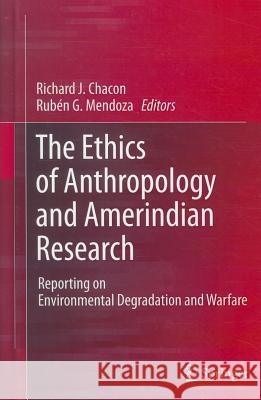
Chacon, Richard J.
The Ethics of Anthropology and Amerindian Research: Reporting on Environmental Degradation and Warfare Chacon, Richard J. 9781461410645 Springer, Berlin - książkaWidoczna okładka, to zdjęcie poglądowe, a rzeczywista szata graficzna może różnić się od prezentowanej.

The Ethics of Anthropology and Amerindian Research: Reporting on Environmental Degradation and Warfare

ISBN-13: 9781461410645 / Angielski / Twarda / 2011 / 524 str.

Chacon, Richard J.
cena 603,81
(netto: 575,06 VAT:  5%)

Najniższa cena z 30 dni: 578,30
Termin realizacji zamówienia:
ok. 22 dni roboczych
Bez gwarancji dostawy przed świętami

Darmowa dostawa!

The decision to publish scholarly findings bearing on the question of Amerindian environmental degradation, warfare, and/or violence is one that weighs heavily on anthropologists. This burden stems from the fact that documentation of this may render descendant communities vulnerable to a host of predatory agendas and hostile modern forces. Consequently, some anthropologists and community advocates alike argue that such culturally and socially sensitive, and thereby, politically volatile information regarding Amerindian-induced environmental degradation and warfare should not be reported. This admonition presents a conundrum for anthropologists and other social scientists employed in the academy or who work at the behest of tribal entities.This work documents the various ethical dilemmas that confront anthropologists, and researchers in general, when investigating Amerindian communities. The contributions to this volume explore the ramifications of reporting--and, specifically, --of non-reporting instances of environmental degradation and warfare among Amerindians. Collectively, the contributions in this volume, which extend across the disciplines of archaeology, anthropology, ethnohistory, ethnic studies, philosophy, and medicine, argue that the non-reporting of environmental mismanagement and violence in Amerindian communities generally harms not only the field of anthropology but the Amerindian populations themselves.

The decision to publish scholarly findings bearing on the question of Amerindian environmental degradation, warfare, and/or social violence is one that weighs heavily on anthropologists. This burden stems from the fact that documentation of this may render descendant communities vulnerable to a host of predatory agendas and hostile modern forces. §Consequently, some anthropologists and community advocates alike argue that such culturally and socially sensitive, and thereby, politically volatile information regarding Amerindian conflicts and other depredations should not be reported. This admonition presents a conundrum for anthropologists and other social scientists employed in the academy or who work at the behest of tribal entities.§This work documents the various ethical dilemmas that confront anthropologists, and researchers in general, when investigating Amerindian communities. The contributions to this volume explore the ramifications of reporting--and, specfically,--under-reporting on problems in Amerindian. §Collectively, the contributions in this volume argue that under-reporting of problems in Amerindian communities generally harm not only the field of anthropology but the Amerindian populations themselves. This volume extend across a wide range of disciplines, including from archaeology, anthropology, ethnohistory, ethnic studies, philosophy, and medicine.


Kategorie:
Nauka, Socjologia i społeczeństwo
Kategorie BISAC:
Social Science > Antropologia
Social Science > Archaeology
Social Science > Ethnic Studies - American - Native American Studies
Wydawca:
Springer, Berlin
Język:
Angielski
ISBN-13:
9781461410645
Rok wydania:
2011
Ilość stron:
524
Waga:
0.88 kg
Wymiary:
23.37 x 15.24 x 3.3
Oprawa:
Twarda
Wolumenów:
01
Dodatkowe informacje:
Bibliografia

Shepard Krech III (Brown University) “Foreword.” 1. Richard J. Chacon (Winthrop University) and Rubén G. Mendoza (California State U. Monterey Bay) “Introduction.”-.2. Christopher W. Schmidt (University of Indianapolis) and Rachel A. Lockhart Sharkey (University of Indianapolis) “Ethical and Political Ramifications of the Reporting/Non-reporting of Native American Ritualized Violence.”.- 3. Charles R. Cobb (South Carolina Institute of Archaeology and Anthropology) and Dawnie Wolfe Steadman (Binghamton University) “Pre-Columbian Warfare and Indecorous Images in Southeastern North America.”.-4. David H. Dye (University of Memphis) and M. Franklin Keel (Bureau of Indian Affairs) “The Portrayal of Native American Violence and Warfare: Who Speaks for the Past?”.- 5. Brooke Bauer (University of North Carolina, Chapel Hill) “Catawba Indians’ Adaptive Response to Colonialism.”.-6. Kitty F. Emery (Florida Museum of Natural History) and Linda Brown (George Washington University) “Maya Hunting Sustainability: Perspectives From Past and Present.”.-7. Arthur A. Demarest (Vanderbilt) and Brent Woodfill (U. of Louisiana, Lafayette) “Sympathetic Ethnocentrism, Repression, and Auto-repression of Q’eqchi’ Maya Blood Sacrifice.”.-8. Richard D. Hansen (Idaho State University) “Relativism, Revisionism, Aboriginalism, and Emic/Etic Truth: The Case Study of Apocalypto.”.-9. Rubén G. Mendoza (California State U. Monterey Bay) and Shari René Harder (California State U. Monterey Bay) “Mythologies of Conquest: Demystifying Amerindian Warfare and European Triumphalism in the Americas.”.-10. John W. Hoopes (University of Kansas) “Imagining Human Alteration of Ancient Landscapes in Central and South America.”.-11.Dennis E. Ogburn (UNC Charlotte) “Overstating, Downplaying and Denying Indigenous Conquest Warfare in Prehispanic Empires of the Andes.”.-12. Elizabeth Arkush (University of Pittsburg) “Violence, indigeneity, and archaeological interpretation in the central Andes.”.-13. Richard J. Chacon (Winthrop University) “Conservation or Resource Maximization? Analyzing Subsistence Hunting Among the Achuar (Shiwiar) of Ecuador.”.- 14. Robert L. Carneiro (American Museum of Natural History). “The Studied Avoidance of War as an Instrument of Political Evolution.”.- 15. John Walden (Marshall University School of Medicine) “Medical Ramifications of Failing to Acknowledge Amerindian Warfare, Violence, Social Inequality and Cultural Enigmas.”.-16. Antonio Chavarria (Museum of Indian Arts and Culture) and Rubén G. Mendoza (California State U. Monterey Bay). “Ancestral Pueblos and Modern Diatribes: An Interview with Antonio Chavarria of Santa Clara Pueblo, Curator of Ethnology, Museum of Indian Arts and Culture, Santa Fe, New Mexico.”.- 17. Alberto Esquit-Choy (Kaqchikel Maya Foundation) “Indigenous Peoples and Environmental Degradation: An Indigenous Perspective.”.- 18. M. Gregory Oakes (Winthrop University) “The Logic of Indigenous Voice.”.-19. Richard J. Chacon (Winthrop University) and Rubén G. Mendoza (California State U. Monterey Bay) “Discussion and Conclusions.”.-

Dr. Richard John Chacon is an associate professor of Anthropology in the Department of Sociology and Anthropology at Winthrop University. His research interests include human behavioral ecology, natural resource conservation, warfare, belief systems, medical anthropology, and the indigenous peoples of the Americas. 

Dr. Rubén G. Mendoza is a professor of Anthropology in the Department of Social, Behavioral, and Global Studies at the California State University, Monterey Bay.  His research interests and publications address pre-Hispanic and Colonial era art, architecture, cosmology, and Amerindian warfare, ritual violence, and social complexity.

.

The decision to publish scholarly findings bearing on the question of Amerindian environmental degradation, warfare, and/or violence is one that weighs heavily on anthropologists. This burden stems from the fact that documentation of this may render indigenous communities vulnerable to a host of predatory agendas and hostile modern forces.

Consequently, some anthropologists and community advocates alike argue that such culturally and socially sensitive, and thereby, politically volatile information regarding Amerindian-induced environmental degradation and warfare should not be reported. This admonition presents a conundrum for anthropologists and other social scientists employed in the academy or who work at the behest of tribal entities.

This work documents the various ethical dilemmas that confront anthropologists, and researchers in general, when investigating Amerindian communities. The contributions to this volume explore the ramifications of reporting--and, specfically,--of non-reporting instances of environmental degradation and warfare among Amerindians.

Collectively, the contributions in this volume, which extend across the disciplines of archaeology, anthropology, ethnohistory, ethnic studies, philosophy, and medicine, argue that the non-reporting of environmental mismanagement and violence in Amerindian communities generally harms not only the field of anthropology but the Amerindian populations themselves.


Udostępnij

Facebook - konto krainaksiazek.pl


Opinie o Krainaksiazek.pl na Opineo.pl

Partner Mybenefit

Krainaksiazek.pl w programie rzetelna firma Krainaksiaze.pl - płatności przez paypal

Czytaj nas na:

Facebook - krainaksiazek.pl
  • książki na zamówienie
  • granty
  • książka na prezent
  • kontakt
  • pomoc
  • opinie
  • regulamin
  • polityka prywatności

Zobacz:

  • Księgarnia czeska

  • Wydawnictwo Książkowe Klimaty

1997-2025 DolnySlask.com Agencja Internetowa

© 1997-2022 krainaksiazek.pl
     
KONTAKT | REGULAMIN | POLITYKA PRYWATNOŚCI | USTAWIENIA PRYWATNOŚCI
Zobacz: Księgarnia Czeska | Wydawnictwo Książkowe Klimaty | Mapa strony | Lista autorów
KrainaKsiazek.PL - Księgarnia Internetowa

Polityka prywatnosci - link
Krainaksiazek.pl - płatnośc Przelewy24
Przechowalnia Przechowalnia






