Conventional hip surgery in traumatology.- A century of experiments and experiences.- Technical properties of the DMS.- The analysis of hip compression screws made of implant steel under static and limit load requirements.- Implants and instruments.- Radioanatomy.- Abnormal radiographic anatomy of the proximal femur.- Fracture classification at the proximal femur.- Statistical items.- Surgical technique for fracture treatment.- Operative procedure.- Operative procedures (Case reports).- The prognosis of the femur neck fracture after headpreserving osteosynthesis.- Intermediate DMS (2/3 implant).- Stabilization of intertrochanteric fractures with the Dynamic Martin Screw (DMS).- The 31A 3-3 fracture: an unstable problem.- Subtrochanteric femur and proximal femur shaft fractures.- Application of the Dynamic Martin Screw (DMS) in the intertrochanteric osteotomy.- Distal femur fractures.- Pathologic fractures and osteolyses at the femur.- The use of an innovative femur neck prosthesis in case of complications after hip fracture surgery.- Exceptional indications.- Additional and adjuvant measurements and procedures.- Systemic antibiotics in the prophylaxis and therapy of postoperative infections in patients with osteosynthesis of the femur.- Prevention of venous thromboembolism in hip surgery.- Physiotherapy after surgery for proximal femur fractures.- Operative revisional management.- Evidence-based drug treatment of osteoporosis.- Closing remarks.
The scope and importance of hip fractures is almost incomprehensible. With a world wide incidence of close to 2 million cases per year, theses fractures pose a daunting challenge to our ability to affect and treat this epidemic.
Basics for operative treatment of proximal and distal femur fractures:
Clear surgical indication
Short planning and preparation < 24 h
Full weight bearing osteosynthesis
Early mobilisation and physiotherapy
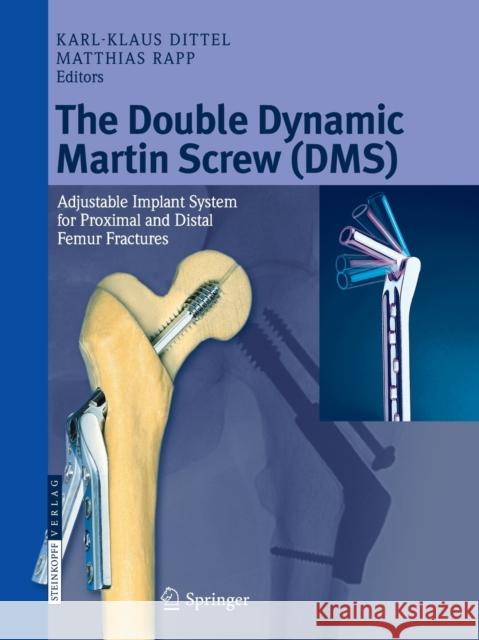
In comprehensive form the book presents the usage of a meanwhile well installed implant (DMS) for osteosynthesis technique in the peritrochanteric region. The „double dynamic" stabilization (sliding tongue principle and angle adapted contoured fit) means a state of the art fracture treatment procedure. It is a convincing alternative to achieve a biological osteosynthesis at the femur. The system includes an infinitely adjustable, flexible angle, dynamic plate with a tubular distal part.