• Wyszukiwanie zaawansowane
  • Kategorie
  • Kategorie BISAC
  • Książki na zamówienie
  • Promocje
  • Granty
  • Książka na prezent
  • Opinie
  • Pomoc
  • Załóż konto
  • Zaloguj się

The Autopoiesis of Architecture, Volume I: A New Framework for Architecture » książka


zaloguj się | załóż konto
Logo Krainaksiazek.pl

koszyk

konto

szukaj
topmenu
Księgarnia internetowa
Szukaj
Książki na zamówienie
Promocje
Granty
Książka na prezent
Moje konto
Pomoc
 
 
Wyszukiwanie zaawansowane
Pusty koszyk
Bezpłatna dostawa dla zamówień powyżej 20 złBezpłatna dostawa dla zamówień powyżej 20 zł

Kategorie główne

• Nauka
 [2952079]
• Literatura piękna
 [1850969]

  więcej...
• Turystyka
 [71058]
• Informatyka
 [151066]
• Komiksy
 [35579]
• Encyklopedie
 [23181]
• Dziecięca
 [620496]
• Hobby
 [139036]
• AudioBooki
 [1646]
• Literatura faktu
 [228729]
• Muzyka CD
 [379]
• Słowniki
 [2932]
• Inne
 [445708]
• Kalendarze
 [1409]
• Podręczniki
 [164793]
• Poradniki
 [480107]
• Religia
 [510956]
• Czasopisma
 [511]
• Sport
 [61267]
• Sztuka
 [243299]
• CD, DVD, Video
 [3411]
• Technologie
 [219640]
• Zdrowie
 [100984]
• Książkowe Klimaty
 [124]
• Zabawki
 [2281]
• Puzzle, gry
 [3363]
• Literatura w języku ukraińskim
 [258]
• Art. papiernicze i szkolne
 [8020]
Kategorie szczegółowe BISAC

The Autopoiesis of Architecture, Volume I: A New Framework for Architecture

ISBN-13: 9780470772980 / Angielski / Miękka / 2011 / 480 str.
Patrik S Schumacher
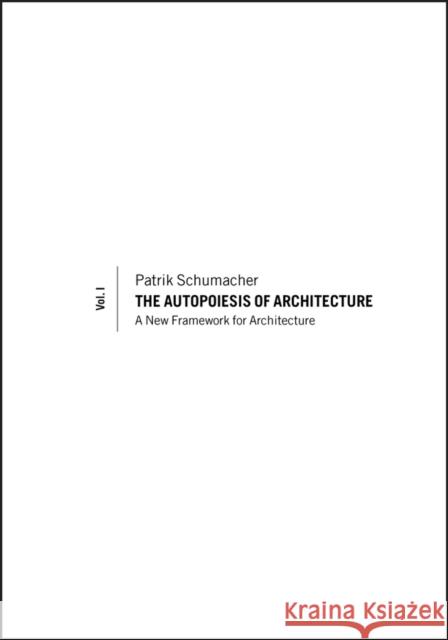
The Autopoiesis of Architecture, Volume I: A New Framework for Architecture Schumacher, Patrik 9780470772980  - książkaWidoczna okładka, to zdjęcie poglądowe, a rzeczywista szata graficzna może różnić się od prezentowanej.

The Autopoiesis of Architecture, Volume I: A New Framework for Architecture

ISBN-13: 9780470772980 / Angielski / Miękka / 2011 / 480 str.

Patrik S Schumacher
cena 214,52
(netto: 204,30 VAT:  5%)

Najniższa cena z 30 dni: 213,19
Termin realizacji zamówienia:
ok. 30 dni roboczych
Dostawa w 2026 r.

Darmowa dostawa!
inne wydania

Take a theoretical approach to architecture with The Autopoiesis of Architecture, which presents the topic as a discipline with its own unique logic. Architecture's conception of itself is addressed as well as its development within wider contemporary society. Author Patrik Schumacher offers innovative treatment that enriches architectural theory with a coordinated arsenal of concepts facilitating both detailed analysis and insightful comparisons with other domains, such as art, science and politics. He explores how the various modes of communication comprising architecture depend upon each other, combine, and form a unique subsystem of society that co-evolves with other important autopoietic subsystems like art, science, politics and the economy. The first of two volumes that together present a comprehensive account of architecture's autopoiesis, this book elaborates the theory of architecture's autopoeisis in 8 parts, 50 sections and 200 chapters. Each of the 50 sections poses a thesis drawing a central message from the insights articulated within the respective section. The 200 chapters are gathering and sorting the accumulated intelligence of the discipline according to the new conceptual framework adopted, in order to catalyze and elaborate the new formulations and insights that are then encapsulated in the theses. However, while the theoretical work in the text of the chapters relies on the rigorous build up of a new theoretical language, the theses are written in ordinary language ? with the theoretical concepts placed in brackets. The full list of the 50 theses affords a convenient summary printed as appendix at the end of the book. The second volume completes the analysis of the discourse and further proposes a new agenda for contemporary architecture in response to the challenges and opportunities that confront architectural design within the context of current societal and technological developments.


Kategorie:
Sztuka, Architektura
Kategorie BISAC:
Architecture > Architektura
Język:
Angielski
ISBN-13:
9780470772980
Rok wydania:
2011
Ilość stron:
480
Waga:
1.07 kg
Wymiary:
22.1 x 17.27 x 3.05
Oprawa:
Miękka
Wolumenów:
01

'...provides a wholly new approach and framework for thinking about architecture.' (Dezeen.com, February 2011).'...does well to relate new developments in architectural media to historical periods, with some fascinating passages on the design process.' (Icon Magazine, February 2011). '...a wholly new theoretical approach to architecture...highly unusual.' (Architecture Today, March 2011).

Preface.

0 Introduction: Architecture as Autopoietic System.

0.1 Architecture as a System of Communications.

0.2 A Unified Theory of Architecture.

0.3 Functional vs Causal Explanations.

0.4 The Quest for Comprehensiveness.

0.5 The Premises Imported from Social Systems Theory.

0.6 Architecture′s Place within Society.

1 Architectural Theory.

1.1 The Unity of Architecture.

1.1.1 Architectural System–formation and Self–regulation.

1.2 The Evolution of Architecture.

1.2.1 Architectural Theory as Mechanism of Selection.

1.3 The Necessity of Theory.

1.3.1 The Function of Architectural Theory.

1.3.2 Types of Theories.

1.3.3 The Necessity to Reflect Architecture′s Societal raison d′etre.

1.3.4 Super–theories.

1.3.5 The Theory of Architectural Autopoiesis as Domain–specific Super–theory.

1.3.6 From Deconstruction to the Programme of Critical Theory.

2 The Historical Emergence of Architecture.

2.1 The Emergence of Architecture as Self–referential System.

2.1.1 Inside–descriptions vs Outside–descriptions.

2.1.2 Function Systems.

2.1.3 The Historical Crystallization of Architecture.

2.2 Foundation and Refoundation of Architecture.

2.2.1 Autonomization: The Origin of the Discipline in the Italian Renaissance.

2.2.2 The Refoundation of the Discipline as Modern Architecture.

2.2.3 The Exclusive Competency and Universal Scope of Modern Architecture.

2.2.4 The Liberation from Traditional Formal Constraints.

2.2.5 The Switch from Edifice to Space.

2.3 Avant–garde vs Mainstream.

2.3.1 A Prerequisite for Evolution.

2.3.2 The Autonomy of the Avant–garde.

2.3.3 Communications between Avant–garde and Mainstream.

2.3.4 The Reciprocal Dependency between Avant–garde and Mainstream.

2.3.5 The Time Structure of the Avant–garde Process: Cumulative vs Revolutionary Periods.

2.3.6 Concrete Exemplars vs Abstract Principles.

2.3.7 Revolution and Philosophy.

2.3.8 Latent Utopias vs the Utopian Ambitions of the Historical Avant–garde.

2.3.9 Retroactive Manifestos.

2.4 Architectural Research.

2.4.1 Architectural Research as Avant–garde Design Research.

2.4.2 Architecture Schools as Laboratories.

2.5 The Necessity of Demarcation.

2.5.1 The Differentiation of Art and Architecture.

2.5.2 The Differentiation of Science and Architecture.

2.5.3 The Differentiation of Architecture and Engineering.

2.5.4 The Rationality of Demarcation.

2.5.5 The Specificity of Architecture within the Design Disciplines.

3 Architecture as Autopoietic System Operations, Structures and Processes.

3.1 Architectural Autopoiesis within Functionally Differentiated Society.

3.1.1 Niklas Luhmann s Theory of Modern Society.

3.1.2 Third Order Observation.

3.1.3 Codes and Media.

3.1.4 The Concept of Social Autopoiesis.

3.2 The Autonomy of Architecture.

3.2.1 Openness through Closure.

3.2.2 Irritations.

3.2.3 Communication Structures.

3.3 The Elemental Operation of Architecture.

3.3.1 Design Decisions.

3.3.2 Network–dependency of Elemental Operations.

3.3.3 Design Decisions and External Demands.

3.4 The Lead–distinction within Architecture and the Design Disciplines.

3.4.1 The Primacy of Distinctions.

3.4.2 Form vs Function as the Lead–distinction within the Design Disciplines.

3.4.3 The Double Reference of the Design Disciplines.

3.5 The Codification of Architecture.

3.5.1 Binary Codes.

3.5.2 Utility and Beauty as the Double Code of Architecture.

3.5.3 Polycontexturality.

3.5.4 The Unique Double Code of Architecture as Demarcation Device.

3.5.5 The Double Code of Architecture and the Triple Code of Avant–garde Architecture.

3.5.6 Discursive Oscillation: Coping with an Expanding Universe of Possibility.

3.5.7 Abstraction and Openness.

3.6 Architectural Styles.

3.6.1 The Concept of Style(s).

3.6.2 The Rationality of Style(s).

3.6.3 Styles as the Necessary Programmes of Architecture.

3.6.4 Styles Regulate Form and Function.

3.6.5 Reluctant Styles.

3.6.6 The Inescapability of the Formal A Priori.

3.6.7 The Double Contingency of Style Formation.

3.6.8 Stylistic Awareness as Second Order Observation.

3.6.9 Progress as Progression of Styles.

3.7 Styles as Research Programmes.

3.7.1 The Creativity of Styles/Research Programmes.

3.7.2 The Tenacity of Styles/Research Programmes.

3.7.3 The Structure of Styles/Research Programmes: Autonomy, Hard Core, Heuristics.

3.7.4 The Great Historical Styles: Hard Core and Heuristics.

3.7.5 Problem Domain and Solution Space as Sources of Stylistic Innovation.

3.7.6 Paradigmatic Mainline and Speculative Extrapolation.

3.7.7 Progressive vs Degenerate Styles/Research Programmes.

3.7.8 Methodological Tolerance.

3.8 The Rationality of Aesthetic Values.

3.8.1 The Historical Transformation of Aesthetic Values.

3.8.2 Aesthetic Values and the Code of Beauty.

3.8.3 The Mystery of Beauty.

3.8.4 Formal A Priori, Idiom and Aesthetic Values.

3.8.5 The Necessity of Aesthetic Revolutions.

3.8.6 Aesthetic Values: Designers vs Users.

3.9 The Double–nexus of Architectural Communications: Themes vs Projects.

3.9.1 The Unity of the Difference between Themes and Projects.

3.9.2 The Difference between Themes and Projects.

3.9.3 The Interaction between Themes and Projects.

4 The Medium of Architecture.

4.1 Medium and Form.

4.1.1 Symbolically Generalized Media of Communication.

4.1.2 The Medium as Revealing and Concealing.

4.1.3 The Medium as Universe of Possibilities.

4.1.4 Medium and Manner.

4.1.5 The Standard Medium of Architecture.

4.1.6 Recursive Self–reference.

4.2 The Medium and the Time Structure of the Design Process.

4.2.1 Differance: The Productive Vagueness of the Medium.

4.2.2 The Diagram.

4.2.3 Specious vs Point–like Time: The Time Structure of the Architectural Project.

5 The Societal Function of Architecture.

5.1 Architecture as Societal Function System.

5.1.1 Function vs Service.

5.1.2 Function Systems and the Functional Exigencies of Society.

5.1.3 Framing as Societal Function of Architecture.

5.1.4 The Definition of the Situation as Precondition of Social Interaction.

5.1.5 Framing Double Contingency.

5.1.6 Double Contingency Radicalized.

5.1.7 The relationship between Art and Architecture in terms of their Societal Function.

5.2 Innovation as Crucial Aspect of Architecture′s Societal Function.

5.2.1 The Burden and Risk of Permanent Innovation.

5.2.2 The Innovative Capacity of Architecture′s Operations and Structures.

5.2.3 Variation, Redundancy and Adaptive Pertinence.

5.3 Strategies and Techniques of Innovation.

5.3.1 The Power of Abstraction.

5.3.2 The history of Architectural Innovations.

5.3.3 Conceptual Manoeuvres.

5.4 Key Innovations: Place, Space, Field.

5.4.1 The Emergence of Architectural Space.

5.4.2 The Hegemony of Architectural Space.

5.4.3 The Transcendence of Architectural Space.

5.4.4 From Space to Field.

Concluding Remarks.

Appendix 1: ComparativeMatrix of Societal Function Systems.

Appendix 2: Theses 1 24.

References.

Index.

Picture Credits.


Udostępnij

Facebook - konto krainaksiazek.pl


Opinie o Krainaksiazek.pl na Opineo.pl

Partner Mybenefit

Krainaksiazek.pl w programie rzetelna firma Krainaksiaze.pl - płatności przez paypal

Czytaj nas na:

Facebook - krainaksiazek.pl
  • książki na zamówienie
  • granty
  • książka na prezent
  • kontakt
  • pomoc
  • opinie
  • regulamin
  • polityka prywatności

Zobacz:

  • Księgarnia czeska

  • Wydawnictwo Książkowe Klimaty

1997-2025 DolnySlask.com Agencja Internetowa

© 1997-2022 krainaksiazek.pl
     
KONTAKT | REGULAMIN | POLITYKA PRYWATNOŚCI | USTAWIENIA PRYWATNOŚCI
Zobacz: Księgarnia Czeska | Wydawnictwo Książkowe Klimaty | Mapa strony | Lista autorów
KrainaKsiazek.PL - Księgarnia Internetowa

Polityka prywatnosci - link
Krainaksiazek.pl - płatnośc Przelewy24
Przechowalnia Przechowalnia






