


ISBN-13: 9783030385125 / Angielski / Miękka / 2020 / 307 str.
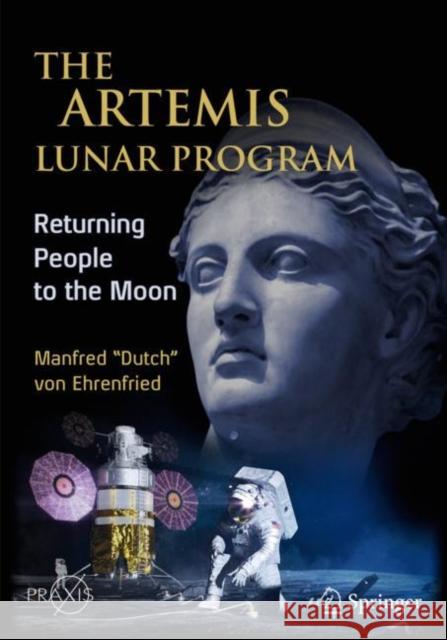
The book tells the story of the buildup of a very small space station in a strange new lunar orbit and the descent of payloads and humans, including the first women and next man, to the lunar surface with the intent to evolve a sustained presence over time.
"I was glad to read this book, and I learned some new things from it. I am happy to recommend it to anyone interested in a brief summary of the technical aspects of the Artemis programme as conceived in its early years." (Ian Crawford, The Observatory, Vol. 141 (1282), June, 2021)
"The book is an excellent basis to understand the further struggle for human space exploration of Moon and Mars, and allows the reader to form his own well-founded opinion and to grasp the technical problems still to be solved. ... A 'treat' for insiders, a reference manual for those interested in human spaceflight and an easily digestible book for laypeople. Predicate: Highly valuable!" (Joachim J. Kehr, Journal of Space Operations & Communicator, February, 2021)
Frontispiece
Dedication
Acknowledgments
Preface
1 Introduction
2 The Artemis Lunar Program Overview
2.1 NASA’s Concept
2.2 Summary of the Elements
2.3 The Controversy
2.4 The Budget
2.5 Politics
3 Spacecraft, Landers, Rovers and Payloads
3.1 Commercial Spacecraft3.2 Commercial Lunar Payload Services
3.3 Commercial Payloads and Instruments
3.4 Lunar Science Participation
3.5 Landing Sites
4 Elements, Crew Landers, Launch Vehicles and Upper Stages
4.1 Propulsion and Power Element
4.2 Habitat and Logistics Modules
4.3 Crew Landers and Transfer Element Studies
4.4 Launch Vehicles
4.5 Upper Stages5 NASA and Commercial Crew Development
5.1 Crew Selection and Training
5.2 Commercial Crew ISS Missions
5.3 Artemis Missions
5.4 The Next Generation Space Suit
5.5 Commercial Crew Space Suits
5.6 Crew Health6 Artemis Lessons for Exploration
6.1 Utility of the Gateway
6.2 Sustainability
6.3 Impact on Future Hardware Design
6.4 Long Duration Science Operations
6.5 Launch Vehicle Payload Capability
7 Enabling Technology Advances7.1 NASA Programs
7.2 Navigation and Precision Landing
7.3 Deep Space Atomic Clock
7.4 In-Situ Resource Utilization
7.5 Lunar Power
7.6 Protection from Radiation
7.7 Advances in Optical Communications7.8 Lunar IceCube
8 Artemis Influence on Mars Planning
8.1 Mission Concepts and Plans
8.2 Technologies and Capabilities
8.3 Artemis Science Influence on Mars
8.4 Robotics
8.5 Regolith Mining and Processing8.6 3D Printing
9 Conclusions
Appendices
1 The National Space Council’s Role in Artemis and Mars
2 Community Letter to Congress Regarding NASA’s Lunar Discovery
and Exploration Program
3 NASA’s Gateway Memorandum for the Record
4 Near Rectilinear Halo Orbit
5 Solar Electric Propulsion and Hall Effect Thrusters
6 Technology
7 Timeline
8 Artemis Mythology
9 The Moon Village Association10 The Chinese Lunar Program
11 Crew Selection: A History and Prediction
12 Quotes
References
Glossary
About the Author
Index
Dutch Von Ehrenfried has worked in both the space flight and aviation fields for about 25 years. He was a NASA Flight Controller in Mission Control for many Mercury, Gemini and Apollo Missions. Dutch also worked on some of the Apollo Lunar Experiment Packages from an operations point of view as well as experiments that went into Skylab from an Earth Resources Program perspective. He later worked in the NASA Headquarters Space Station Task Force and the Program Office as a contractor for about 10 years, and the FAA Aviation Safety Office for a year. In recent years he has written several insightful books in the Springer-Praxis series.
1997-2026 DolnySlask.com Agencja Internetowa












