• Wyszukiwanie zaawansowane
  • Kategorie
  • Kategorie BISAC
  • Książki na zamówienie
  • Promocje
  • Granty
  • Książka na prezent
  • Opinie
  • Pomoc
  • Załóż konto
  • Zaloguj się

Text Analytics with Python: A Practitioner's Guide to Natural Language Processing » książka


zaloguj się | załóż konto
Logo Krainaksiazek.pl

koszyk

konto

szukaj
topmenu
Księgarnia internetowa
Szukaj
Książki na zamówienie
Promocje
Granty
Książka na prezent
Moje konto
Pomoc
 
 
Wyszukiwanie zaawansowane
Pusty koszyk
Bezpłatna dostawa dla zamówień powyżej 20 złBezpłatna dostawa dla zamówień powyżej 20 zł

Kategorie główne

• Nauka
 [2946912]
• Literatura piękna
 [1852311]

  więcej...
• Turystyka
 [71421]
• Informatyka
 [150889]
• Komiksy
 [35717]
• Encyklopedie
 [23177]
• Dziecięca
 [617324]
• Hobby
 [138808]
• AudioBooki
 [1671]
• Literatura faktu
 [228371]
• Muzyka CD
 [400]
• Słowniki
 [2841]
• Inne
 [445428]
• Kalendarze
 [1545]
• Podręczniki
 [166819]
• Poradniki
 [480180]
• Religia
 [510412]
• Czasopisma
 [525]
• Sport
 [61271]
• Sztuka
 [242929]
• CD, DVD, Video
 [3371]
• Technologie
 [219258]
• Zdrowie
 [100961]
• Książkowe Klimaty
 [124]
• Zabawki
 [2341]
• Puzzle, gry
 [3766]
• Literatura w języku ukraińskim
 [255]
• Art. papiernicze i szkolne
 [7810]
Kategorie szczegółowe BISAC

Text Analytics with Python: A Practitioner's Guide to Natural Language Processing

ISBN-13: 9781484243534 / Angielski / Miękka / 2019 / 674 str.
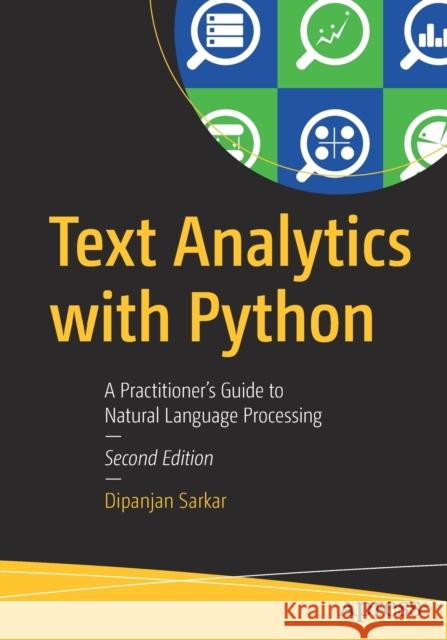
Dipanjan Sarkar
Text Analytics with Python: A Practitioner's Guide to Natural Language Processing Sarkar, Dipanjan 9781484243534 Apress - książkaWidoczna okładka, to zdjęcie poglądowe, a rzeczywista szata graficzna może różnić się od prezentowanej.

Text Analytics with Python: A Practitioner's Guide to Natural Language Processing

ISBN-13: 9781484243534 / Angielski / Miękka / 2019 / 674 str.

Dipanjan Sarkar
cena 170,53
(netto: 162,41 VAT:  5%)

Najniższa cena z 30 dni: 171,48
Termin realizacji zamówienia:
ok. 16-18 dni roboczych
Bez gwarancji dostawy przed świętami

Darmowa dostawa!
Kategorie:
Informatyka, Bazy danych
Kategorie BISAC:
Computers > Languages - Python
Computers > Database Administration & Management
Computers > Artificial Intelligence - Natural Language Processing
Wydawca:
Apress
Język:
Angielski
ISBN-13:
9781484243534
Rok wydania:
2019
Ilość stron:
674
Waga:
1.18 kg
Wymiary:
25.4 x 17.78 x 3.56
Oprawa:
Miękka
Wolumenów:
01
Dodatkowe informacje:
Wydanie ilustrowane

Chapter 1:  Natural Language Basics
Chapter Goal: Introduces the readers to the basics of NLP and Text processing
No of pages: 40 - 50
Sub -Topics
1. Language Syntax and Structure
2. Text formats and grammars
3. Lexical and Text Corpora resources
4. Deep dive into the Wordnet corpus
5. Parts of speech, Stemming and lemmatization

Chapter 2:  Python for Natural Language Processing
Chapter Goal: A useful chapter for people focusing on how to setup your own python environment for NLP and also some basics on handling text data with python and coverage of popular open source frameworks for NLP
No of pages: 20 - 30
Sub - Topics
1. Setup Python for NLP
2. Handling strings with Python
3. Regular Expressions with Python
4. Quick glance into nltk, gensim, spacy, scikit-learn, keras 

Chapter 3:  Processing and Understanding Text
Chapter Goal: This chapter covers all the techniques and capabilities needed for processing and parsing text into easy to understand formats. We also look at how to segment and normalize text. 
No of pages : 35 - 40
Sub - Topics:  
1. Sentence and word tokenization
2. Text tagging and chunking
3. Text Parse Trees
3. Text normalization
4.   Text spell checks and removal of redundant characters
5.   Synonyms and Synsets

Chapter 4:  Feature Engineering for Text Data
Chapter Goal: This chapter covers important strategies to extract meaningful features from unstructured text data. This includes traditional techniques as well as newer deep learning based methods. 
No of pages : 40 - 50
Sub - Topics:  
1. Feature engineering strategies for text data
2. Bag of words model
3. TF-IDF model
3. Bag of N-grams model
4.   Topic Models
5.   Word Embedding based models (word2vec, glove)

Chapter 5: Text Classification
Chapter Goal: Introduces readers to the concept of classification as a supervised machine learning problem and looks at a real world example for classifying text documents
No of pages: 30 - 40
Sub - Topics: 
1.  Classification basics
2.   Types of classifiers
3.   Feature generation of text documents
4. Binary and multi-class classification models
5. Building a text classifier on real world data with machine learning
6. Some coverage of deep learning based classifiers
7. Evaluating Classifiers

Chapter 6: Text summarization and topic modeling
Chapter Goal: Introduces the concepts of text summarization, n-gram tagging analysis and topic models to the readers and looks at some real world datasets and hands-on implementations on the same
No of pages: 40 - 45
Sub - Topics: 
1. Text summarization concepts
2. Dimensionality reduction
3. N-gram tagging models
4. Topic modeling using LDA and LSA
5. Generate topics from real world data
6. N-gram analysis to generate patterns from app reviews (only if it performs well)
7. Basics on deep learning for summarization 


Chapter 7: Text Clustering and Similarity analysis
Chapter Goal: We look at unsupervised machine learning concepts here like text clustering and similarity measures
No of pages: 35 - 40
Sub - Topics: 
1. Clustering concepts
2. Analyzing text similarity
3. Implementing text similarity with cosine, jaccard measures
4. Text clustering algorithms
5. Coverage of partition based clustering like k-means clustering as well as hierarchical clustering methods in detail 
6. Hands on text clustering example on real world data

Chapter 8: Sentiment Analysis 
Chapter Goal: We look at solving a popular problem of analyzing sentiment from text using a combination of methods learnt earlier including classification and also lexical analysis
No of pages: 35 - 40
Sub - Topics: 
1. What is sentiment analysis
2. Looking at lexical corpora for sentiment 
3. Unsupervised sentiment analysis using lexical methods (hands-on)
4. Supervised sentiment analysis (hands-on)

Chapter 9: Deep learning in NLP
Chapter Goal: Deep Learning is one of the most trending topics in the machine learning and data science space these days. Here we will cover a brief introduction into the promise deep learning holds for text analytics and NLP.
No of pages: 30 - 35
Sub - Topics: 
1. What is Deep Learning
2.  Deep learning for text classification (concepts only)
3.  Deep learning for natural language generation (concepts only)
4.  Deep learning for text summarization (concepts only)


Dipanjan (DJ) Sarkar is a Data Scientist at Red Hat, a published author and a consultant and trainer. He has consulted and worked with several startups as well as Fortune 500 companies like Intel. He primarily works on leveraging data science, advanced analytics, machine learning and deep learning to build large- scale intelligent systems. He holds a master of technology degree with specializations in Data Science and Software Engineering. He is also an avid supporter of self-learning and massive open online courses. He has recently ventured into the world of open-source products to improve the productivity of developers across the world.


Dipanjan has been an analytics practitioner for several years now, specializing in machine learning, natural language processing, statistical methods and deep learning. Having a passion for data science and education, he also acts as an AI Consultant and Mentor at various organizations like Springboard, where he helps people build their skills on areas like Data Science and Machine Learning. He also acts as a key contributor and Editor for Towards Data Science, a leading online journal focusing on Artificial Intelligence and Data Science. Dipanjan has also authored several books on R, Python, Machine Learning, Social Media Analytics, Natural Language Processing and Deep Learning.



Dipanjan's interests include learning about new technology, financial markets, disruptive start-ups, data science, artificial intelligence and deep learning. In his spare time he loves reading, gaming, watching popular sitcoms and football and writing interesting articles on https://medium.com/@dipanzan.sarkar and https://www.linkedin.com/in/dipanzan. He is also a strong supporter of open-source and publishes his code and analyses from his books and articles on GitHub at https://github.com/dipanjanS.


Leverage Natural Language Processing (NLP) in Python and learn how to set up your own robust environment for performing text analytics. The second edition of this book will show you how to use the latest state-of-the-art frameworks in NLP, coupled with Machine Learning and Deep Learning to solve real-world case studies leveraging the power of Python.

This edition has gone through a major revamp introducing several major changes and new topics based on the recent trends in NLP. We have a dedicated chapter around Python for NLP covering fundamentals on how to work with strings and text data along with introducing the current state-of-the-art open-source frameworks in NLP. We have a dedicated chapter on feature engineering representation methods for text data including both traditional statistical models and newer deep learning based embedding models. Techniques around parsing and processing text data have also been improved with some new methods.

Considering popular NLP applications, for text classification, we also cover methods for tuning and improving our models. Text Summarization has gone through a major overhaul in the context of topic models where we showcase how to build, tune and interpret topic models in the context of an interest dataset on NIPS conference papers. Similarly, we cover text similarity techniques with a real-world example of movie recommenders. Sentiment Analysis is covered in-depth with both supervised and unsupervised techniques. We also cover both machine learning and deep learning models for supervised sentiment analysis. Semantic Analysis gets its own dedicated chapter where we also showcase how you can build your own Named Entity Recognition (NER) system from scratch. To conclude things, we also have a completely new chapter on the promised of Deep Learning for NLP where we also showcase a hands-on example on deep transfer learning.

While the overall structure of the book remains the same, the entire code base, modules, and chapters will be updated to the latest Python 3.x release.
----------------------------------
Also the key selling points
• Implementations are based on Python 3.x and state-of-the-art popular open source libraries in NLP 
• Covers Machine Learning and Deep Learning for Advanced Text Analytics and NLP
• Showcases diverse NLP applications including Classification, Clustering, Similarity Recommenders, Topic Models, Sentiment and Semantic Analysis


Udostępnij

Facebook - konto krainaksiazek.pl


Opinie o Krainaksiazek.pl na Opineo.pl

Partner Mybenefit

Krainaksiazek.pl w programie rzetelna firma Krainaksiaze.pl - płatności przez paypal

Czytaj nas na:

Facebook - krainaksiazek.pl
  • książki na zamówienie
  • granty
  • książka na prezent
  • kontakt
  • pomoc
  • opinie
  • regulamin
  • polityka prywatności

Zobacz:

  • Księgarnia czeska

  • Wydawnictwo Książkowe Klimaty

1997-2025 DolnySlask.com Agencja Internetowa

© 1997-2022 krainaksiazek.pl
     
KONTAKT | REGULAMIN | POLITYKA PRYWATNOŚCI | USTAWIENIA PRYWATNOŚCI
Zobacz: Księgarnia Czeska | Wydawnictwo Książkowe Klimaty | Mapa strony | Lista autorów
KrainaKsiazek.PL - Księgarnia Internetowa

Polityka prywatnosci - link
Krainaksiazek.pl - płatnośc Przelewy24
Przechowalnia Przechowalnia




