• Wyszukiwanie zaawansowane
  • Kategorie
  • Kategorie BISAC
  • Książki na zamówienie
  • Promocje
  • Granty
  • Książka na prezent
  • Opinie
  • Pomoc
  • Załóż konto
  • Zaloguj się

Tarangire: Human-Wildlife Coexistence in a Fragmented Ecosystem » książka


zaloguj się | załóż konto
Logo Krainaksiazek.pl

koszyk

konto

szukaj
topmenu
Księgarnia internetowa
Szukaj
Książki na zamówienie
Promocje
Granty
Książka na prezent
Moje konto
Pomoc
 
 
Wyszukiwanie zaawansowane
Pusty koszyk
Bezpłatna dostawa dla zamówień powyżej 20 złBezpłatna dostawa dla zamówień powyżej 20 zł

Kategorie główne

• Nauka
 [2950560]
• Literatura piękna
 [1849509]

  więcej...
• Turystyka
 [71097]
• Informatyka
 [151150]
• Komiksy
 [35848]
• Encyklopedie
 [23178]
• Dziecięca
 [617388]
• Hobby
 [139064]
• AudioBooki
 [1657]
• Literatura faktu
 [228597]
• Muzyka CD
 [383]
• Słowniki
 [2855]
• Inne
 [445295]
• Kalendarze
 [1464]
• Podręczniki
 [167547]
• Poradniki
 [480102]
• Religia
 [510749]
• Czasopisma
 [516]
• Sport
 [61293]
• Sztuka
 [243352]
• CD, DVD, Video
 [3414]
• Technologie
 [219456]
• Zdrowie
 [101002]
• Książkowe Klimaty
 [124]
• Zabawki
 [2311]
• Puzzle, gry
 [3459]
• Literatura w języku ukraińskim
 [254]
• Art. papiernicze i szkolne
 [8079]
Kategorie szczegółowe BISAC

Tarangire: Human-Wildlife Coexistence in a Fragmented Ecosystem

ISBN-13: 9783030936068 / Angielski
Christian Kiffner; Monica L. Bond; Derek E. Lee
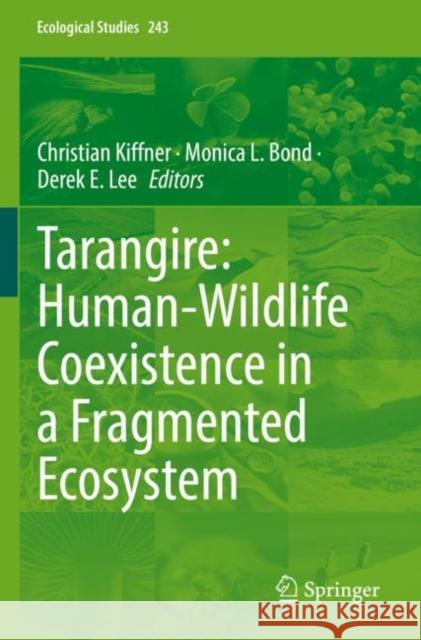
Tarangire: Human-Wildlife Coexistence in a Fragmented Ecosystem Christian Kiffner Monica L. Bond Derek E. Lee 9783030936068 Springer - książkaWidoczna okładka, to zdjęcie poglądowe, a rzeczywista szata graficzna może różnić się od prezentowanej.

Tarangire: Human-Wildlife Coexistence in a Fragmented Ecosystem

ISBN-13: 9783030936068 / Angielski

Christian Kiffner; Monica L. Bond; Derek E. Lee
cena 724,58
(netto: 690,08 VAT:  5%)

Najniższa cena z 30 dni: 693,97
Termin realizacji zamówienia:
ok. 22 dni roboczych
Dostawa w 2026 r.

Darmowa dostawa!
inne wydania

This edited volume summarizes multidisciplinary work on wildlife conservation in the Tarangire Ecosystem of northern Tanzania. By drawing together human-centered, wildlife-centered, and interdisciplinary research, this book contributes to furthering our understanding of the often complex mechanisms underlying human-wildlife interactions in dynamic landscapes. By synthesizing the wealth of knowledge generated by anthropologists, ecologists, conservationists, entrepreneurs, geographers, sociologists, and zoologists over the last decades, this book also highlights practicable and locally adapted solutions for shaping human-wildlife interactions towards coexistence.Readers will discover the reciprocal and often unexpected direct and indirect dynamics between people and wildlife. While boundaries (e.g. between people and wildlife, between protected and un-protected areas, and between different groups of people) are a common theme throughout the different chapters, this book stresses the commonalities, links, and synergies between seemingly disparate disciplines, opinions, and conservation approaches.The chapters are divided into clear sections, such as the human dimension, the wildlife dimension  and  human-wildlife interactions,  representing a detailed summary of anthropological, ecological, and interdisciplinary research projects that have been conducted in the Tarangire Ecosystem over the last decades. Beyond, this work contributes to the debate about land-sharing versus land-sparing and provides an in-depth case study for understanding the complexities associated with human-wildlife coexistence in one of the few remaining ecosystems that supports migratory populations of large mammals.The topic of this book is particularly relevant for students, scholars, and practitioners who are interested in reconciling the needs of human populations with those of the environment in general and large mammal populations in particular.


This edited volume summarizes multidisciplinary work on wildlife conservation in the Tarangire Ecosystem of northern Tanzania. By drawing together human-centered, wildlife-centered, and interdisciplinary research, this book contributes to furthering our understanding of the often complex mechanisms underlying human-wildlife interactions in dynamic landscapes. By synthesizing the wealth of knowledge generated by anthropologists, ecologists, conservationists, entrepreneurs, geographers, sociologists, and zoologists over the last decades, this book also highlights practicable and locally adapted solutions for shaping human-wildlife interactions towards coexistence.Readers will discover the reciprocal and often unexpected direct and indirect dynamics between people and wildlife. While boundaries (e.g. between people and wildlife, between protected and un-protected areas, and between different groups of people) are a common theme throughout the different chapters, this book stresses the commonalities, links, and synergies between seemingly disparate disciplines, opinions, and conservation approaches. The chapters are divided into clear sections, such as the human dimension, the wildlife dimension  and  human-wildlife interactions,  representing a detailed summary of anthropological, ecological, and interdisciplinary research projects that have been conducted in the Tarangire Ecosystem over the last decades. Beyond, this work contributes to the debate about land-sharing versus land-sparing and provides an in-depth case study for understanding the complexities associated with human-wildlife coexistence in one of the few remaining ecosystems that supports migratory populations of large mammals.The topic of this book is particularly relevant for students, scholars, and practitioners who are interested in reconciling the needs of human populations with those of the environment in general and large mammal populations in particular.    

Kategorie:
Nauka, Biologia i przyroda
Kategorie BISAC:
Science > Life Sciences - Ecology
Nature > Environmental Conservation & Protection - General
Political Science > Public Policy - Environmental Policy
Wydawca:
Springer
Seria wydawnicza:
Ecological Studies
Język:
Angielski
ISBN-13:
9783030936068

Introduction

Chapter 1: A framework for human-wildlife coexistence in the Tarangire Ecosystem
Chapter 2: The ecohistory of the Maasai Ecosystem 

The human dimension of conservation

Chapter 3: Spatial conservation and social-ecological systems: changes to local livelihoods, tenure, and wildlife conservation in Tanzania’s Tarangire Ecosystem
Chapter 4: Political ecology of the Tarangire
Chapter 5: A conservationist political ecology of the Tarangire Ecosystem
Chapter 6: Human livelihoods in a changing climate
Chapter 7: Well-being and the Maasai of Simanjiro
Chapter 8: Community attitudes towards conservation areas in the Maasai Steppe 

The wildlife dimension of conservation

Chapter 9: Ungulate population dynamics in the Tarangire
Chapter 10: Metapopulation dynamics of giraffes in the Tarangire Ecosystem
Chapter 11: The history of the Tarangire elephant
Chapter 12: Large carnivores in the Tarangire Ecosystem

Human-wildlife coexistence 

Chapter 13: Wildlife movements and landscape connectivity in the Tarangire Ecosystem
Chapter 14: Effects of roads on the distribution of wildlife, livestock, settlements and pollution
Chapter 15: Human-carnivore conflicts and coexistence in the Tarangire Ecosystem
Chapter 16: Funding conservation in the Anthropocene - Investing in nature-based climate solutions in Makame Wildlife Management Area 
Chapter 17: Education as a tool to live in harmony with natur

Synthesis 

Chapter 18: Shaping human-wildlife coexistence: a synthesis 

Dr. Christian Kiffner is a research associate at the Leibniz Centre for Agricultural Landscape Research and served as faculty at the School for Field Studies in northern Tanzania from 2011 to 2020. Christian received a B.S. degree in Forestry and Forest Ecology, a M.S. in Tropical and International Forestry, and a doctoral degree in Forest Sciences from the University of Göttingen, Germany. Together with undergraduate and graduate students and colleagues, he has conducted field research on the ecology of large carnivores and herbivores, carried out landscape-scale wildlife surveys over multiple years to assess the effectiveness of different conservation approaches in northern Tanzania, and conducted interdisciplinary studies on human-wildlife interactions. Christian has published more than 50 peer-reviewed journal articles and book chapters.

Monica L. Bond, Ph.D., is a principal scientist at the Wild Nature Institute and a research associate at the University of Zurich, with a focus on population ecology, habitat selection, and social behavior of wildlife. Monica is also an advocate for biodiversity conservation: she is a graduate of the first year of Green Corps, the field school for environmental organizing, and has worked as an Endangered Species Act grassroots organizer for the National Wildlife Federation and a staff biologist for the Center for Biological Diversity. Monica received her B.A. degree in Biology from Duke University, her M.S. degree in Wildlife Science from the Department of Fisheries and Wildlife at Oregon State University, and her Ph.D. in Ecology from the Department of Evolutionary Biology and Environmental Studies at the University of Zurich. She has conducted field research on gray-tailed voles, Western Burrowing Owls, Spotted Owls, Black-backed Woodpeckers, arboreal salamanders, northern elephant seals, Hawaiian monk seals, eastern white-bearded wildebeests, and Masai giraffes. She has lived and worked in northern Tanzania since 2012. Monica has published more than 50 peer-reviewed scientific journal articles and book chapters.

Derek E. Lee, Ph.D., is principal scientist at the Wild Nature Institute and associate research professor at Pennsylvania State University. Derek has published more than 50 peer-reviewed scientific journal articles and book chapters on population biology, fire ecology, animal migration, and animal coloration. Derek received a B.A. degree in Cultural Anthropology from University of California Santa Barbara, a M.S. in Natural Resource Management from Humboldt State University, and a Ph.D. in Biological Sciences from Dartmouth College. Since 2012 he has lived and worked full time in Tanzania studying wildlife population biology and behavior.

This edited volume summarizes multidisciplinary work on wildlife conservation in the Tarangire Ecosystem of northern Tanzania. By drawing together human-centered, wildlife-centered, and interdisciplinary research, this book contributes to furthering our understanding of the often complex mechanisms underlying human-wildlife interactions in dynamic landscapes. By synthesizing the wealth of knowledge generated by anthropologists, ecologists, conservationists, entrepreneurs, geographers, sociologists, and zoologists over the last decades, this book also highlights practicable and locally adapted solutions for shaping human-wildlife interactions towards coexistence.

Readers will discover the reciprocal and often unexpected direct and indirect dynamics between people and wildlife. While boundaries (e.g. between people and wildlife, between protected and un-protected areas, and between different groups of people) are a common theme throughout the different chapters, this book stresses the commonalities, links, and synergies between seemingly disparate disciplines, opinions, and conservation approaches.

The chapters are divided into clear sections, such as the human dimension, the wildlife dimension  and  human-wildlife interactions,  representing a detailed summary of anthropological, ecological, and interdisciplinary research projects that have been conducted in the Tarangire Ecosystem over the last decades. Beyond, this work contributes to the debate about land-sharing versus land-sparing and provides an in-depth case study for understanding the complexities associated with human-wildlife coexistence in one of the few remaining ecosystems that supports migratory populations of large mammals.

The topic of this book is particularly relevant for students, scholars, and practitioners who are interested in reconciling the needs of human populations with those of the environment in general and large mammal populations in particular.     



Udostępnij

Facebook - konto krainaksiazek.pl


Opinie o Krainaksiazek.pl na Opineo.pl

Partner Mybenefit

Krainaksiazek.pl w programie rzetelna firma Krainaksiaze.pl - płatności przez paypal

Czytaj nas na:

Facebook - krainaksiazek.pl
  • książki na zamówienie
  • granty
  • książka na prezent
  • kontakt
  • pomoc
  • opinie
  • regulamin
  • polityka prywatności

Zobacz:

  • Księgarnia czeska

  • Wydawnictwo Książkowe Klimaty

1997-2025 DolnySlask.com Agencja Internetowa

© 1997-2022 krainaksiazek.pl
     
KONTAKT | REGULAMIN | POLITYKA PRYWATNOŚCI | USTAWIENIA PRYWATNOŚCI
Zobacz: Księgarnia Czeska | Wydawnictwo Książkowe Klimaty | Mapa strony | Lista autorów
KrainaKsiazek.PL - Księgarnia Internetowa

Polityka prywatnosci - link
Krainaksiazek.pl - płatnośc Przelewy24
Przechowalnia Przechowalnia



