Termin realizacji zamówienia: ok. 30 dni roboczych.
Darmowa dostawa!
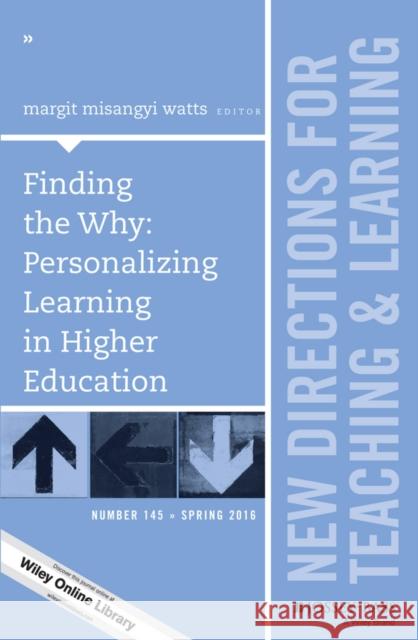
This volume addresses how we might help students find the -why- of their educational endeavors. The ideas found in this volume range from:
changing the perceptions and attitudes of whole communities toward education,
retuning the first year experience to give students more opportunities to find meaning in their learning,
suggesting new ways of integrating students' experiences with their learning in core courses, and
connecting major initiatives already in place to demonstrate how we might restructure undergraduate education through the content of the curriculum, the way we teach, and our curricular learning experiences.
This is the 145th volume of this Jossey-Bass higher education series. It offers a comprehensive range of ideas and techniques for improving college teaching based on the experience of seasoned instructors and the latest findings of educational and psychological researchers.
1. Personalizing Learning 17 margit misangyi watts
The editor offers a personal account of how she came to embrace the why as being important to address, as well as giving an overview of changes that have not occurred yet should.
2. Educational Success and Surrounding Culture 25 Garrison Walters
Highlighting the need for a change in attitudes toward education, this author finds that students perceptions about their ability to learn matters a lot, and that often this perception is a response to other influences.
3. Integrative Learning: Making Liberal Education Purposeful, Personal, and Practical 33 Ann S. Ferren, Chad B. Anderson
This chapter focuses on learning as a way to construct personal meaning. The authors argue for teaching in such a manner that students receive a holistic perspective on their education.
4. Project–Based Learning in Colleges of Business: Is it Enough to Develop Educated Graduates? 41 Penny Pence Smith, Lindsey A. Gibson
Though project–based learning is heralded as an excellent way to engage students in learning, this chapter suggests that perhaps new ways might be better suited to at least some business students.
5. Making Learning Meaningful: Engaging Students in Ways That Matter to Them 49 George D. Kuh
In order to raise our national retention rates, this author is convinced that students need to connect what they are learning to their lives. He suggests focusing on what he calls goal realization as a way to help students find their studies to be personally meaningful.
6. Challenging the First Year of College: Old Models and New Imperatives 57 Shala A. Mills, George L. Mehaffy
This chapter describes how the AASCU is experimenting with new blended courses in which the content transcends the typical general education courses and invites students to create solutions to global challenges.
7. After the Doors Opened: Asking Why at a New Community College 67 Scott Evenbeck, Linda E. Merians
These authors detail the founding of Guttman Community College and how the programs put in place were focused on helping students discover the why of their educational pursuits.
8. The Undergraduate Learning Community: A Bridge to Understanding Why 77 Stephen J. Romanoff
This chapter describes the Russell Scholars Program and how well it has accomplished meaning for students who participate. The foundation of the program is clearly personalizing education.
9. Why Higher Education: Lessons Learned in a Learner–Centered College 85 Sandford C. Shugart
Valencia College is a national leader in showing successful outcomes for students. This author shares key lessons learned that could extend beyond the world of community colleges.
10. Concluding Remarks 93 margit misangyi watts
INDEX 97
Volume Editor: Margit Misangyi watts is a professor in the College of Education at the University of Hawaii at Manoa.
Series Editor–in–Chief: Catherine M. Wehlburg is the assistant provost for Institutional Effectiveness at Texas Christian University.