Systems of Buddhistic Thought » książka





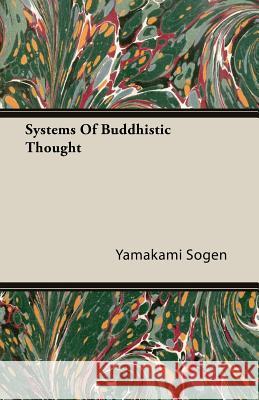
Systems of Buddhistic Thought
ISBN-13: 9781406773064 / Angielski / Miękka / 2007 / 372 str.
PREFACE. In the autumn of the year 1906, when I was leaving the shores of Japan, as a Post-Graduate Research Scholar of the S6to-shiu Daigak of T6ki6, with the object of studying Sanskrit and Pali in the land. of Buddhas hirth, I came across a fellow-passenger, a kind-hearted American gentleman, who, on learning that I was a Buddhist priest, enquired of me in a half-curious, half-condescending manner, what Buddhism really meant. I fully understood the import of the question, and, though my heart was over-flowing with eagerness, to explain to my interlocutor the doctrines of the religion in which I had beeft - brought up, I discovered, to my very great regret, that my defective knowledge of the English language proved an unsurmountable barrier to the accomplishment of my pious purpose. A few words of broken English came to my lips and melted there. But my fellow-passenger was inexorable he was determined to have an answer. Being at a loss to satisfy his laudable curiosity, I went down to my cabin and brought up Hepburns English-Japanese Dictionary and a brand-new copy of Dr. Brewers Dictionary of Phrase and Fable, the parting gift of a benevolent friend and fellow-countryman. The Eng ish-Japanese Dictionary was unfortunately of little or . no use but Brewers work appeared for the time being to relieve me of my helplessness. Without hesitating for a single moment, I turned over the leaves of Brewers book until I came to the article on Buddhism, and showed it to my trans-Atlantic companion who read it with apparent pleasure, thanked me for the information thus supplied, and departed in good humour. When he had gone out of sight, I retired to my cabin and attempted the then somewhat heroic feat of interpreting to myself, with the help of Hepburns Dictonary, the account given of Buddhism by the venerable Brewer and distressing indeed was my surprise when I had made the passage intelligible to myself, Most of you, who are no doubt more familiar with Brewers Dictionary of Phrase and Fable than I can claim to be, will recollect how even in the revised, corrected and enlarged edition IV PREFACE. of that work published in 1900, the article on Buddhism reads. Buddhism, says Brewer on p. 184 of that book, is a system of religion established in India in the third century. The general outline of the system is that the world is a transient reflex of deity, that the soul is a vital spark of deity, and that after death it will be bound to matter again till the wearer has, by divine contemplation, been so purged and purified that it is fit to be absorbed into the divitie ewtetice . Surely 1 said I to myself after perusing Brewers statements, there must be some error somewhere for the Buddhism which I have practised and studied from my earliest youth believes in neither deity nor its spark, and is something quite different. And the necessity of exposing the erroneous notions prevalent in occidental countries about Buddhism the enormity of which might be measured by the fact of their having misled even the octogenarian encyclopaedic Brewer urged itself upon me more strongly than ever. At that very time I made a solemn resolve that, should I be spared to acquire a sufficient command over English and Sanskrit, it would be my first care to explain to the inhabitants of the country which gave us our religion, what Buddhism really is and what jt is not. Such an opportunity, however, seemed never to be coming, until, to my great surprise, I was informed one day that the large-hearted and erudite Vice-Chancellor and the learned Syndicate had appointed me Eeader on Buddhism to the University of Calcutta...
PREFACE. In the autumn of the year 1906, when I was leaving the shores of Japan, as a Post-Graduate Research Scholar of the S6to-shiu Daigak of T6ki6, with the object of studying Sanskrit and Pali in the land. of Buddhas hirth, I came across a fellow-passenger, a kind-hearted American gentleman, who, on learning that I was a Buddhist priest, enquired of me in a half-curious, half-condescending manner, what Buddhism really meant. I fully understood the import of the question, and, though my heart was over-flowing with eagerness, to explain to my interlocutor the doctrines of the religion in which I had beeft - brought up, I discovered, to my very great regret, that my defective knowledge of the English language proved an unsurmountable barrier to the accomplishment of my pious purpose. A few words of broken English came to my lips and melted there. But my fellow-passenger was inexorable he was determined to have an answer. Being at a loss to satisfy his laudable curiosity, I went down to my cabin and brought up Hepburns English-Japanese Dictionary and a brand-new copy of Dr. Brewers Dictionary of Phrase and Fable, the parting gift of a benevolent friend and fellow-countryman. The Eng ish-Japanese Dictionary was unfortunately of little or . no use but Brewers work appeared for the time being to relieve me of my helplessness. Without hesitating for a single moment, I turned over the leaves of Brewers book until I came to the article on Buddhism, and showed it to my trans-Atlantic companion who read it with apparent pleasure, thanked me for the information thus supplied, and departed in good humour. When he had gone out of sight, I retired to my cabin and attempted the then somewhat heroic feat of interpreting to myself, with the help of Hepburns Dictonary, the account given of Buddhism by the venerable Brewer and distressing indeed was my surprise when I had made the passage intelligible to myself, Most of you, who are no doubt more familiar with Brewers Dictionary of Phrase and Fable than I can claim to be, will recollect how even in the revised, corrected and enlarged edition IV PREFACE. of that work published in 1900, the article on Buddhism reads. Buddhism, says Brewer on p. 184 of that book, is a system of religion established in India in the third century. The general outline of the system is that the world is a transient reflex of deity , that the soul is a vital spark of deity, and that after death it will be bound to matter again till the wearer has, by divine contemplation, been so purged and purified that it is fit to be absorbed into the divitie ewtetice . Surely 1 said I to myself after perusing Brewers statements, there must be some error somewhere for the Buddhism which I have practised and studied from my earliest youth believes in neither deity nor its spark, and is something quite different. And the necessity of exposing the erroneous notions prevalent in occidental countries about Buddhism the enormity of which might be measured by the fact of their having misled even the octogenarian encyclopaedic Brewer urged itself upon me more strongly than ever. At that very time I made a solemn resolve that, should I be spared to acquire a sufficient command over English and Sanskrit, it would be my first care to explain to the inhabitants of the country which gave us our religion, what Buddhism really is and what jt is not. Such an opportunity, however, seemed never to be coming, until, to my great surprise, I was informed one day that the large-hearted and erudite Vice-Chancellor and the learned Syndicate had appointed me Eeader on Buddhism to the University of Calcutta...




Czytaj nas na:
KrainaKsiazek.PL - Księgarnia Internetowa


