• Wyszukiwanie zaawansowane
  • Kategorie
  • Kategorie BISAC
  • Książki na zamówienie
  • Promocje
  • Granty
  • Książka na prezent
  • Opinie
  • Pomoc
  • Załóż konto
  • Zaloguj się

Systematic Introduction to Expert Systems: Knowledge Representations and Problem-Solving Methods » książka


zaloguj się | załóż konto
Logo Krainaksiazek.pl

koszyk

konto

szukaj
topmenu
Księgarnia internetowa
Szukaj
Książki na zamówienie
Promocje
Granty
Książka na prezent
Moje konto
Pomoc
 
 
Wyszukiwanie zaawansowane
Pusty koszyk
Bezpłatna dostawa dla zamówień powyżej 20 złBezpłatna dostawa dla zamówień powyżej 20 zł

Kategorie główne

• Nauka
 [2952079]
• Literatura piękna
 [1850969]

  więcej...
• Turystyka
 [71058]
• Informatyka
 [151066]
• Komiksy
 [35579]
• Encyklopedie
 [23181]
• Dziecięca
 [620496]
• Hobby
 [139036]
• AudioBooki
 [1646]
• Literatura faktu
 [228729]
• Muzyka CD
 [379]
• Słowniki
 [2932]
• Inne
 [445708]
• Kalendarze
 [1409]
• Podręczniki
 [164793]
• Poradniki
 [480107]
• Religia
 [510956]
• Czasopisma
 [511]
• Sport
 [61267]
• Sztuka
 [243299]
• CD, DVD, Video
 [3411]
• Technologie
 [219640]
• Zdrowie
 [100984]
• Książkowe Klimaty
 [124]
• Zabawki
 [2281]
• Puzzle, gry
 [3363]
• Literatura w języku ukraińskim
 [258]
• Art. papiernicze i szkolne
 [8020]
Kategorie szczegółowe BISAC

Systematic Introduction to Expert Systems: Knowledge Representations and Problem-Solving Methods

ISBN-13: 9783642779732 / Angielski / Miękka / 2011 / 352 str.
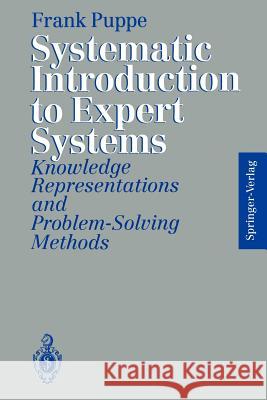
Frank Puppe
Systematic Introduction to Expert Systems: Knowledge Representations and Problem-Solving Methods Puppe, Frank 9783642779732 Springer - książkaWidoczna okładka, to zdjęcie poglądowe, a rzeczywista szata graficzna może różnić się od prezentowanej.

Systematic Introduction to Expert Systems: Knowledge Representations and Problem-Solving Methods

ISBN-13: 9783642779732 / Angielski / Miękka / 2011 / 352 str.

Frank Puppe
cena 443,82
(netto: 422,69 VAT:  5%)

Najniższa cena z 30 dni: 424,07
Termin realizacji zamówienia:
ok. 22 dni roboczych
Dostawa w 2026 r.

Darmowa dostawa!

At present one of the main obstacles to a broader application of expert systems is the lack of a theory to tell us which problem-solving methods areavailable for a given problem class. Such a theory could lead to significant progress in the following central aims of the expert system technique: - Evaluating the technical feasibility of expert system projects: This depends on whether there is a suitable problem-solving method, and if possible a corresponding tool, for the given problem class. - Simplifying knowledge acquisition and maintenance: The problem-solving methods provide direct assistance as interpretation models in knowledge acquisition. Also, they make possible the development of problem-specific expert system tools with graphical knowledge acquisition components, which can be used even by experts without programming experience. - Making use of expert systems as a knowledge medium: The structured knowledge in expert systems can be used not only for problem solving but also for knowledge communication and tutorial purposes. With such a theory in mind, this book provides a systematic introduction to expert systems. It describes the basic knowledge representations and the present situation with regard tothe identification, realization, and integration of problem-solving methods for the main problem classes of expert systems: classification (diagnostics), construction, and simulation.


Kategorie:
Informatyka, Bazy danych
Kategorie BISAC:
Computers > Artificial Intelligence - Expert Systems
Computers > Languages - General
Business & Economics > Information Management
Wydawca:
Springer
Język:
Angielski
ISBN-13:
9783642779732
Rok wydania:
2011
Wydanie:
Softcover Repri
Ilość stron:
352
Waga:
0.56 kg
Wymiary:
23.5 x 15.5
Oprawa:
Miękka
Wolumenów:
01

I Introduction.- 1 Characterization and History of Expert Systems.- 1.1 Characterization.- 1.2 History.- 2 Programming Languages and Expert System Tools.- 2.1 Knowledge Acquisition Problems.- 2.2 Knowledge Acquisition with Specialized Programming Environments.- 2.3 Architecture of Expert Systems.- 3 Use and Usability of Expert Systems.- 3.1 Potential Benefits and Modes of Use.- 3.2 Expert Systems as Knowledge Media.- 3.3 Criteria for Expert System Domains.- 3.4 Summary.- II Basic Techniques of Knowledge Representation.- 4 Logic.- 4.1 Predicate Logic.- 4.2 Properties of Logic Calculi.- 4.3 PROLOG.- 4.4 Summary.- 5 Rules.- 5.1 Forward Chaining.- 5.2 Backward Chaining.- 5.3 Complexity of the Precondition.- 5.4 Rule Structuring.- 5.5 Summary.- 6 Objects/Frames.- 6.1 Example: FRL.- 6.2 Active Objects.- 6.3 Cognitive Meaning of Frames.- 6.4 Automatic Classification in KL-ONE Languages.- 6.5 Frames and Problem-Solving Types.- 6.6 Summary.- 7 Constraints.- 7.1 Types of Constraints and Propagation Algorithms.- 7.2 Solution of a Non-Trivial Constraint Problem.- 7.3 Discussion of the Solution.- 7.4 Formal Characterization of Simple Constraint Systems.- 7.5 Summary.- 8 Probabilistic Reasoning.- 8.1 Bayes’ Theorem.- 8.2 The Dempster-Shafer Theory.- 8.3 The INTERNIST Model.- 8.4 The MYCIN Model.- 8.5 The MED1 Model.- 8.6 Summary.- 9 Non-Monotonic Reasoning.- 9.1 JTMS with Direct Justifications.- 9.2 ATMS with Basic Assumptions as Justifications.- 9.3 Summary.- 10 Temporal Reasoning.- 10.1 Exact Time Relations: VM and MED2.- 10.2 Inexact Quantitative Time Relations: TMM of McDermott.- 10.3 Qualitative Relations: the Time Calculus of Allen.- 10.4 Summary.- III Problem Classes and Problem-Solving Methods.- 11 Previous Approaches to Problem Classification.- 11.1 The Approach of Stefik et al. and Hayes-Roth et al.- 11.2 The Approach of Clancey.- 11.3 The Approach of Breuker et al.- 11.4 The Approach of Chandrasekaran.- 11.5 The Approach of Harmon.- 11.6 The Approach of McDermott.- 11.7 Discussion.- 12 Principles of Problem-Solving Methods.- 12.1 Survey of Problem-Solving Methods.- 12.2 Restriction of Use of Variables.- 12.3 Structure of Knowledge Representation.- 12.4 Structure of Knowledge Manipulation.- 12.5 Structure of Knowledge Acquisition.- Classification.- 13 Survey of the Problem-Solving Type Classification.- 13.1 Domains.- 13.2 Problem Types.- 13.3 Analysis of Problem Characteristics.- 13.4 Problem-Solving Methods.- 14 Simple Classification.- 14.1 Decision Trees.- 14.2 Decision Tables.- 14.3 State of the Art.- 15 Heuristic Classification.- 15.1 Knowledge Representation.- 15.2 Knowledge Manipulation.- 15.3 Knowledge Acquisition.- 15.4 State of the Art.- 15.5 Example: CLASSIKA.- 16 Heuristic Classification: Additional Mechanisms.- 16.1 Treatment of Uncertain Data and Solution Classes.- 16.2 Treatment of Subjective Observations.- 16.3 Recognition of False Observations.- 16.4 Treatment of Time-Dependent Data.- 16.5 Belief Revision.- 16.6 Treatment of Parametrized Data and Solutions.- 16.7 Treatment of Multiple Solutions.- 16.8 Combined Recommendations for Multiple Solutions.- 17 Set-Covering Classification.- 17.1 Knowledge Representation.- 17.2 Knowledge Manipulation.- 17.3 Knowledge Acquisition.- 17.4 State of the Art.- 17.5 Example: FEMO.- 18 Functional Classification.- 18.1 Knowledge Representation.- 18.2 Knowledge Manipulation.- 18.3 Knowledge Acquisition.- 18.4 State of the Art.- 18.5 Example: SIMUL.- 19 Statistical Classification.- 19.1 Knowledge Representation.- 19.2 Knowledge Manipulation.- 19.3 Knowledge Acquisition.- 19.4 State of the Art.- 19.5 Variants of Bayes’ Theorem.- 19.6 Example: FAKTA.- 20 Case-Comparing Classification.- 20.1 Knowledge Representation.- 20.2 Knowledge Manipulation.- 20.3 Knowledge Acquisition.- 20.4 State of the Art.- 20.5 Example: CcC.- V Construction.- 21 Review of the Problem-Solving Type Construction.- 21.1 Domains.- 21.2 Problem Types.- 21.3 Analysis of Problem Characteristics.- 21.4 Problem-Solving Methods.- 22 Skeletal Construction.- 22.1 Knowledge Representation.- 22.2 Knowledge Manipulation.- 22.3 Knowledge Acquisition.- 22.4 State of the Art.- 22.5 Variants of Skeletal Construction: Generate and Test.- 22.6 Heuristic Classification and Skeletal Construction.- 23 Propose and Revise.- 23.1 Knowledge Representation.- 23.2 Knowledge Manipulation.- 23.3 Knowledge Acquisition.- 23.4 State of the Art.- 23.5 Variant for Therapy Planning by Parameter Adjustment.- 23.6 Heuristic Classification and Propose and Revise.- 24 Propose and Exchange.- 24.1 Knowledge Representation.- 24.2 Knowledge Manipulation.- 24.3 Knowledge Acquisition.- 24.4 State of the Art.- 24.5 Example: COKE and REST.- 25 Least-Commitment Strategy.- 25.1 Knowledge Representation.- 25.2 Knowledge Manipulation.- 25.3 Knowledge Acquisition.- 25.4 State of the Art.- 25.5 Example: ExAP.- 26 Model-Based Planning.- 26.1 Non-Hierarchical Planning.- 26.2 Hierarchical Planning.- 26.3 Non-Linear Planning.- 27 Case-Comparing Construction.- 28 Partial Integration of Construction Methods.- 28.1 Knowledge Representation.- 28.2 Knowledge Manipulation.- 28.3 Knowledge Acquisition.- 28.4 State of the Art.- VI Simulation.- 29 Review of the Problem-Solving Type Simulation.- 29.1 Domains.- 29.2 Classification According to Problem Types.- 29.3 Analysis of Problem Characteristics.- 29.4 Problem-Solving Methods.- 30 Single-Phase Simulation.- 31 Numerical Multiple-Phase Simulation.- 31.1 Knowledge Representation.- 31.2 Knowledge Manipulation.- 31.3 Knowledge Acquisition.- 31.4 State of the Art.- 32 Qualitative Multiple-Phase Simulation.- 32.1 Knowledge Representation.- 32.2 Knowledge Manipulation.- 32.3 Knowledge Acquisition.- 32.4 State of the Art.- VII Integration of Problem-Solving Methods.- 33 Basic Ideas for the Integration of Problem-Solving Methods.- 33.1 Domains.- 33.2 Levels of Integration.- 33.3 References to Objects in the Knowledge Representation.- 33.4 Problem Solving.- 33.5 Knowledge Acquisition.- 33.6 Explainability.- 33.7 Data Collection.- 33.8 Programming.- 33.9 Survey of the Integration of Problem-Solving Methods.- 34 Integration of Classification Methods.- 34.1 Strengths and Weaknesses of the Problem-Solving Methods.- 34.2 Knowledge Representation.- 34.3 Knowledge Manipulation.- 34.4 Knowledge Acquisition.- 34.5 Explainability.- 34.6 Data Collection.- 34.7 Programming.- 34.8 State of the Art.- 35 Aspects of the Overall Integration.- 35.1 Survey.- 35.2 Decision-Making in Medicine.- 35.3 Tendering, Configuration and Maintenance of Technical Systems.- 35.4 Job and Production Planning and Quality Control.- Appendix: Survey of Knowledge Representation Formalisms.- References.- System Index.


Udostępnij

Facebook - konto krainaksiazek.pl


Opinie o Krainaksiazek.pl na Opineo.pl

Partner Mybenefit

Krainaksiazek.pl w programie rzetelna firma Krainaksiaze.pl - płatności przez paypal

Czytaj nas na:

Facebook - krainaksiazek.pl
  • książki na zamówienie
  • granty
  • książka na prezent
  • kontakt
  • pomoc
  • opinie
  • regulamin
  • polityka prywatności

Zobacz:

  • Księgarnia czeska

  • Wydawnictwo Książkowe Klimaty

1997-2025 DolnySlask.com Agencja Internetowa

© 1997-2022 krainaksiazek.pl
     
KONTAKT | REGULAMIN | POLITYKA PRYWATNOŚCI | USTAWIENIA PRYWATNOŚCI
Zobacz: Księgarnia Czeska | Wydawnictwo Książkowe Klimaty | Mapa strony | Lista autorów
KrainaKsiazek.PL - Księgarnia Internetowa

Polityka prywatnosci - link
Krainaksiazek.pl - płatnośc Przelewy24
Przechowalnia Przechowalnia





