• Wyszukiwanie zaawansowane
  • Kategorie
  • Kategorie BISAC
  • Książki na zamówienie
  • Promocje
  • Granty
  • Książka na prezent
  • Opinie
  • Pomoc
  • Załóż konto
  • Zaloguj się

System Design Through Matlab(r), Control Toolbox and Simulink(r) » książka


zaloguj się | załóż konto
Logo Krainaksiazek.pl

koszyk

konto

szukaj
topmenu
Księgarnia internetowa
Szukaj
Książki na zamówienie
Promocje
Granty
Książka na prezent
Moje konto
Pomoc
 
 
Wyszukiwanie zaawansowane
Pusty koszyk
Bezpłatna dostawa dla zamówień powyżej 20 złBezpłatna dostawa dla zamówień powyżej 20 zł

Kategorie główne

• Nauka
 [2946600]
• Literatura piękna
 [1856966]

  więcej...
• Turystyka
 [72221]
• Informatyka
 [151456]
• Komiksy
 [35826]
• Encyklopedie
 [23190]
• Dziecięca
 [619653]
• Hobby
 [140543]
• AudioBooki
 [1577]
• Literatura faktu
 [228355]
• Muzyka CD
 [410]
• Słowniki
 [2874]
• Inne
 [445822]
• Kalendarze
 [1744]
• Podręczniki
 [167141]
• Poradniki
 [482898]
• Religia
 [510455]
• Czasopisma
 [526]
• Sport
 [61590]
• Sztuka
 [243598]
• CD, DVD, Video
 [3423]
• Technologie
 [219201]
• Zdrowie
 [101638]
• Książkowe Klimaty
 [124]
• Zabawki
 [2473]
• Puzzle, gry
 [3898]
• Literatura w języku ukraińskim
 [254]
• Art. papiernicze i szkolne
 [8170]
Kategorie szczegółowe BISAC

System Design Through Matlab(r), Control Toolbox and Simulink(r)

ISBN-13: 9781852333379 / Angielski / Miękka / 2000 / 488 str.
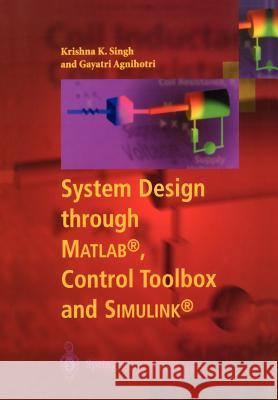
Krishna K. Singh; Gayatri Agnihotri; Gayatri Agnihotri
System Design Through Matlab(r), Control Toolbox and Simulink(r) Singh, Krishna K. 9781852333379 Springer - książkaWidoczna okładka, to zdjęcie poglądowe, a rzeczywista szata graficzna może różnić się od prezentowanej.

System Design Through Matlab(r), Control Toolbox and Simulink(r)

ISBN-13: 9781852333379 / Angielski / Miękka / 2000 / 488 str.

Krishna K. Singh; Gayatri Agnihotri; Gayatri Agnihotri
cena 322,77 zł
(netto: 307,40 VAT:  5%)

Najniższa cena z 30 dni: 308,41 zł
Termin realizacji zamówienia:
ok. 22 dni roboczych
Bez gwarancji dostawy przed świętami

Darmowa dostawa!

MATLAB, a software package developed by Math Works, Inc. is powerful, versatile and interactive software for scientific and technical computations including simulations. Specialised toolboxes provided with several built-in functions are a special feature of MATLAB . This book titled System Design through MATLAB, Control Toolbox and SIMULINK aims at getting the reader started with computations and simulations in system engineering quickly and easily and then proceeds to build concepts for advanced computations and simulations that includes the control and compensation of systems. Simulation through SIMULINK has also been described to allow the reader to get the feel of the real world situation. This book is appropriate for undergraduate students undergoing final semester of their project work, postgraduate students who have MATLAB integrated in their course or wish to take up simulation problem in the area of system engineering for their dissertation work and research scholars for whom MATLABE"


Kategorie:
Technologie
Kategorie BISAC:
Technology & Engineering > Industrial Technology
Computers > Mathematical & Statistical Software
Mathematics > Matematyka
Wydawca:
Springer
Język:
Angielski
ISBN-13:
9781852333379
Rok wydania:
2000
Wydanie:
Edition.
Ilość stron:
488
Waga:
0.87 kg
Wymiary:
24.4 x 17.0
Oprawa:
Miękka
Wolumenów:
01
Dodatkowe informacje:
Wydanie ilustrowane

1. System Representation and Modeling.- 1.1 Properties of the Models.- 1.1.1 Generic Properties.- 1.1.2 Model-specific Properties.- 1.2 Creating a Model.- 1.2.1 Zero/Pole/Gain (zpk) Model.- 1.2.2 Transfer Function (tf) Model.- 1.2.3 State Space (ss) Model.- 1.2.3.1 Standard State Space Model.- 1.2.3.2 Descriptor State Space Model.- 1.2.4 Frequency Response Data (frd) Model.- 1.2.5 Generation of Random Stahle Models.- Exercise for Chapter 1.- 2. Model Manipulation.- 2.1 The Precedence Rule and the Law of Property Inheritance.- 2.1.1 The Precedence Rule.- 2.1.2 The Law of Property Inheritance.- 2.2 Arithmetic Operations on Models.- 2.2.1 Addition and Subtraction.- 2.2.2 Multiplication.- 2.2.3 Inversion.- 2.2.4 Right Divide.- 2.2.5 Left Divide.- 2.2.6 Transposition.- 2.2.7 Pertransposition.- 2.2.8 Power of Model.- 2.2.9 Stacking.- 2.3 Interconnection of Models.- 2.3.1 Concatenation.- 2.3.2 Append.- 2.3.3 Augstate.- 2.3.4 Connect.- 2.3.5 Feedback.- 2.3.6 Linear Fractional Transformation (lft) Connection.- 2.3.7 Parallel and Series Connection.- 2.4 The Linear Time Invariant (LTI) Subsystem.- 2.4.1 Obtaining a Subsystem.- 2.4.2 Modifying a System/Subsystem.- 2.4.3 Subsystem Manipulations.- Exercise for Chapter 2.- 3. Getting Information from the Models.- 3.1 Model-specific Information.- 3.1.1 Zero/Pole/Gain Model.- 3.1.2 Transfer Function Model.- 3.1.3 State Space Model.- 3.1.4 Frequency Response Data Model.- 3.2 Direct Property Referencing Method of Getting Information.- 3.3 The ‘get’ Function.- 3.4 Information about Model Dimensions and Characteristics.- 3.5 Conversion of Models.- 3.5.1 Automatic Conversion.- 3.5.2 Conversion by Specifying.- 3.5.3 Continuous/Discrete Conversions.- 3.6 A Few Words on Model Properties Again.- 3.6.1 Overruling the Precedence Rule and the Law of Property Inheritance.- 3.6.2 Setting/Modifying the LTI Properties.- 3.6.3 More on Time Delays.- 3.6.3.1 Mapping Discrete-time Delays to Poles at the Origin.- 3.6.3.2 Pade Approximation of Time Delays.- 3.6.3.3 Computing Time Delays of LTI Models.- Exercise for Chapter 3.- 4. Model Analysis.- 4.1 Model Dynamics of Control System.- 4.1.1 System Poles.- 4.1.2 System Zeros.- 4.1.3 Low-frequency or DC Gain.- 4.1.4 Pole-zero Map.- 4.1.5 H2 and L? Norms.- 4.1.6 Covariance of Response to White Noise.- 4.1.7 Natural Frequency and Damping of LTI Model Poles.- 4.1.8 Sorting Eigenvalues.- 4.2 Time Response Analysis of Control Systems.- 4.2.1 Response of a Model to Standard Signals.- 4.2.2 Response of a Model to Arbitrary Periodic Signals.- 4.2.3 The Unit Step Function.- 4.3 Frequency Response Analysis of Control Systems.- 4.3.1 Obtaining Frequency Response Plots.- 4.3.2 Getting Information from the Plots.- 4.3.2.1 Evaluating Frequency Response over a Frequency Range.- 4.3.2.2 Evaluating Frequency Response at a Particular Frequency.- 4.3.2.3 Evaluating Gain Margin, Phase Margin, Crossover Frequencies and Judging Stability.- 4.4 State Space Analysis of Control Systems.- 4.4.1 Eigenvalues and Eigenvectors.- 4.4.2 Initial Condition Response of ss Model.- 4.4.3 Canonical State Space Realization.- 4.4.4 Controlability and Observability.- 4.4.5 Controlability and Observability Gramians.- 4.4.6 Balancing of ss Model.- 4.4.6.1 Using Diagonal Similarity.- 4.4.6.2 Using Gramian-based Balancing of State Space Realizations.- 4.4.7 State Reduction of ss Model.- 4.4.7.1 The modred Function.- 4.4.7.2 The minreal Function.- 4.4.7.3 The sminreal Function.- Exercise for Chapter 4.- 5. The Control System Toolbox’s GUIs.- 5.1 The LTI Viewer.- 5.1.1 Initializing the LTI Viewer.- 5.1.2 More about the ltiview Function.- 5.1.3 The LTI Viewer Environment.- 5.1.4 The Bottom Command Bar.- 5.1.5 The Right Click Menus.- 5.1.6 More about Clicking on the Plots.- 5.1.7 A Few Words on the LTI Arrays Response Plots.- 5.1.7.1 The Model Selector for LTI Arrays Window.- 5.2 The Root Locus Design GUI.- 5.2.1 Initializing the Root Locus Design GUI.- 5.2.2 The Root Locus Design GUI Environment.- 5.2.3 Using Root Locus Design GUI.- Exercise for Chapter 5.- 6. Control System Design through Simulink®.- 6.1 System Representation/Modeling.- 6.1.1 Modeling Using Simulink® Library.- 6.1.2 Modeling Using Control System Toolbox Library.- 6.2 Model Manipulation.- 6.2.1 Arithmetic Operations on Models.- 6.2.2 Interconnection of Models.- 6.3 Model Analysis.- 6.4 The Simulink® LTI Viewer.- 6.4.1 Invoking and Using the Simulink® LTI Viewer.- 6.5 A Few Words of Caution.- Exercise for Chapter 6.- 7. Design of Compensators for Systems.- 7.1 Classical Methods for Design.- 7.1.1 Obtaining Root Locus Plot for a Model.- 7.1.2 Selecting Feedback Gain from Root Locus Plot.- 7.1.3 Designing Compensator Using Root Locus Technique.- 7.2 Solution of Lyapunov’s Equation and Stability.- 7.3 Modern Methods for Design.- 7.3.1 Design of State Feedback Controller.- 7.3.1.1 For SISO Models.- 7.3.1.2 For MIMO Models.- 7.3.2 Design of State Estimator/Observer.- 7.3.3 Design of State Regulator.- 7.4 Design of Optimal Compensators.- 7.4.1 Riccati Equations.- 7.4.1.1 Solution of Continuous-time Algebraic Riccati Equations.- 7.4.1.2 Solution of Discrete-time Algebraic Riccati Equations.- 7.4.2 Design of Kalman State Estimator.- 7.4.2.1 Kalman Estimator for Continuous-/Discrete-time Models.- 7.4.2.2 Discrete Kalman State Estimator for Continuous-time Models.- 7.4.3 Design of Linear Quadratic State Feedback Regulator.- 7.4.3.1 Linear Quadratic State Feedback Regulator for Continuous Models.- 7.4.3.2 Linear Quadratic State Feedback Regulator for Discrete Models.- 7.4.3.3 Linear Quadratic State Feedback Regulator with Output Weighting.- 7.4.3.4 Discrete Linear Quadratic State Feedback Regulator for Continuous Model.- 7.4.4 Design of Linear Quadratic Gaussian Regulator.- Exercise for Chapter 7.- 8. Some Simple Applications.- 8.1 Which Method to Choose.- 8.2 Electrical Systems.- 8.2.1 Purely Resistive Circuit.- 8.2.2 Purely Inductive Circuit.- 8.2.3 Purely Capacitive Circuit.- 8.2.4 Series RL Circuit.- 8.2.4.1 Simulation from the Matlab® Window.- 8.2.4.1 Simulation from the Simulink® Window.- 8.2.5 Output Characteristics of a PNP Transistor (Linear Portion in Common Emitter Configuration).- 8.2.6 Series RLC Circuit.- 8.2.7 Bandpass Filter.- 8.3 Mechanical System.- 8.3.1 Translational Mechanical Systems.- 8.3.1.1 Force-displacement System.- 8.3.1.2 Spring-mass-damper-lever System.- 8.3.1.3 Double Spring-mass-damper System.- 8.3.2 Rotational Mechanical Systems.- 8.3.2.1 Spring-inertia-damper System.- 8.3.2.2 Inertia-spring-inertia-damper System.- 8.4 Fluid Systems.- 8.4.1 Hydraulic Systems.- 8.4.1.1 Isolated-tank System.- 8.4.1.2 Interacting-fluid System.- 8.4.2 Pneumatic Systems.- 8.4.1.1 Pneumatic-valve System.- 8.5 Thermal Systems.- 8.5.1 A Mercury-thermometer System.- 8.5.2 Oil-heating System.- Exercise for Chapter 8.- 9. Some Complex Applications.- 9.1 DC Motors.- 9.1.1 Separately-excited DC Motor.- 9.1.2 DC Series Motor.- 9.2 Plunger System.- 9.3 Power-generating Systems.- 9.4 Power-plant System.- 9.5 Pacemaker System.- 9.6 Inverted-pendulum-on-cart System.- 9.7 Essential-oil-extraction Plant.- 9.8 Musical-octave System.- Exercise for Chapter 9.- Appendix A.- Appendix B.- Appendix C.- C.l Plotting some Typical Signals.- Appendix D.- D.l Plotting some Typical Signals.- Appendix E.- References.


Udostępnij

Facebook - konto krainaksiazek.pl


Opinie o Krainaksiazek.pl na Opineo.pl

Partner Mybenefit

Krainaksiazek.pl w programie rzetelna firma Krainaksiaze.pl - płatności przez paypal

Czytaj nas na:

Facebook - krainaksiazek.pl
  • książki na zamówienie
  • granty
  • książka na prezent
  • kontakt
  • pomoc
  • opinie
  • regulamin
  • polityka prywatności

Zobacz:

  • Księgarnia czeska

  • Wydawnictwo Książkowe Klimaty

1997-2025 DolnySlask.com Agencja Internetowa

© 1997-2022 krainaksiazek.pl
     
KONTAKT | REGULAMIN | POLITYKA PRYWATNOŚCI | USTAWIENIA PRYWATNOŚCI
Zobacz: Księgarnia Czeska | Wydawnictwo Książkowe Klimaty | Mapa strony | Lista autorów
KrainaKsiazek.PL - Księgarnia Internetowa

Polityka prywatnosci - link
Krainaksiazek.pl - płatnośc Przelewy24
Przechowalnia Przechowalnia





