• Wyszukiwanie zaawansowane
  • Kategorie
  • Kategorie BISAC
  • Książki na zamówienie
  • Promocje
  • Granty
  • Książka na prezent
  • Opinie
  • Pomoc
  • Załóż konto
  • Zaloguj się

Symbolic Logic and Mechanical Theorem Proving » książka

zaloguj się | załóż konto
Logo Krainaksiazek.pl

koszyk

konto

szukaj
topmenu
Księgarnia internetowa
Szukaj
Książki na zamówienie
Promocje
Granty
Książka na prezent
Moje konto
Pomoc
 
 
Wyszukiwanie zaawansowane
Pusty koszyk
Bezpłatna dostawa dla zamówień powyżej 20 złBezpłatna dostawa dla zamówień powyżej 20 zł

Kategorie główne

• Nauka
 [2946600]
• Literatura piękna
 [1856966]

  więcej...
• Turystyka
 [72221]
• Informatyka
 [151456]
• Komiksy
 [35826]
• Encyklopedie
 [23190]
• Dziecięca
 [619653]
• Hobby
 [140543]
• AudioBooki
 [1577]
• Literatura faktu
 [228355]
• Muzyka CD
 [410]
• Słowniki
 [2874]
• Inne
 [445822]
• Kalendarze
 [1744]
• Podręczniki
 [167141]
• Poradniki
 [482898]
• Religia
 [510455]
• Czasopisma
 [526]
• Sport
 [61590]
• Sztuka
 [243598]
• CD, DVD, Video
 [3423]
• Technologie
 [219201]
• Zdrowie
 [101638]
• Książkowe Klimaty
 [124]
• Zabawki
 [2473]
• Puzzle, gry
 [3898]
• Literatura w języku ukraińskim
 [254]
• Art. papiernicze i szkolne
 [8170]
Kategorie szczegółowe BISAC

Symbolic Logic and Mechanical Theorem Proving

ISBN-13: 9780121703509 / Angielski / Twarda / 1973 / 331 str.
Chin-Liang Chang; Richard C. Lee
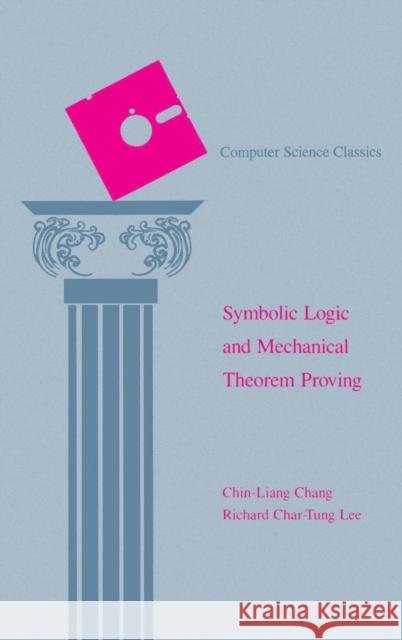
Symbolic Logic and Mechanical Theorem Proving Chin-Liang Chang Richard C. Lee 9780121703509 Academic Press - książkaWidoczna okładka, to zdjęcie poglądowe, a rzeczywista szata graficzna może różnić się od prezentowanej.

Symbolic Logic and Mechanical Theorem Proving

ISBN-13: 9780121703509 / Angielski / Twarda / 1973 / 331 str.

Chin-Liang Chang; Richard C. Lee
cena 257,94 zł
(netto: 245,66 VAT:  5%)

Najniższa cena z 30 dni: 255,83 zł
Termin realizacji zamówienia:
ok. 30 dni roboczych
Bez gwarancji dostawy przed świętami

Darmowa dostawa!

This book contains an introduction to symbolic logic and a thorough discussion of mechanical theorem proving and its applications. The book consists of three major parts. Chapters 2 and 3 constitute an introduction to symbolic logic. Chapters 4-9 introduce several techniques in mechanical theorem proving, and Chapters 10 an 11 show how theorem proving can be applied to various areas such as question answering, problem solving, program analysis, and program synthesis.

Kategorie:
Inne
Kategorie BISAC:
Mathematics > Logic
Mathematics > Matematyka dyskretna
Wydawca:
Academic Press
Seria wydawnicza:
Computer Science and Applied Mathematics
Język:
Angielski
ISBN-13:
9780121703509
Rok wydania:
1973
Numer serii:
000124796
Ilość stron:
331
Waga:
0.69 kg
Wymiary:
23.62 x 16.1 x 2.67
Oprawa:
Twarda
Wolumenów:
01
Dodatkowe informacje:
Bibliografia
Wydanie ilustrowane

?Preface

Acknowledgments

1. Introduction

1.1 Artificial Intelligence, Symbolic Logic, and Theorem Proving

1.2 Mathematical Background

References

2. The Propositional Logic

2.1 Introduction

2.2 Interpretations of Formulas in the Propositional Logic

2.3 Validity and Inconsistency in the Propositional Logic

2.4 Normal Forms in the Propositional Logic

2.5 Logical Consequences

2.6 Applications of the Propositional Logic

References

Exercises

3. The First-Order Logic

3.1 Introduction

3.2 Interpretations of Formulas in the First-Order Logic

3.3 Prenex Normal Forms in the First-Order Logic

3.4 Applications of the First-Order Logic

References

Exercises

4. Herbrand's Theorem

4.1 Introduction

4.2 Skolem Standard Forms

4.3 The Herbrand Universe of a Set of Clauses

4.4 Semantic Trees

4.5 Herbrand's Theorem

4.6 Implementation of Herbrand's Theorem

References

Exercises

5. The Resolution Principle

5.1 Introduction

5.2 The Resolution Principle for the Propositional Logic

5.3 Substitution and Unification

5.4 Unification Algorithm

5.5 The Resolution Principle for the First-Order Logic

5.6 Completeness of the Resolution Principle

5.7 Examples Using the Resolution Principle

5.8 Deletion Strategy

References

Exercises

6. Semantic Resolution and Lock Resolution

6.1 Introduction

6.2 An Informal Introduction to Semantic Resolution

6.3 Formal Definitions and Examples of Semantic Resolution

6.4 Completeness of Semantic Resolution

6.5 Hyperresolution and the Set-of-Support Strategy: Special Cases of Semantic Resolution

6.6 Semantic Resolution Using Ordered Clauses

6.7 Implementation of Semantic Resolution

6.8 Lock Resolution

6.9 Completeness of Lock Resolution

References

Exercises

7. Linear Resolution

7.1 Introduction

7.2 Linear Resolution

7.3 Input Resolution and Unit Resolution

7.4 Linear Resolution Using Ordered Clauses and the Information of Resolved Literals

7.5 Completeness of Linear Resolution

7.6 Linear Deduction and Tree Searching

7.7 Heuristics in Tree Searching

7.8 Estimations of Evaluation Functions

References

Exercises

8. The Equality Relation

8.1 Introduction

8.2 Unsatisfiability under Special Classes of Models

8.3 Paramodulation-An Inference Rule for Equality

8.4 Hyperparamodulation

8.5 Input and Unit Paramodulations

8.6 Linear Paramodulation

References

Exercises

9. Some Proof Procedures Based on Herbrand's Theorem

9.1 Introduction

9.2 The Prawitz Procedure

9.3 The V-Resolution Procedure

9.4 Pseudosemantic Trees

9.5 A Procedure for Generating Closed Pseudosemantic Trees

9.6 A Generalization of the Splitting Rule of Davis and Putnam

References

Exercises

10. Program Analysis

10.1 Introduction

10.2 An Informal Discussion

10.3 Formal Definitions of Programs

10.4 Logical Formulas Describing the Execution of a Program

10.5 Program Analysis by Resolution

10.6 The Termination and Response of Programs

10.7 The Set-of-Support Strategy and the Deduction of the Halting Clause

10.8 The Correctness and Equivalence of Programs

10.9 The Specialization of Programs

References

Exercises

11. Deductive Question Answering, Problem Solving, and Program Synthesis

11.1 Introduction

11.2 Class A Questions

11.3 Class B Questions

11.4 Class C Questions

11.5 Class D Questions

11.6 Completeness of Resolution for Deriving Answers

11.7 The Principles of Program Synthesis

11.8 Primitive Resolution and Algorithm A (A Program-Synthesizing Algorithm)

11.9 The Correctness of Algorithm A

11.10 The Application of Induction Axioms to Program Synthesis

11.11 Algorithm A (An Improved Program-Synthesizing Algorithm)

References

Exercises

12. Concluding Remarks

References

Appendix A

A.1 A Computer Program Using Unit Binary Resolution

A.2 Brief Comments on the Program

A.3 A Listing of the Program

A.4 Illustrations

References

Appendix B

Bibliography

Index

Chang, Chin-Liang Chang, Artificial Intelligence Center, Lockheed Mi... więcej >
Lee, Richard C. "Richard C. Lee" has more than 35 years experience... więcej >


Udostępnij

Facebook - konto krainaksiazek.pl


Opinie o Krainaksiazek.pl na Opineo.pl

Partner Mybenefit

Krainaksiazek.pl w programie rzetelna firma Krainaksiaze.pl - płatności przez paypal

Czytaj nas na:

Facebook - krainaksiazek.pl
  • książki na zamówienie
  • granty
  • książka na prezent
  • kontakt
  • pomoc
  • opinie
  • regulamin
  • polityka prywatności

Zobacz:

  • Księgarnia czeska

  • Wydawnictwo Książkowe Klimaty

1997-2025 DolnySlask.com Agencja Internetowa

© 1997-2022 krainaksiazek.pl
     
KONTAKT | REGULAMIN | POLITYKA PRYWATNOŚCI | USTAWIENIA PRYWATNOŚCI
Zobacz: Księgarnia Czeska | Wydawnictwo Książkowe Klimaty | Mapa strony | Lista autorów
KrainaKsiazek.PL - Księgarnia Internetowa

Polityka prywatnosci - link
Krainaksiazek.pl - płatnośc Przelewy24
Przechowalnia Przechowalnia







