• Wyszukiwanie zaawansowane
  • Kategorie
  • Kategorie BISAC
  • Książki na zamówienie
  • Promocje
  • Granty
  • Książka na prezent
  • Opinie
  • Pomoc
  • Załóż konto
  • Zaloguj się

Sustainable Intensification to Advance Food Security and Enhance Climate Resilience in Africa » książka


zaloguj się | załóż konto
Logo Krainaksiazek.pl

koszyk

konto

szukaj
topmenu
Księgarnia internetowa
Szukaj
Książki na zamówienie
Promocje
Granty
Książka na prezent
Moje konto
Pomoc
 
 
Wyszukiwanie zaawansowane
Pusty koszyk
Bezpłatna dostawa dla zamówień powyżej 20 złBezpłatna dostawa dla zamówień powyżej 20 zł

Kategorie główne

• Nauka
 [2949965]
• Literatura piękna
 [1857847]

  więcej...
• Turystyka
 [70818]
• Informatyka
 [151303]
• Komiksy
 [35733]
• Encyklopedie
 [23180]
• Dziecięca
 [617748]
• Hobby
 [139972]
• AudioBooki
 [1650]
• Literatura faktu
 [228361]
• Muzyka CD
 [398]
• Słowniki
 [2862]
• Inne
 [444732]
• Kalendarze
 [1620]
• Podręczniki
 [167233]
• Poradniki
 [482388]
• Religia
 [509867]
• Czasopisma
 [533]
• Sport
 [61361]
• Sztuka
 [243125]
• CD, DVD, Video
 [3451]
• Technologie
 [219309]
• Zdrowie
 [101347]
• Książkowe Klimaty
 [123]
• Zabawki
 [2362]
• Puzzle, gry
 [3791]
• Literatura w języku ukraińskim
 [253]
• Art. papiernicze i szkolne
 [7933]
Kategorie szczegółowe BISAC

Sustainable Intensification to Advance Food Security and Enhance Climate Resilience in Africa

ISBN-13: 9783319093598 / Angielski / Twarda / 2014 / 665 str.
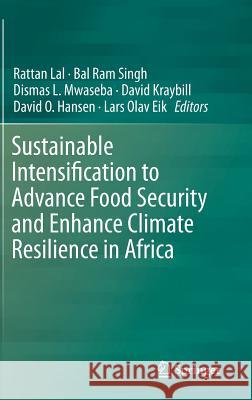
Rattan Lal; Bal Ram Singh; Dismas L. Mwaseba
Sustainable Intensification to Advance Food Security and Enhance Climate Resilience in Africa Rattan Lal Bal Ram Singh Dismas L. Mwaseba 9783319093598 Springer - książkaWidoczna okładka, to zdjęcie poglądowe, a rzeczywista szata graficzna może różnić się od prezentowanej.

Sustainable Intensification to Advance Food Security and Enhance Climate Resilience in Africa

ISBN-13: 9783319093598 / Angielski / Twarda / 2014 / 665 str.

Rattan Lal; Bal Ram Singh; Dismas L. Mwaseba
cena 605,23
(netto: 576,41 VAT:  5%)

Najniższa cena z 30 dni: 578,30
Termin realizacji zamówienia:
ok. 22 dni roboczych
Bez gwarancji dostawy przed świętami

Darmowa dostawa!

This 32-chapter volume represents the core of several oral and poster presentations made at the conference. In addition to Introduction and Conclusion sections, the book is thematically divided into 7 sections, namely, 1) Land Use and Farming Systems, 2) Effects of Climate Change on Crop Yield, 3) Soil Nutrient and Water Management for Carbon Sequestration, 4) Rehabilitation of Degraded Lands through Forestry and Agroforestry, 5) Management of Animal Production for Greenhouse Gas Emissions, 6) Smallholder Adaptation to Climate Change, and 7) Economic, Social and Policy Issues. It addresses these themes in the context of sustainable intensification (SI). It implies increasing agronomic production from the existing land while improving/restoring its quality and decreasing the C or environmental footprint. Simply put, SI means producing more from less.


Kategorie:
Nauka, Biologia i przyroda
Kategorie BISAC:
Nature > Environmental Conservation & Protection - General
Science > Global Warming & Climate Change
Science > Environmental Science (see also Chemistry - Environmental)
Wydawca:
Springer
Język:
Angielski
ISBN-13:
9783319093598
Rok wydania:
2014
Wydanie:
2015
Ilość stron:
665
Wymiary:
23.5 x 15.5
Oprawa:
Twarda
Wolumenów:
01

Introduction
1. Sustainable Intensification for Adaptation and Mitigation of Climate Change and Advancement of Food Security in Africa; Rattan Lal
Land Use and Farming System
2. Geopedological and Landscape Dynamic Controls on Productivity Potentials and Constraints in Selected Spatial Entities in Sub Saharan Africa; Yazidhi Bamutaze
3. Land Degradation and Soil Carbon Pool in Different Land Uses and their Implication for Food Security in Southern Ethiopia; Ambachew Demessi , Bal Ram Singh, and Rattan Lal
4. Land use Impact on Soil Organic Carbon and Total Nitrogen Storage in a typical Dry Land District in Tigray, Northern Ethiopia; Aweke M. Gelaw, Bal Ram Singh, and Rattan Lal
5. Climate Risk Management through Sustainable Land Management in Sub-Saharan Africa; Ephraim Nkonya, Frank Place, John Pender and Edward Kato
6. Effects of Land Cover Changes on Soil Organic Carbon and Nitrogen Stocks in Eastern Mau Forest Reserve, Kenya; Kennedy O. Were, Bal Ram Singh, B. Dick Øystein
Effects of Climate Change and Crop Yield
7. Soil Erosion Hazard under the Current and Potential Climate Change Induced Loss of Soil Organic Matter in the Upper Blue Nile (Abay) River Basin, Ethiopia; Daniel Mengistu, Woldeamlak Bewket and Rattan Lal
8. Climate Change and Crop Yield in Sub-Saharan Africa; Charles K.K. Gachene, Anne N. Karuma and Mary W Baaru
9. Factors in Smallholder Farmers’ Vulnerability to Climate Change Impacts in the Uluguru Mountains, Morogoro, Tanzania; Amon Z.,Mattee, K.R. Musa, Dismas L. Mwaseba, C.P. Mahonge and J.V. Nsenga
10. Using Climate and Crop Simulation Models for Assessing Climate Change Impacts on Agronomic Practices and Productivity; W.B. Mbungu, Henry F. Mahoo, Siza .D. Tumbo, F.C. Kahimba, Filbert B. Rwehumbiza and B.P. Mbilinyi
Soil Nutrient and Water Management For Carbon Sequestration
11. Microdosing of Mineral Fertilizer and Conservation Agriculture for Sustainable Agricultural Intensification in Sub-Saharan Africa; Jens B. Aune and Adama Coulibaly
12. Approaches to Reinforce Crop Productivity under Water-limited Conditions in Sub-humid Environments in Africa; Regis Chikowo, Shamie Zingore, Justice Nyamangara, Mateete Bekunda, Joseph Messina and Sieglinde Snapp
13 Effect of In situ Soil Water Harvesting Techniques and Local Plant Nutrient Resources on Grain Yield of Drought Resistant Sorghum Varieties in Semi-arid zone, Tanzania; Method Kilasara, M.E. Boa, E.Y. Swai, K.P. Sibuga, H.J. Boniface, and E. Kisetu
Rehabilitation of Degraded Land Through Forestry and Agro-Forestry
14. Restoration of Degraded Lands Affected by Salinization Process under Climate Change Conditions: Impacts on Food Security in the River Valley of Senegal; Mateugue Diack, T. Diop and R. Ndiaye
15. Tree Integration In Banana Based Cropping Systems: A Case Study Of Jinja; Lukman N Mulumba
16. Rehabilitation of Degraded Lands: Sustainable Land Management Practices/ Techniques Commonly Used in Niger Republic, West Africa; Habibou, Gabou Mohamadou and Abdou Maisharou
17. Soil Organic Carbon Stocks of Kitonga Catchment Forest Reserve, Tanzania: Variations with Elevation;  Shelukindo, H. B., E. Semu,B.M. Msanya, Bal Ram Singh and P. K. T. Munishi
Management of Animal Production for Greenhouse Gas Emissions
18. Alternative Goat Kid-Rearing Systems for Improved Performance and Milk Sharing between Humans and Offspring in Climate Change Mitigation; F. Chigwa, L.O. Eik, G.C. Kifaro, V.CM. Muhikambele and Daniel E. Mushi
19. Reducing GHG Emissions from Traditional Livestock Systems to Mitigate Changing Climate and Biodiversity; D.E. Mushi, L.O. Eik, A. Bernués, R. Ripoll-Bosch, F. Sundstøl, and M.Mo
20. Feeding Strategies for Improved Beef Productivity and Reduced GHG Emission in Tanzania: Effect of Type of Finish-feeding on Carcass Yield and Meat Quality of Zebu Steers; Ismail Saidi Selemani, Lars Olav Eik, Øystein Holand, Tormod Ådnøy, Ephraim Mtengeti, Daniel Mushi and Sørheim Oddvin
Smallholder Adaptation to Climate Change
21. Enhancing Resilience of Food Production Systems under Changing Climate and Soil Degradation in Semi Arid and Highlands of Tanzania; Nyambilila A. Amuri
22 A Risk-Based Strategy for Climate Change Adaptation in Dryland Systems Based on an Understanding of Potential Production, Soil Resistance and Resilience, and Social Stability; Jeffrey E. Herrick and Adam Beh
23. Use of Conservation Tillage and Cropping Systems to Sustain Crop Yields under Drought Conditions in Zambial; Obed Lungu
24. Sustainable Intensification of Maize and Rice in Small-holder Farming Systems under Climate Change in Tanzania; Ephraim J. Mtengeti, Frank Bentrup, Eva Mtengeti, Lars O. Eik, and Ramadhani Chambuya
25. Smallholder Adaptation to Climate Change in Semi arid Areas of Tanzania: Experiences from Iramba and Meatu Districts; Gry Synnevåg, Samwel J. Kabote, Carolyne I. Nombo, Delphina Mamiro and Amon Z. Mattee
Economic, Social and Policy Issues
26. Exploring the Meso-level of Agricultural Carbon Finance Projects; Corinna Clements, and Keith M. Moore
27. Community, Climate Change and Sustainable Intensification: Why Gender is Important; Cornelia Butler Flora
28. Designing Environmental Instruments for Developing Economies under Asymmetric Information: Direct Cost Subsidy versus Tax Cut; Albert N.Honlonkou
29. Farming Systems in Tanzania: Empirical Evidence of Changes in Livelihood Patterns and Poverty among Smallholder Farmers; Ntengua S. Y. Mdoe, Gilead I. Mlay, and Michael L. Kadigi
30. Carbon Markets Impacts on Farm Management Practices on Mount Kilimanjaro; Francis Mulangu and David Kraybill
31. Adaptation to Climate Change: Changing Gender relations in Meatu and Iramba Districts in Tanzania; C.I. Nombo, S.J Kabote, D.P Mamiro, G. Synnevåg, A.Z. Mattee, J.K Urassa and L. Matata
Conclusion
32. Forgotten Facts: Research and Development Priorities; Rattan Lal, B. R. Singh, D. L. Mwaseba, D. Kraybill, D. Hansen, Lars O. Eik
Appendix
Working Group Recommendations

Whereas the Green Revolution of the 1960’s and 1970’s in South Asia and elsewhere did not happen in Sub-Saharan Africa (SSA), several regions of SSA have experienced substantial improvements in crop yields and growth in agricultural production since the beginning of the 21st century. Yet, no drastic increase in per capita food grain production has occurred, primarily because of rapid rates of population growth. On the contrary, per capita food production has decreased in East Africa, Southern Africa and Central Africa. Thus, hunger, malnutrition and poverty remain endemic throughout SSA.  Agriculture in SSA is vulnerable to harsh and uncertain climate variations. Resource-poor and small landholders are particularly susceptible to their negative impacts. SSA is one of the global hotspots for adverse effects of climate change on agricultural production and the environment. These include severe problems of soil degradation, nutrient and organic matter depletion, water contamination and eutrophication, and loss of biodiversity, especially the below-ground’s diversity.

Thus sustainable intensification (SI) can play an important role in enhancing agricultural production while restoring degraded/desertified soils, mitigating global warming by sequestering atmospheric CO2 in soils and vegetation (forests), adapting to climate change by using recommended management practices of the so called “climate-resilient” or “climate-strategic” agriculture, improving farm income, and empowering women and other under-privileged populations.  The relevance of SI is more now than ever before because of decreasing per capita arable land area, competing uses of land for non-agricultural purposes, increasing risks of land/soil degradation, and changing and uncertain climate. Resource-poor and smallholder farmers of SSA neither have the capacity to adapt nor have the resilience to recover.


Udostępnij

Facebook - konto krainaksiazek.pl


Opinie o Krainaksiazek.pl na Opineo.pl

Partner Mybenefit

Krainaksiazek.pl w programie rzetelna firma Krainaksiaze.pl - płatności przez paypal

Czytaj nas na:

Facebook - krainaksiazek.pl
  • książki na zamówienie
  • granty
  • książka na prezent
  • kontakt
  • pomoc
  • opinie
  • regulamin
  • polityka prywatności

Zobacz:

  • Księgarnia czeska

  • Wydawnictwo Książkowe Klimaty

1997-2025 DolnySlask.com Agencja Internetowa

© 1997-2022 krainaksiazek.pl
     
KONTAKT | REGULAMIN | POLITYKA PRYWATNOŚCI | USTAWIENIA PRYWATNOŚCI
Zobacz: Księgarnia Czeska | Wydawnictwo Książkowe Klimaty | Mapa strony | Lista autorów
KrainaKsiazek.PL - Księgarnia Internetowa

Polityka prywatnosci - link
Krainaksiazek.pl - płatnośc Przelewy24
Przechowalnia Przechowalnia






