• Wyszukiwanie zaawansowane
  • Kategorie
  • Kategorie BISAC
  • Książki na zamówienie
  • Promocje
  • Granty
  • Książka na prezent
  • Opinie
  • Pomoc
  • Załóż konto
  • Zaloguj się

Sustainable Development Goals in Northeast India: Challenges and Achievements » książka


zaloguj się | załóż konto
Logo Krainaksiazek.pl

koszyk

konto

szukaj
topmenu
Księgarnia internetowa
Szukaj
Książki na zamówienie
Promocje
Granty
Książka na prezent
Moje konto
Pomoc
 
 
Wyszukiwanie zaawansowane
Pusty koszyk
Bezpłatna dostawa dla zamówień powyżej 20 złBezpłatna dostawa dla zamówień powyżej 20 zł

Kategorie główne

• Nauka
 [2949965]
• Literatura piękna
 [1857847]

  więcej...
• Turystyka
 [70818]
• Informatyka
 [151303]
• Komiksy
 [35733]
• Encyklopedie
 [23180]
• Dziecięca
 [617748]
• Hobby
 [139972]
• AudioBooki
 [1650]
• Literatura faktu
 [228361]
• Muzyka CD
 [398]
• Słowniki
 [2862]
• Inne
 [444732]
• Kalendarze
 [1620]
• Podręczniki
 [167233]
• Poradniki
 [482388]
• Religia
 [509867]
• Czasopisma
 [533]
• Sport
 [61361]
• Sztuka
 [243125]
• CD, DVD, Video
 [3451]
• Technologie
 [219309]
• Zdrowie
 [101347]
• Książkowe Klimaty
 [123]
• Zabawki
 [2362]
• Puzzle, gry
 [3791]
• Literatura w języku ukraińskim
 [253]
• Art. papiernicze i szkolne
 [7933]
Kategorie szczegółowe BISAC

Sustainable Development Goals in Northeast India: Challenges and Achievements

ISBN-13: 9789811964770 / Angielski / Twarda / 2023 / 490 str.
Subhash Anand; Madhushree Das; Rituparna Bhattacharyya
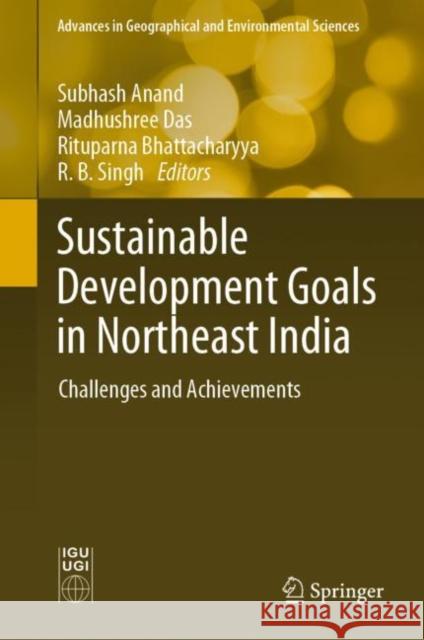
Sustainable Development Goals in Northeast India: Challenges and Achievements Subhash Anand Madhushree Das Rituparna Bhattacharyya 9789811964770 Springer - książkaWidoczna okładka, to zdjęcie poglądowe, a rzeczywista szata graficzna może różnić się od prezentowanej.

Sustainable Development Goals in Northeast India: Challenges and Achievements

ISBN-13: 9789811964770 / Angielski / Twarda / 2023 / 490 str.

Subhash Anand; Madhushree Das; Rituparna Bhattacharyya
cena 605,23 zł
(netto: 576,41 VAT:  5%)

Najniższa cena z 30 dni: 578,30 zł
Termin realizacji zamówienia:
ok. 22 dni roboczych
Bez gwarancji dostawy przed świętami

Darmowa dostawa!
inne wydania

This book covers themes related to the geosphere, biosphere, sociosphere and ecosphere dealing with changing geographical, environmental and socio-economic realities to plan a sustainable future for the northeast region (NER) of India. The NER consists of eight states—Assam, Arunachal Pradesh, Tripura, Nagaland, Manipur, Mizoram, Meghalaya and Sikkim—and they carry political, economic and social importance. The book integrates the past, present and future of geospheric attributes incorporating progress towards the Sustainable Development Goals (SDGs) to meet the demands for improving human wellbeing under diverse and challenging socio-economic, political and environmental conditions. The key SDGs, as in food and agriculture, health, education, water, energy and other overarching goals of the region, have yet to incorporate providing sustainable jobs and promoting equality and inclusive development, although there have been a few studies in that regard.The challenges to achieve SDGs in the NER are formidable compared to the rest of India. The NER has put a great deal of effort into achieving the SDGs, mainly in poverty (SDG-1), good health (SDG-3), education (SDG-4), gender (SDG-5), decent work (SDG-8) and reduced inequalities (SDG-10), similar to the rest of the country. However, the standard development indicators such as road length, access to health care, power consumption and other measures are far below the national average. A multi-pronged strategy has played a pivotal role in the region, but development strategy to attain the SDGs 2030 must be more inclusive in empowering people with maximising self-governance, considering the resources, needs and aspirations of the people.This book evaluates the performance of the SDGs and fills in the gaps. It includes case studies focusing on different SDGs using advanced cartographic, statistical and GIS techniques and methods. It also provides unique findings that serve as valuable resources for planners and policy-makers so that a sustainable future in Northeast India can be achieved.


This book covers themes related to the geosphere, biosphere, sociosphere and ecosphere dealing with changing geographical, environmental and socio-economic realities to plan a sustainable future for the northeast region (NER) of India. The NER consists of eight states—Assam, Arunachal Pradesh, Tripura, Nagaland, Manipur, Mizoram, Meghalaya and Sikkim—and they carry political, economic and social importance. The book integrates the past, present and future of geospheric attributes incorporating progress towards the Sustainable Development Goals (SDGs) to meet the demands for improving human wellbeing under diverse and challenging socio-economic, political and environmental conditions. The key SDGs, as in food and agriculture, health, education, water, energy and other overarching goals of the region, have yet to incorporate providing sustainable jobs and promoting equality and inclusive development, although there have been a few studies in that regard.The challenges to achieve SDGs in the NER are formidable compared to the rest of India. The NER has put a great deal of effort into achieving the SDGs, mainly in poverty (SDG-1), good health (SDG-3), education (SDG-4), gender (SDG-5), decent work (SDG-8) and reduced inequalities (SDG-10), similar to the rest of the country. However, the standard development indicators such as road length, access to health care, power consumption and other measures are far below the national average. A multi-pronged strategy has played a pivotal role in the region, but development strategy to attain the SDGs 2030 must be more inclusive in empowering people with maximising self-governance, considering the resources, needs and aspirations of the people.This book evaluates the performance of the SDGs and fills in the gaps. It includes case studies focusing on different SDGs using advanced cartographic, statistical and GIS techniques and methods. It also provides unique findings that serve as valuable resources for planners and policy-makers so that a sustainable future in Northeast India can be achieved.

Kategorie:
Nauka, Polityka
Kategorie BISAC:
Science > Environmental Science (see also Chemistry - Environmental)
Science > Earth Sciences - Geography
Business & Economics > Zarządzenie zasobami ludzkimi
Wydawca:
Springer
Seria wydawnicza:
Advances in Geographical and Environmental Sciences
Język:
Angielski
ISBN-13:
9789811964770
Rok wydania:
2023
Dostępne języki:
Numer serii:
000479129
Ilość stron:
490
Oprawa:
Twarda

1.           Sustainable Development Goals in Northeast India - Challenges and Achievements

              Rituparna Bhattacharyya,  Subhash Anand and  Madhushree Das


2.           Professor Narendra Nath Bhattacharyya: A Brief Profile of His Life, Academic Career and Contributions

              Bimal K. Kar


3.           Just Transition, (Re)vision 2020- The Story Hitherto

              Syeda Fahima Shahnaz Sultana, Payel Saha, Chandan Bhuyan, Madhushree Das, Rituparna Bhattacharyya and Subhash Anand


4.           An Analysis of the Performance of Sustainable Development Goals (SDGS) in the North East Region of India: An Economics Perspective

              Pawan Kumar, Paramjit and Subhash Anand


5.           Extreme Weather Events and Food Insecurity in Northeast India

              Raju Mandal, Binoy Goswami, Munmi Sarma and Hiranya Nath


6.           Food Security in North-East India: the Role of Agriculture, Challenges and the Road Ahead

              Navneet Hazarika,   Joyeeta Deka, Praditya Kumar Das, Kandarpa Kumar Saikia


7.           Juxtaposing Food Security and Sustainable Development Goals (SDGs) in Northeast India: Evidence and Explanations

              Dibyajyoti Dutta and Akhil Ranjan Dutta


8.           Land Degradation, Desertification and Food Security in North East India: Present and Future Scenarios

              Vimla Singh and Nivedita Chaudhary


9.           Enhanced Vegetation Index and Land Use Analysis for Seven Sister States of India (2000-2022)

              Priyanka Puri


10.         Quality of Living Space Among Rural Households in North Eastern Region of India

              K.V. Chamar and  Rekha Dhanak


11.         Augmentation of North-East Resources: intervention through Data Science & Advanced Technology

              Eeshankur Saiki and  Parvej Reja Saleh


12.         Sustainable development goals (SDG 3) “health and wellbeing”: What’s ailing north eastern states?

              Mridul Kumar Sarma


13.         Progress Made by The North Eastern States of India Towards the 2030 Health-Related Sustainable Development Goals (SDGs: Performance of The Health and Well-Being Indicators

              Sahana Bhattacharjee


14.         Status of Gender Equality in the North Eastern States: A Pathway towards Achievement of Sustainable Development Goal

              Lovleen Gupta, Shubham Singhania, Rohit Kumar Shrivastav


15.         Change in Dominant and Deficient Functions of Rural Female Workers in North-Eastern Region of India: An Analysis

              Ashu Rani and K.V. Chamar


16.         An Evolving Paradigm Of Cybersecurity In North East India

              Subimal Bhattacharjee


17.         Sustainable Development Goals and Assam- A Roadmap to a Better Future

              Payel Saha, Syeda Fahima Shahnaz Sultana, Ankabehari Saha and Madhushree Das


18.         Measuring Gaps to Achieve the SDG 1 in Assam and Identifying the Causes

              Barnali Gogoi and Swapnali Saikia


19.         On Understanding the Drinking Water Treatment Requirements in India during Emergencies

              Rituparna Bhattacharyya, Bowen Tan and Diganta Bhusan Das


20.         Perilous Waters: Gendering Community Based Disasters Management Practices from floods a study of Majuli Assam

              Bikash Chetry


21.         Rejuvenating Geographies of Manas through People’s Participation: A Success Story of Community Conservation

              Pranjit Kumar Sarma, Rituparna Bhattacharyya and Sanatan Deka


22.         Ephemeral char ecosystems and mitigation of flood induced vulnerability along River Brahmaputra

              Nazifa Ahmed


23.         Making Unpaid Work Visible - The Key To Removing Gender Inequality: A Study In The Urban Households Of Assam

              Chandrama Goswami and Manisha Bhattacharyya


24.         Wildlife habitat dynamics and sustainable development: revisiting Pabitora Wildlife Sanctuary of Assam

              Pranjit Kumar Sarma, Bibhab Kumar Talukdar, Pradipta Baruah and Mukul Tamuli


25.         Prospects of Tourism Sector in Assam to achieve Sustainable Development Goals

              Shikha Yadav,  Gautam Kakaty, Usha Rani and Vaibhav Anand


26.         Sustainable Ethnic Tourism Development in Arunachal Pradesh

              Parijat Borgohain and Barnali Patowary


27.         SDG 3 in Manipur: A Story of Hill-Valley Divide

              Esther Ngaihte and Anushruti


28.         An Analytical Study on the inseparable relations between food, population, arable land and economy in Manipur from the Perspective of Sustainability

              Irom Luckychand Meitei  and Gurumayum Jadumani Sharma


29.         Application of Remote Sensing and GIS techniques for Landslide hazard Zonation in Tamenglong District of Manipur, North East India

              Lunghim Rongmei, Irom Luckychand Meitei and Ekta Raman


30.         Analysing development induced trade-offs: A Case Study of Loktak Multipurpose Project (LMP) in Manipur

              Himani Tiwari & Harshita Tiwari


Subhash Anand is currently a Professor at the Department of Geography, Delhi School of Economics, University of Delhi, India. He has to his credit 25 years of teaching and research experience and published 07 books (including Urban Health Risk and Resilience in Asian Cities, Water Science and Sustainability, and Global Geographical Heritage, Geoparks and Geotourism by Springer Nature) and more than 75 research papers, articles and chapters in high reputed journals and books. He has specialization in Urban Environmental Issues, Sustainable Cities, Solid Waste Management & Planning, Geotourism. Prof. Anand is  Associate Editor-in- Chief of the International Journal of Geoheritage and Parks (Elsevier) and also Vice-Chair of Commission on Geoheritage and Parks, International Geographical Union (IGU). He is also on the editorial boards of many reputed journals. He has supervised several Ph.D, M.Phil & Master theses and dissertations. Prof. Anand possesses administrative experience having worked in various capacities in different organizations. He has done successful UGEC & SARCS advanced training workshop on Urban Spatial Planning in response to Climate Change in Asia, in Taipei, and Commonwealth Geographical Bureau (CGB) workshop on Human Consequences of Climate Change at University of Colombo. He has widely travelled and participated in several international conferences, seminars & workshops and delivered lectures in various countries. He is recipient of Dr. Rajendra Prasad Award by International Eminent Educationist Forum of India.

Madhushree Das is the head of the Department of Geography, Gauhati University, and is a social and cultural geographer, working in the field of gender and tribal geography. She has more than 25 years of teaching and research experience and has published 3 books and more than 45 research papers. She currently supervises 8 Ph.D. scholars. Under her supervision, 7 students have received Ph.D. degrees and 6 have been awarded M.Phil. degrees. She participated in the Commonwealth Geographical Bureau Workshop on Human Consequences on Climate Change at the University of Colombo (Sri Lanka) in 2005 and received the International Geographical Award three times to present her research in Durban (South Africa), Cologne (Germany), Szeged (Hungary) and Kyoto (Japan). She also presented her research in Boston, USA, in 2017. She has initiated an academic collaboration with the Royal Geographical Society, London, and has visited the University of Sydney, New South Wales, and Canberra in Australia as part of the Gauhati University team in connection with academic links and the opening of Gauhati University Alumni chapter in Australia. She was the general secretary of the North East India Geographical Society from 2016 to 2018.

Rituparna Bhattacharyya holds a Ph.D. from the School of Geography, Politics and Sociology, University of Newcastle, UK. She is a Senior Fellow, Advance HE (formerly Higher Education Academy), UK, and an Adjunct Professor, Indian Insitute of Technology, Guwahati. She also works as a research consultant and editor-in-chief (Joint) of the journal Space and Culture, India. She does volunteer work at the Prag Foundation for Capacity Building, a public charitable trust in India, and the Alliance for Community Capacity Building for North East India, a UK-registered charity. She has more than 65 publications to her credit in international outlets.


R.B. Singh was the secretary general and treasurer of the International Geographical Union and a former head of the Department of Geography, Delhi School of Economics, University of Delhi, India (2013–2016 and 2019–2020). He has supervised 40 Ph.D. and 81 M.Phil. research scholars and numerous M.A. students. He has been the chair of the University Grants Commission (UGC) National Committee’s Learning Outcome Based Curriculum Framework since July 2018. He was invited by the InterAcademy Partnership (IAP)–Global Network of Science Academies to join a working group for statements on science and technology for disaster risk reduction. Prof. Singh was unanimously elected president of the Earth System Science Section of the Indian Science Congress Association for 2019–2020. The National Institution for Transforming India (NITI) Aayog, Government of India, invited him to be a member of the committee for preparing Vision India 2035. He has authored 16 books and edited 40 books, with more than 250 research papers published in national and international journals. He is the series editor of Advances in Geographical and Environmental Sciences (Springer) and Sustainable Development Goals (Springer). He was awarded the prestigious Japan Society for Promotion of Science (JSPS) Research Fellowship at Hiroshima in 2013 and several travel fellowships and support from various organisations.

This book covers themes related to the geosphere, biosphere, sociosphere and ecosphere dealing with changing geographical, environmental and socio-economic realities to plan a sustainable future for the northeast region (NER) of India. The NER consists of eight states—Assam, Arunachal Pradesh, Tripura, Nagaland, Manipur, Mizoram, Meghalaya and Sikkim—and they carry political, economic and social importance. The book integrates the past, present and future of geospheric attributes incorporating progress towards the Sustainable Development Goals (SDGs) to meet the demands for improving human wellbeing under diverse and challenging socio-economic, political and environmental conditions. The key SDGs, as in food and agriculture, health, education, water, energy and other overarching goals of the region, have yet to incorporate providing sustainable jobs and promoting equality and inclusive development, although there have been a few studies in that regard.


The challenges to achieve SDGs in the NER are formidable compared to the rest of India. The NER has put a great deal of effort into achieving the SDGs, mainly in poverty (SDG-1), good health (SDG-3), education (SDG-4), gender (SDG-5), decent work (SDG-8) and reduced inequalities (SDG-10), similar to the rest of the country. However, the standard development indicators such as road length, access to health care, power consumption and other measures are far below the national average. A multi-pronged strategy has played a pivotal role in the region, but development strategy to attain the SDGs 2030 must be more inclusive in empowering people with maximising self-governance, considering the resources, needs and aspirations of the people.

This book evaluates the performance of the SDGs and fills in the gaps. It includes case studies focusing on different SDGs using advanced cartographic, statistical and GIS techniques and methods. It also provides unique findings that serve as valuable resources for planners and policy-makers so that a sustainable future in Northeast India can be achieved.




Udostępnij

Facebook - konto krainaksiazek.pl


Opinie o Krainaksiazek.pl na Opineo.pl

Partner Mybenefit

Krainaksiazek.pl w programie rzetelna firma Krainaksiaze.pl - płatności przez paypal

Czytaj nas na:

Facebook - krainaksiazek.pl
  • książki na zamówienie
  • granty
  • książka na prezent
  • kontakt
  • pomoc
  • opinie
  • regulamin
  • polityka prywatności

Zobacz:

  • Księgarnia czeska

  • Wydawnictwo Książkowe Klimaty

1997-2025 DolnySlask.com Agencja Internetowa

© 1997-2022 krainaksiazek.pl
     
KONTAKT | REGULAMIN | POLITYKA PRYWATNOŚCI | USTAWIENIA PRYWATNOŚCI
Zobacz: Księgarnia Czeska | Wydawnictwo Książkowe Klimaty | Mapa strony | Lista autorów
KrainaKsiazek.PL - Księgarnia Internetowa

Polityka prywatnosci - link
Krainaksiazek.pl - płatnośc Przelewy24
Przechowalnia Przechowalnia



