Sustainable Agriculture » książka





Sustainable Agriculture
ISBN-13: 9789048126651 / Angielski / Twarda / 2009 / 919 str.
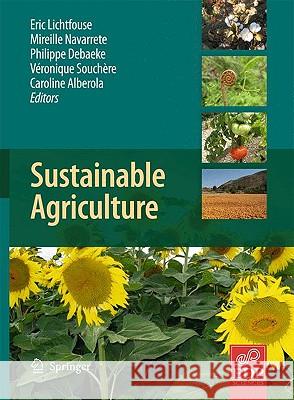
Sustainable agriculture is an alternative for solving fundamental and applied issues related to food production in an ecological way. This book is suitable for scientists, decision-makers, professors, farmers and politicians who wish to build a safe agricu
From the reviews:
“This work is a collection of literature reviews on a wide variety of topics pertinent to sustainable agriculture. … provides an excellent overview to many of the current trends in sustainable agriculture. … the compilation of the papers in one volume is an attractive feature, especially for researchers interested in an accessible reference guide. … Summing Up: Highly recommended. Graduate students, researchers, faculty, and professionals.” (J. R. Reeve, Choice, Vol. 47 (11), July, 2010)Agronomy for Sustainable Agriculture; Laws of Sustainable Soil Management Section 1. CLIMATE CHANGE Soils and sustainable agriculture; Soils and food sufficiency; Denitrification in cropping systems at sub-zero soil temperatures; Re-thinking the conservation of carbon, water and soil: a different perspective; Cropping systems, carbon sequestration and erosion in Brazil; Influence of land use on carbon sequestration and erosion in Mexico; Rhizodeposition of organic C by plants: mechanisms and controls; Environmental costs and benefits of transportation biofuel production from food- and lignocellulose-based energy crops; Grasslands for bioenergy production; Plant drought stress: effects, mechanisms and management Section 2. GENETICALLY MODIFIED ORGANISMS Pharmaceutical crops in California, benefits and risks; Coexistence of genetically modified (GM) and non-GM crops in the European Union; Agro-environmental effects due to altered cultivation practices with genetically modified herbicidetolerant oilseed rape and implications for monitoring; Bacillus thuringiensis: applications in agriculture and insect resistance management; Genetically modified glyphosate-tolerant soybean in the USA: adoption factors, impacts and prospects Section 3. BIODIVERSITY Small eats big: ecology and diversity of Bdellovibrio and like organisms, and their dynamics in predatorprey interactions; Identification of traits implicated in the rhizosphere competence of fluorescent pseudomonads: description of a strategy based on population and model strain studies; Progress in Mechanisms of Mutual Effect between Plants and the Environment; Biodiversity: function and assessment in agricultural areas; Mixing plant species in cropping systems: concepts, tools and models; Saffron, an alternative crop for sustainable agricultural systems; Digital imaging information technology applied to seed germination testing; Section 4. ALTERNATIVE CONTROL Managing weeds with a dualistic approach of prevention and control; Mechanical destruction of weeds; Sustainable pest management for cotton production; Role of nutrients in controlling plant diseases in sustainable agriculture; Crop protection, biological control, habitat management and integrated farming; Using grassed strips to limit pesticide transfer to surface water; Section 5. ALTERNATIVE FERTILISATION Recycling biosolids and lake-dredged materials to pasture-based animal agriculture: alternative nutrient sources for forage productivity and sustainability; Symbiotic nitrogen fixation in legume nodules: process and signaling; Factors Responsible for Nitrate Accumulation; Role of phosphate-solubilizing microorganisms in sustainable agriculture; Iron and zinc biofortification strategies in dicot plants by intercropping with gramineous species; Soil exploration and resource acquisition by plant roots: an architectural and modelling point of view; Methods for studying root colonization by introduced beneficial bacteria; Section 6. NEW FARMING SYSTEMS Sustainable urban agriculture in developing countries; Nitrogen, sustainable agriculture and food security; Conversion to organic farming: a multidimensional research object at the crossroads of agricultural and social sciences; Triggering transitions towards sustainable development of the Dutch agricultural sector: TransForum’s approach; Spatialising crop models; Iterative design and evaluation of rule-based cropping systems: methodology and case studies; Agri-environmental indicators to assess cropping and farming systems; Methodological progress in on-farm regional agronomic diagnosis; Ex ante assessment of the sustainability of alternative cropping systems: implications for using multicriteria decision-aid methods; Comparison of methods to assess the sustainability of agricultural
Dr. Eric LICHTFOUSE completed his PhD in organic geochemistry in 1989 at the University of Strasbourg. He became engaged as a soil scientist at the French National Institute for Agricultural Research (INRA) in 1992. His studies led to the first determination of the dynamics of soil organic molecules in maize field experiments. In 2000 he founded the European Association of Environmental Chemistry and in 2003 the Journal Environmental Chemistry Letters. He has co-edited the book Environmental Chemistry. He is working in Dijon for the INRA Department of Environment and Agronomy as Editor-in-Chief of the journal Agronomy for Sustainable Development. He is teaching scientific writing.
Dr. Mireille Navarrete became engaged as a research scientist at the INRA in 1994. As an agronomist she is currently analysing and modelling of farming systems in order to build innovative and sustainable systems with farmers. She works in the domain of pests and disease management in the market gardening area. Since 2007, she is Associate Editor of the international journal Agronomy for Sustainable Development (EDPS).
Dr Philippe DEBAEKE completed his Ph.D in agronomy in 1987 at the National Agronomical Institute of Paris. He is currently the leader of a research group at the INRA Centre of Toulouse. His main research topics are designing and evaluation of cropping systems, dynamic G x E interactions, integrated pest and water management, and crop modelling. He is associate editor for the journal Agronomy for Sustainable Development (EDPS).
Dr. Véronique Souchère completed his Ph.D in agronomy in 1995 at the National Agronomical Institute of Paris. She is currently engaged as agricultural engineer at the INRA Department of Science for Action and Development. Her research interests are soil erosion modelling using participatory approaches, geographic information systems, multi-agent systems and role playing games to promote collective watershed management of erosive runoff. Since 2006, she is field editor for the journal Agronomy for Sustainable Development.
Caroline Alberola completed her Master Degree in information sciences in 2004 after biochemical studies. She is currently working as the editorial assistant for the INRA journal Agronomy for Sustainable Development.
Sustainability rests on the principle that we must meet the needs of the present without compromising the ability of future generations to meet their own needs. Starving people in poor nations, obesity in rich nations, increasing food prices, on-going climate changes, increasing fuel and transportation costs, flaws of the global market, worldwide pesticide pollution, pest adaptation and resistance, loss of soil fertility and organic carbon, soil erosion, decreasing biodiversity, desertification, and so on. Despite unprecedented advances in sciences allowing to visit planets and disclose subatomic particles, serious terrestrial issues about food show clearly that conventional agriculture is not suited any longer to feed humans and to preserve ecosystems. Sustainable agriculture is an alternative for solving fundamental and applied issues related to food production in an ecological way. While conventional agriculture is driven almost solely by productivity and profit, sustainable agriculture integrates biological, chemical, physical, ecological, economic and social sciences in a comprehensive way to develop new farming practices that are safe and do not degrade our environment. In that respect, sustainable agriculture is not a classical and narrow science. Instead of solving problems using the classical painkiller approach that treats only negative impacts, sustainable agriculture treats problem sources. As most actual society issues are now intertwined, global, and fast-developing, sustainable agriculture will bring solutions to build a safer world.
This book gathers review articles that analyze current agricultural issues and knowledge, then propose alternative solutions. It will therefore help all scientists, decision-makers, professors, farmers and politicians who wish to build a safe agriculture, energy and food system for future generations.




Czytaj nas na:
1997-2026 DolnySlask.com Agencja Internetowa
KrainaKsiazek.PL - Księgarnia Internetowa


