Termin realizacji zamówienia: ok. 30 dni roboczych Bez gwarancji dostawy przed świętami
Darmowa dostawa!
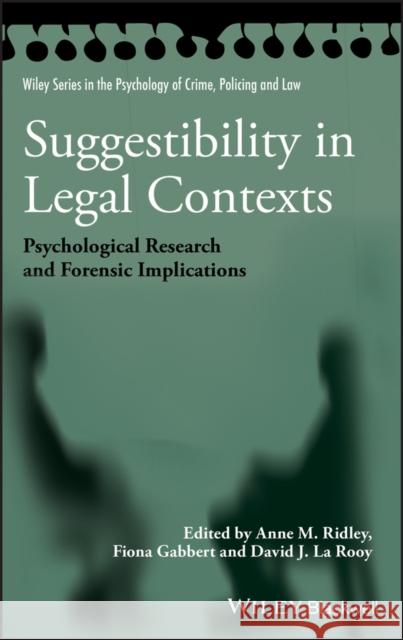
A comprehensive survey of the theory, research and forensic implications related to suggestibility in legal contexts that includes the latest research.
Provides a useful digest for academics and a trusted text for students of forensic and applied psychology
A vital resource for legal practitioners who need to familiarize themselves with the subject
Includes practical suggestions for minimizing witness suggestibility in interviews
Features topics that focus on suggestibility at each stage - from witnessing a crime through to trial
1 Suggestibility: A History and Introduction 1 Anne M. Ridley
2 The Misinformation Effect: Past Research and Recent Advances 21 Quin M. Chrobak and Maria S. Zaragoza
3 Interrogative Suggestibility and Compliance 45 Gisli H. Gudjonsson
4 Suggestibility and Memory Conformity 63 Fiona Gabbert and Lorraine Hope
5 Suggestibility and Individual Differences: Psychosocial and Memory Measures 85 Anne M. Ridley and Gisli H. Gudjonsson
6 Recovered Memories and Suggestibility for Entire Events 107 James Ost
7 Suggestibility and Individual Differences in Typically Developing and Intellectually Disabled Children 129 Kamala London, Lucy A. Henry, Travis Conradt and Ryan Corser
8 Suggestibility in Vulnerable Groups: Witnesses with Intellectual Disability, Autism Spectrum Disorder, and Older People 149 Katie L. Maras and Rachel Wilcock
9 Acute Suggestibility in Police Interrogation: Self–regulation Failure as a Primary Mechanism of Vulnerability 171 Deborah Davis and Richard A. Leo
10 Suggestibility and Witness Interviewing using the Cognitive Interview and NICHD Protocol 197 David J. La Rooy, Deirdre Brown and Michael E. Lamb
11 Suggestibility in Legal Contexts: What Do We Know? 217 Anne M. Ridley, Fiona Gabbert and David J. La Rooy
Index 229
Anne Ridley is Principal Lecturer in Psychology at London South Bank University, UK, with particular interest in individual differences in witness suggestibility as well as strategies for supporting vulnerable witnesses in the legal system. In 2008 she was awarded a National Teaching Fellowship by the Higher Education Academy.
Fiona Gabbert is a Reader in Psychology at the University of Abertay Dundee, UK. She is an expert in the area of social influences on memory, and has published widely on this topic, including a chapter on memory conformity in the current book. Another of Fiona s interests is developing methods to obtain reliable evidence from eyewitnesses. She received an Academic Excellence Award for Outstanding Achievements in the Area of Investigative Interviewing in 2011.
David La Rooy is a Reader in Psychology at the University of Abertay Dundee, UK. He is also a Scottish Institute for Policing Research Lecturer and his research focuses on issues surrounding the forensic interviewing of children. He teaches evidence–based investigative–interviewing and oversees the university s degree course in Forensic Psychobiology.
Suggestibility in Legal Contexts is a comprehensive guide to the theory, research and forensic implications related to suggestibility in legal contexts. It traces the history of the topic from the early twentieth century to the present, including its post–1970s resurgence after the publication of the seminal research of Elizabeth Loftus.
The text engages with the investigative and theoretical controversies that have attended the subject, including controversial topics such as recovered memories of childhood sexual abuse in adulthood, and coerced or false confessions.
Core chapters are structured thematically and cover salient aspects of the field such as research on immediate versus delayed suggestibility; memory conformity and the relationship between suggestibility and vulnerability factors including age, intellectual disabilities, personality and memory. The text also outlines witness interview techniques that can reduce the effect of suggested evidence in legal cases.