• Wyszukiwanie zaawansowane
  • Kategorie
  • Kategorie BISAC
  • Książki na zamówienie
  • Promocje
  • Granty
  • Książka na prezent
  • Opinie
  • Pomoc
  • Załóż konto
  • Zaloguj się

Substantive Bias and Natural Classes: An Empirical Approach » książka

zaloguj się | załóż konto
Logo Krainaksiazek.pl

koszyk

konto

szukaj
topmenu
Księgarnia internetowa
Szukaj
Książki na zamówienie
Promocje
Granty
Książka na prezent
Moje konto
Pomoc
 
 
Wyszukiwanie zaawansowane
Pusty koszyk
Bezpłatna dostawa dla zamówień powyżej 20 złBezpłatna dostawa dla zamówień powyżej 20 zł

Kategorie główne

• Nauka
 [2949965]
• Literatura piękna
 [1857847]

  więcej...
• Turystyka
 [70818]
• Informatyka
 [151303]
• Komiksy
 [35733]
• Encyklopedie
 [23180]
• Dziecięca
 [617748]
• Hobby
 [139972]
• AudioBooki
 [1650]
• Literatura faktu
 [228361]
• Muzyka CD
 [398]
• Słowniki
 [2862]
• Inne
 [444732]
• Kalendarze
 [1620]
• Podręczniki
 [167233]
• Poradniki
 [482388]
• Religia
 [509867]
• Czasopisma
 [533]
• Sport
 [61361]
• Sztuka
 [243125]
• CD, DVD, Video
 [3451]
• Technologie
 [219309]
• Zdrowie
 [101347]
• Książkowe Klimaty
 [123]
• Zabawki
 [2362]
• Puzzle, gry
 [3791]
• Literatura w języku ukraińskim
 [253]
• Art. papiernicze i szkolne
 [7933]
Kategorie szczegółowe BISAC

Substantive Bias and Natural Classes: An Empirical Approach

ISBN-13: 9789811335334 / Angielski / Twarda / 2019 / 122 str.
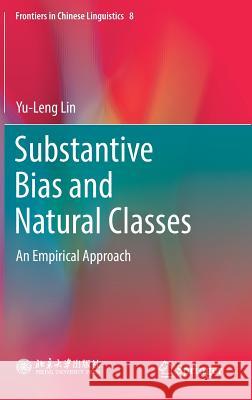
Yu-Leng Lin
Substantive Bias and Natural Classes: An Empirical Approach Lin, Yu-Leng 9789811335334 Springer - książkaWidoczna okładka, to zdjęcie poglądowe, a rzeczywista szata graficzna może różnić się od prezentowanej.

Substantive Bias and Natural Classes: An Empirical Approach

ISBN-13: 9789811335334 / Angielski / Twarda / 2019 / 122 str.

Yu-Leng Lin
cena 201,72
(netto: 192,11 VAT:  5%)

Najniższa cena z 30 dni: 192,74
Termin realizacji zamówienia:
ok. 22 dni roboczych
Bez gwarancji dostawy przed świętami

Darmowa dostawa!

This book offers a laboratory phonological analysis of the sonority hierarchy and natural classes in nasal harmony using an artificial grammar-learning paradigm. It is aimed at postgraduate students and linguists in general whose research interests lie in phonology, phonetics, and/or psycholinguistics. It is useful for linguists who are struggling to figure out how to effectively design an artificial phonological grammar and those who have not designed experiments on their own but would like to do so as an additional means to testing linguistic theories. This book is also a valuable resource for anyone building crosslinguistic artificial grammar paradigm resources.


Kategorie:
Nauka, Językoznawstwo
Kategorie BISAC:
Language Arts & Disciplines > Linguistics - Phonetics & Phonology
Wydawca:
Springer
Seria wydawnicza:
Frontiers in Chinese Linguistics
Język:
Angielski
ISBN-13:
9789811335334
Rok wydania:
2019
Wydanie:
2019
Ilość stron:
122
Waga:
0.38 kg
Wymiary:
23.5 x 15.5
Oprawa:
Twarda
Wolumenów:
01
Dodatkowe informacje:
Wydanie ilustrowane

Chapter 1 Introduction
1.1 Universal implicational nasalized segment hierarchy
1.2 Artificial grammar learning paradigm as the methodology
1.3 Outline of the current study
Chapter 2 An introduction to Vowel-consonant nasal harmony
2.1 Typology of nasal vowel-consonant harmony
2.2 Nasal vowel-consonant harmony with opaque segments
2.3 Predictions of the nasalized segment hierarchy
Chapter 3 Introduction to artificial goals and challenges
3.1 Assumptions of artificial grammar learning: poverty of the stimulus
3.2 Natural markedness and substantive bias
3.2.1 Implicational universals in substantive bias
3.2.2 Statistical tendencies
3.2.3 Robustness and learnability
3.2.4 Summary
3.3 Artificial grammar studies in substance bias
3.3.1 Implicational universals involving a substance bias: palatalization
3.3.1.1 Fronting effect
3.3.1.2 Experimental design
3.3.1.3 Procedure
3.3.1.4 Results and analysis
3.3.2 Implicational universals involving a formal complexity bias: sibilant harmony
3.3.3 Implicational universals involving a substantive bias: round vowel harmony
3.3.4 Sonority hierarchy
3.3.5 Implicational universals: natural classes/features
3.3.5.1 Nasal assimilation and dissimilation
3.3.5.2 Height-voice and voice-voice
3.3.6 Summary
3.4 Formal complexity bias
3.4.1 Domain-general: attribute-based object classification
3.4.1.1 Contiguity-similarity tradeoff
3.4.1.2 Feature agreement
3.4.2 Domain-specific: natural language
3.5 Summary
Chapter 4 Experiment 1
4.1 Testing the prediction of learnability
4.2 Determining which grammar is learned better: learner types
4.3 Rationale of the current design
4.4 Methods
4.4.1 Language choice
4.4.1.1 Inventory, phonotactics and syllable shapes
4.4.1.2 Limited nasal spreading
4.4.1.3 Reasons for choosing S. Min speakers as participants
4.4.2 Design
4.4.2.1 Shapes of words and syllable forms
4.4.2.2 Stimuli
4.4.2.3 Task
4.4.2.4 Exposure and test phases
4.4.2.5 Post-test and post-interview
4.4.3 Participants
4.4.4 Procedure
4.5 Grouped statistics: Patterns 1 and 2
4.6 Individual learner types
4.7 Individual data: Patterns 1 (S(k)→W(k)) and 2 (W(k)→S(k))
4.7.1 Categorization learner-generalizer
4.7.2 Categorization learner-generalized (opposite)
4.7.3 Categorization learner-pattern learner
4.7.4 Statistical learner-positional statistician
4.7.5 Statistical learner-unbound nasalizer
4.8 Discussion: learner types
4.8.1 Possibility 1: reference to the sonority hierarchy type
4.8.2 Possibility 2: reference to sonority natural classes
4.8.3 Possibility 3: floor effect
4.8.4 Possibility 4: game strategy
4.8.5 Possibility 1 vs. Possibility 2
4.9 Follow-up experiments:
4.9.1 Hypothesis 1: game strategy
4.9.2 Hypothesis 2: phonological processes
4.9.3 Hypothesis 3: floor effect
4.10 Methods
4.10.1 Participants
4.11 Grouped statistics: Patterns 3 kt(S) and 4 kt(W)
4.12 Individual data: Patterns 3 kt(S) and 4 kt(W)
4.13 General discussion: Patterns 1-4
4.13.1 Inferential statistics
4.13.2 Learner types
4.14 Discussion: interactive approach vs. pure sonority natural classes
4.15 Summary
Chapter 5 Experiment 2: sonority effects
5.1 Predictions: directionality (sonority hierarchy type)
5.2 Sonority natural classes:
5.3 Continuancy
5.4 Summary
5.5 Methods
5.5.1 Materials
5.5.2 Participants
5.6 Testing directionality (sonority hierarchy type): Patterns 3-6
5.7 Testing directionality (sonority hierarchy): Patterns 7 and 8
5.8 Testing sonority natural classes: learner type (Patterns 5 & 6)
5.9 Testing sonority natural classes: learner type (Patterns 7 & 8)
5.10 Testing the continuancy natural class hypothesis
5.11 Summary
5.12 Confound: place of articulation
5.12.1 Testing place natural classes
5.13 Summary: Patterns 1-8
Chapter 6 Conclusions
6.1 Summary of the monograph
6.2 Testing a language with sonority hierarchy effects
6.3 Hierarchy and natural classes
6.4 Could participants learn any patterns?
6.5 Exposure and robustness
6.6 Conclusion
References
Appendix I
Appendix II

​Yu-Leng Lin is an Assistant Professor in the Department of Foreign Languages and Literature at the Feng Chia University. She received her PhD degree from the Department of Linguistics at the University of Toronto in 2016. Before joining the Feng Chia University, she served as a postdoctoral fellow in the Hong Kong Polytechnic University’s Department of Chinese and Bilingual Studies. Her research interests include psycholinguistics, Chinese linguistics, laboratory phonology, and sociophonetics. Her publications include a journal paper, a book chapter and conference proceedings, and she has presented her work – ranging from learning bias, speech perception and production, tonal studies, and comparative studies among Mandarin, Taiwan Southern Min, Cantonese, and English – at several international conferences.

This book offers a laboratory phonological analysis of the sonority hierarchy and natural classes in nasal harmony using an artificial grammar-learning paradigm. It is aimed at postgraduate students and linguists in general whose research interests lie in phonology, phonetics, and/or  psycholinguistics. It is useful for linguists who are struggling to figure out how to effectively design an artificial phonological grammar and those who have not designed experiments on their own but would like to do so as an additional means to testing linguistic theories. This book is also a valuable resource for anyone building crosslinguistic artificial grammar paradigm resources.




Udostępnij

Facebook - konto krainaksiazek.pl


Opinie o Krainaksiazek.pl na Opineo.pl

Partner Mybenefit

Krainaksiazek.pl w programie rzetelna firma Krainaksiaze.pl - płatności przez paypal

Czytaj nas na:

Facebook - krainaksiazek.pl
  • książki na zamówienie
  • granty
  • książka na prezent
  • kontakt
  • pomoc
  • opinie
  • regulamin
  • polityka prywatności

Zobacz:

  • Księgarnia czeska

  • Wydawnictwo Książkowe Klimaty

1997-2025 DolnySlask.com Agencja Internetowa

© 1997-2022 krainaksiazek.pl
     
KONTAKT | REGULAMIN | POLITYKA PRYWATNOŚCI | USTAWIENIA PRYWATNOŚCI
Zobacz: Księgarnia Czeska | Wydawnictwo Książkowe Klimaty | Mapa strony | Lista autorów
KrainaKsiazek.PL - Księgarnia Internetowa

Polityka prywatnosci - link
Krainaksiazek.pl - płatnośc Przelewy24
Przechowalnia Przechowalnia





