• Wyszukiwanie zaawansowane
  • Kategorie
  • Kategorie BISAC
  • Książki na zamówienie
  • Promocje
  • Granty
  • Książka na prezent
  • Opinie
  • Pomoc
  • Załóż konto
  • Zaloguj się

Studies in Inductive Probability and Rational Expectation » książka


zaloguj się | załóż konto
Logo Krainaksiazek.pl

koszyk

konto

szukaj
topmenu
Księgarnia internetowa
Szukaj
Książki na zamówienie
Promocje
Granty
Książka na prezent
Moje konto
Pomoc
 
 
Wyszukiwanie zaawansowane
Pusty koszyk
Bezpłatna dostawa dla zamówień powyżej 20 złBezpłatna dostawa dla zamówień powyżej 20 zł

Kategorie główne

• Nauka
 [2952079]
• Literatura piękna
 [1850969]

  więcej...
• Turystyka
 [71058]
• Informatyka
 [151066]
• Komiksy
 [35579]
• Encyklopedie
 [23181]
• Dziecięca
 [620496]
• Hobby
 [139036]
• AudioBooki
 [1646]
• Literatura faktu
 [228729]
• Muzyka CD
 [379]
• Słowniki
 [2932]
• Inne
 [445708]
• Kalendarze
 [1409]
• Podręczniki
 [164793]
• Poradniki
 [480107]
• Religia
 [510956]
• Czasopisma
 [511]
• Sport
 [61267]
• Sztuka
 [243299]
• CD, DVD, Video
 [3411]
• Technologie
 [219640]
• Zdrowie
 [100984]
• Książkowe Klimaty
 [124]
• Zabawki
 [2281]
• Puzzle, gry
 [3363]
• Literatura w języku ukraińskim
 [258]
• Art. papiernicze i szkolne
 [8020]
Kategorie szczegółowe BISAC

Studies in Inductive Probability and Rational Expectation

ISBN-13: 9789400998322 / Angielski / Miękka / 2014 / 154 str.
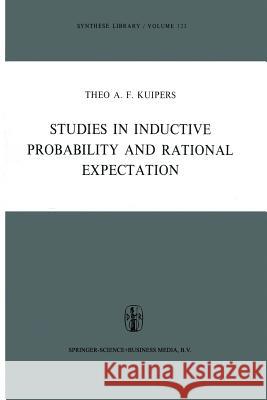
Theo A.F. Kuipers
Studies in Inductive Probability and Rational Expectation Theo A.F. Kuipers 9789400998322 Springer - książkaWidoczna okładka, to zdjęcie poglądowe, a rzeczywista szata graficzna może różnić się od prezentowanej.

Studies in Inductive Probability and Rational Expectation

ISBN-13: 9789400998322 / Angielski / Miękka / 2014 / 154 str.

Theo A.F. Kuipers
cena 201,72
(netto: 192,11 VAT:  5%)

Najniższa cena z 30 dni: 192,74
Termin realizacji zamówienia:
ok. 22 dni roboczych.

Darmowa dostawa!

3 in philosophy, and therefore in metaphilosophy, cannot be based on rules that avoid spending time on pseudo-problems. Of course, this implies that, if one succeeds in demonstrating convincingly the pseudo-character of a problem by giving its 'solution', the time spent on it need not be seen as wasted. We conclude this section with a brief statement of the criteria for concept explication as they have been formulated in several places by Carnap, Hempel and Stegmiiller. Hempel's account ([13J, Chapter 1) is still very adequate for a detailed introduction. The process of explication starts with the identification of one or more vague and, perhaps, ambiguous concepts, the so-called explicanda. Next, one tries to disentangle the ambiguities. This, however, need not be possible at once. Ultimately the explicanda are to be replaced (not necessarily one by one) by certain counterparts, the so-called explicata, which have to conform to four requirements. They have to be as precise as possible and as simple as possible. In addition, they have to be useful in the sense that they give rise to the formulation of theories and the solution of problems. The three requirements of preciseness, simplicity and usefulness. have of course to be pursued in all concept formation.


Kategorie:
Nauka, Biologia i przyroda
Kategorie BISAC:
Philosophy > Logic
Science > Philosophy & Social Aspects
Wydawca:
Springer
Seria wydawnicza:
Synthese Library
Język:
Angielski
ISBN-13:
9789400998322
Rok wydania:
2014
Dostępne języki:
Angielski
Wydanie:
Softcover Repri
Numer serii:
000171709
Ilość stron:
154
Waga:
0.26 kg
Wymiary:
22.922.9 x 15.2
Oprawa:
Miękka
Wolumenów:
01

1. Introduction.- 1. Concept Explication.- 2. Objectives and Survey.- 2. Cognitive Rationality.- 1. On the Explication of the Concept of Rationality.- 2. Cognitive Rationality and Patterns of Expectation.- 3. Inductive Reasoning and Inductive Probability Theory.- 3. Logico-Mathematical Preliminaries.- 1. Logical Vocabulary.- 2. Set-theoretical Vocabulary.- 3. Some Elements of Probability Theory.- 4. Formally Rational Expectation in a Paradigmatic Context.- 1. Paradigmatic Contexts.- 2. Two Conditions for Rational Expectation.- 3. A Framework for a Paradigmatic Context.- 4. First Analysis of a Rational Expectation Pattern.- 5. A Framework for a Paradigmatic Context (continued).- 6. Third Formal Condition for Rational Expectation.- 7. Decidable Contexts.- 5. Generalized Carnapian Systems.- 1. Introduction.- 2. Constitutive Principles and Definition of GC-systems.- 3. General Analysis of GC-systems.- 1. Some Direct Consequences.- 2. Generalized Special Values.- 3. First Interpretation of GC-systems: the Urn-model (w < ?).- 4. Mathematical Expectations According to GC-systems.- 5. Non-inductive (? = ± ?) and Extreme-inductive (? = 0) GC-systems.- 6. Carnapian Systems (C-systems).- 4. Analysis of Positive Inductive GC-systems (0 < ? < oo).- 1. Possible Reformulations.- 2. Generalized Special Values as Weighted Means.- 3. Second Interpretation of GC-systems: Repeated Experiments Governed by a Density-function (w < ?).- 4. Principle of Structural Indifference (w < ?): C *- systems (? = w).- 5. Analysis of Negative Inductive GC-systems (? < 0).- 1. Possible Reformulations.- 2. Generalized Special Values as Weighted Means (continued).- 3. Hypergeometric Systems.- Appendix to Section 2 (Proof of T2).- 6. Hintikka and Universalized Carnapian Systems.- 1. Introduction.- 2. NH-systems.- 3. Hintikka-systems (H-systems).- 4. Some Fundamental Properties of H-systems.- 5. An Urn-model for H-systems.- 6. The Equivalence of NH- and SH-systems: Universalized Carnapian systems (UC-systems).- 7. Analysis of UC-systems.- 1. General.- 2. Structurally Indifferent UC-systems: UC*-systems (? = 1).- 3. Extreme UC-systems: ? = ?, ? = 0.- 8. Fundamental Discussion Related to Applications.- 9. Finite Parameters for H-systems.- 10. Reformulation of H-systems; k ? ?.- 11. GH-systems and G UC-systems.- 12. Survey of Systems.- Appendix to Section 2 (Proof of T1 ).- 7. Rational Expectation in Multinomial Contexts.- 1. Carnap’s Intended Application.- 2. The Multinomial Context.- 3. Formally Rational Patterns for Open Multinomial Contexts.- 4. Material Conditions of Adequacy; UC-systems as Expectation Pattern for Open Multinomial Contexts.- 5. Constitutional Distributions for Open Multinomial Contexts.- 6. The Hypergeometric Context.- 8. Some Problems and Related Topics.- 1. PER-systems.- 2. On Weakening WPERR.- 3. *UC*-systems and k ? ?.- 4. Confirmation Theory.- 5. Falsification.- 6. Rules of Acceptance in UC-systems.- 9. Concluding Remarks.- References.- Index of Names.- Index of Subjects.- Recurring Symbols.- Conditions/Principles/Axioms.- Definition of Systems.

Professor Theo Kuipers is the author of From Instrumentalism to Constructive Realism (Synthese Library 287, 2000). He is the leader of the Groningen Research Group `Cognitive Structures in Knowledge and Knowledge Development', which gained the highest possible scores in two successive assessments of Dutch philosophical research by international committees.


Udostępnij

Facebook - konto krainaksiazek.pl


Opinie o Krainaksiazek.pl na Opineo.pl

Partner Mybenefit

Krainaksiazek.pl w programie rzetelna firma Krainaksiaze.pl - płatności przez paypal

Czytaj nas na:

Facebook - krainaksiazek.pl
  • książki na zamówienie
  • granty
  • książka na prezent
  • kontakt
  • pomoc
  • opinie
  • regulamin
  • polityka prywatności

Zobacz:

  • Księgarnia czeska

  • Wydawnictwo Książkowe Klimaty

1997-2026 DolnySlask.com Agencja Internetowa

© 1997-2022 krainaksiazek.pl
     
KONTAKT | REGULAMIN | POLITYKA PRYWATNOŚCI | USTAWIENIA PRYWATNOŚCI
Zobacz: Księgarnia Czeska | Wydawnictwo Książkowe Klimaty | Mapa strony | Lista autorów
KrainaKsiazek.PL - Księgarnia Internetowa

Polityka prywatnosci - link
Krainaksiazek.pl - płatnośc Przelewy24
Przechowalnia Przechowalnia





