• Wyszukiwanie zaawansowane
  • Kategorie
  • Kategorie BISAC
  • Książki na zamówienie
  • Promocje
  • Granty
  • Książka na prezent
  • Opinie
  • Pomoc
  • Załóż konto
  • Zaloguj się

Structure-Function Relations of Warm Desert Plants » książka


zaloguj się | załóż konto
Logo Krainaksiazek.pl

koszyk

konto

szukaj
topmenu
Księgarnia internetowa
Szukaj
Książki na zamówienie
Promocje
Granty
Książka na prezent
Moje konto
Pomoc
 
 
Wyszukiwanie zaawansowane
Pusty koszyk
Bezpłatna dostawa dla zamówień powyżej 20 złBezpłatna dostawa dla zamówień powyżej 20 zł

Kategorie główne

• Nauka
 [2949965]
• Literatura piękna
 [1857847]

  więcej...
• Turystyka
 [70818]
• Informatyka
 [151303]
• Komiksy
 [35733]
• Encyklopedie
 [23180]
• Dziecięca
 [617748]
• Hobby
 [139972]
• AudioBooki
 [1650]
• Literatura faktu
 [228361]
• Muzyka CD
 [398]
• Słowniki
 [2862]
• Inne
 [444732]
• Kalendarze
 [1620]
• Podręczniki
 [167233]
• Poradniki
 [482388]
• Religia
 [509867]
• Czasopisma
 [533]
• Sport
 [61361]
• Sztuka
 [243125]
• CD, DVD, Video
 [3451]
• Technologie
 [219309]
• Zdrowie
 [101347]
• Książkowe Klimaty
 [123]
• Zabawki
 [2362]
• Puzzle, gry
 [3791]
• Literatura w języku ukraińskim
 [253]
• Art. papiernicze i szkolne
 [7933]
Kategorie szczegółowe BISAC

Structure-Function Relations of Warm Desert Plants

ISBN-13: 9783642646386 / Angielski / Miękka / 2011 / 216 str.
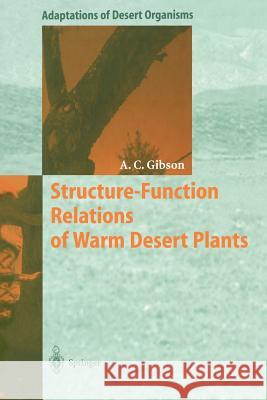
Arthur C. Gibson
Structure-Function Relations of Warm Desert Plants Arthur C. Gibson 9783642646386 Springer - książkaWidoczna okładka, to zdjęcie poglądowe, a rzeczywista szata graficzna może różnić się od prezentowanej.

Structure-Function Relations of Warm Desert Plants

ISBN-13: 9783642646386 / Angielski / Miękka / 2011 / 216 str.

Arthur C. Gibson
cena 443,82
(netto: 422,69 VAT:  5%)

Najniższa cena z 30 dni: 424,07
Termin realizacji zamówienia:
ok. 22 dni roboczych
Bez gwarancji dostawy przed świętami

Darmowa dostawa!

For centuries biologists have been extremely interested in the structure of desert plants as examples of natural selection to harsh environmental conditions. Indeed, desert plants are frequently used as examples in many biology classes and textbooks to illustrate natural selection, but this has led to an unfortunate litany of errors and misconceptions about desert plant adaptations.
This new synthesis focuses on plants of lowland tropical and subtropical arid deserts. Readers will be surprised to discover that many features commonly ascribed to desert plants are rareley observed in the most common species. Instead, the typical structural adaptations of nonsucculent warm desert plants are now viewed as ways to maximize photosynthetic rate.


Kategorie:
Nauka, Biologia i przyroda
Kategorie BISAC:
Science > Botanika
Science > Biologia i przyroda
Science > Life Sciences - Ecology
Wydawca:
Springer
Seria wydawnicza:
Adaptations of Desert Organisms
Język:
Angielski
ISBN-13:
9783642646386
Rok wydania:
2011
Wydanie:
Softcover Repri
Numer serii:
000034705
Ilość stron:
216
Waga:
0.36 kg
Wymiary:
23.5 x 15.5
Oprawa:
Miękka
Wolumenów:
01

"This book can be recommended to all researchers working on desert plants." Trends in Plant Sciences

1 Plant Life Forms of Warm Desert Climates.- 1.1 Distribution and Climates of Warm Deserts.- 1.2 Physiological Problems for Plants.- 1.2.1 Water and Heat Stress.- 1.2.2 Soil Characters.- 1.2.3 Wind and Flash-Flood Damage.- 1.3 Conceptual Models for Desert Plant Adaptations.- 1.3.1 Xerophyte and Similar Terms.- 1.3.2 Stress Resistance.- 1.3.3 Carbon Gain Models.- 1.4 Plants of Warm Deserts.- 1.4.1 Floras and Endemism.- 1.4.2 Primary Vegetation Types.- 1.4.3 Life Forms.- 1.4.3.1 Shrubs and Subshrubs with Drought-Deciduous Leaves.- 1.4.3.2 Evergreen Shrubs.- 1.4.3.3 Phreatophytes.- 1.4.3.4 Perennial Grasses.- 1.4.3.5 Ephemerals.- 1.4.3.6 Nonsucculent Aphyllous Shrubs and Trees.- 1.4.3.7 Stem and Leaf Succulents.- 1.4.3.8 Poikilohydric Cryptogams.- 1.4.3.9 Epiphytes and Mat-Forming Air Plants.- 1.4.3.10 Stem Mistletoes.- 2 Functional Morphology of Nonsucculent Leaves.- 2.1 Energy Balance of a Leaf.- 2.1.1 Absorptance as Influenced by Organ Orientation and Reflectance.- 2.1.2 Effects of Leaf Size and Form.- 2.1.3 Energy Storageand Metabolic Heat Production.- 2.2 Leaf Size.- 2.2.1 Microphylly.- 2.2.2 Broad Desert Leaves.- 2.2.3 Seasonal Heteroblasty.- 2.3 Encelia as a Model System.- 2.4 Structural Nature of Surface Reflectance.- 2.5 Leaf Orientation and Display.- 2.6 Leaf Rolling and Revolute Margins.- 3 Functional Morphology of Nonsucculent Leaves.- 3.1 Gas Diffusion Pathway.- 3.1.1 Water Vapor.- 3.1.2 Carbon Dioxide.- 3.1.3 Flux Density of Gases.- 3.1.4 Characteristics of Leaf Conductances.- 3.1.4.1 Leaf Boundary Layer Characteristics.- 3.1.4.2 Cuticle and Groundmass Epidermis.- 3.1.4.3 Stomata.- 3.1.4.4 Intercelluar Air Spaces.- 3.1.4.5 Liquid-Phase Conduction of C02.- 3.1.5 Factors Limiting Photosynthetic Rates at Saturated Photon Flux Density.- 3.1.5.1 Relative Effects of Parameters.- 3.1.5.2 C4 Physiology and Elimination of Photorespiration.- 3.1.6 Water-Use Efficiency.- 3.2 Physiological Anatomy of Nonsucculent Leaves of Desert Plants.- 3.2.1 Deciduous and Evergreen Shrubs.- 3.2.1.1 Groundmass Epidermis and Trichomes.- 3.2.1.2 Stomata.- 3.2.1.3 Mesophylla.- 3.2.2 Phyllodineous Acacias.- 3.2.3 Woody Dicotyledons with C4 Photosynthesis.- 3.3 Phreatophytes.- 3.3.1 Desert Palms.- 3.3.2 Tropical Dicotyledonous Trees.- 3.3.3 Welwitschia mirabilis.- 3.3.4 Temperate Trees and Shrubs.- 3.3.5 Saltcedars and Casuarina.- 3.4 Herbaceous Species.- 3.4.1 Perennial and Annual Grasses.- 3.4.2 Herbaceous Dicotyledons.- 3.4.3 Geophytes.- 3.4.4 Desert Springs.- 3.5 Fruit Photosynthesis.- 4 Photosynthetic Stems of Nonsucculent Plants.- 4.1 Functional Morphology.- 4.1.1 Energy Budget Considerations.- 4.1.2 Canopy Architecture and Phenology.- 4.2 Anatomy of Woody Plants.- 4.2.1 Epidermis.- 4.2.1.1 Delay in Periderm Formation.- 4.2.1.2 Composition.- 4.2.1.3 Surface Coverings.- 4.2.1.4 Stomata.- 4.2.2 Hypodermis.- 4.2.3 Chlorenchyma and Associated Sclerenchyma.- 4.2.4 Leaf Anatomy.- 4.3 Special Cases.- 4.3.1 Bark Photosynthesis of Cercidium.- 4.3.2 C4 Chenopodiaceae and Calligonum.- 4.3.3 Herbaceous Species.- 4.3.3.1 Solid Stems and Grass Culms.- 4.3.3.2 Inflated Stems.- 5 Succulent Photosynthetic Organs.- 5.1 General Properties of Succulent Photosynthetic Organs.- 5.1.1 Water Content.- 5.1.2 High Volume-to-Surface Ratio.- 5.1.3 Crassulacean Acid Metabolism.- 5.1.4 Epidermal Water Vapor Conductances.- 5.1.5 Stomatal Patterns.- 5.1.6 Chlorenchyma.- 5.1.7 Succulent Hydrostats.- 5.2 Taxon-Specific Adaptations.- 5.2.1 Aloe.- 5.2.2 Agave and Yucca.- 5.2.3 Windowed Leaves.- 5.2.4 Epidermis of Aizoaceae.- 5.2.5 Areoles and Spines of Cacti.- 5.2.6 Euphorbiaceaewith CAM Stem Photosynthesis.- 5.2.7 Stapelieae.- 5.2.8 Leaves of Crassulaceae.- 5.2.9 Fouquieriaceae.- 5.2.10 Elephant Trees, Pachycauls, and Caudiciforms.- 5.2.11 Asteraceae.- 5.3 Fleshy Leaves.- 6 Special Topics in Water Relations.- 6.1 Xerohalophytes.- 6.1.1 Vesiculated Trichomes of Atriplex.- 6.1.2 Excreting Salt Glands.- 6.1.3 Halophytic Succulence.- 6.1.4 Nolana mollis and Other Atacaman Shrubs.- 6.1.5 Crystal Deposition in Shoots.- 6.2 Water Uptake.- 6.2.1 Vesiculated Trichomes of Atriplex.- 6.2.1.1 Morphology and Depth.- 6.2.1.2 Structural Responses to Drought and Rewetting.- 6.2.2 Leaves and Stems.- 6.2.2.1 Bromeliaceae.- 6.2.2.2 Selaginella lepidophylla and Other Poikilohydric Plants.- 6.2.2.3 Water-Absorbing Stem Epidermis.- 6.2.3 Parasitic Vascular Plants.- 6.2.3.1 Mistletoes.- 6.2.3.2 Root Parasites.- 6.3 Vascular Tissues.- 6.3.1 Veins in Leaves.- 6.3.2 Secondary Xylem.- 6.3.2.1 Shrubs and Subshrubs with Drought-Deciduous Leaves.- 6.3.2.2 Evergreen Shrubs.- 6.3.2.3 Phreatophytes.- 6.3.2.4 Nonsucculent Aphyllous Shrubs and Trees.- 6.3.2.5 Succulents.- 6.3.2.6 Herbaceous Angiosperms.- 6.3.3 Split Axis.- 6.3.4 Anomalous Secondary Thickening.- 6.3.5 Ground Tissues.- 7 Origins of Desert Structural Adaptations.- 7.1 Where Desert Adaptations Evolved.- 7.2 Warm Desert Versus Semiarid Habitats.- 7.2.1 Leaves.- 7.2.2 Wood.- 7.2.3 Ontogeny of Desert Shoots.- 7.3 Future Directions of Structure-Function Research.- References.- Taxonomic Index.

Desert plants are exposed to harsh environmental conditions, such as heat, drought, intense solar radiation, and strong winds. The book analyses the structural adaptations of these plants that allow them to survive.


Udostępnij

Facebook - konto krainaksiazek.pl


Opinie o Krainaksiazek.pl na Opineo.pl

Partner Mybenefit

Krainaksiazek.pl w programie rzetelna firma Krainaksiaze.pl - płatności przez paypal

Czytaj nas na:

Facebook - krainaksiazek.pl
  • książki na zamówienie
  • granty
  • książka na prezent
  • kontakt
  • pomoc
  • opinie
  • regulamin
  • polityka prywatności

Zobacz:

  • Księgarnia czeska

  • Wydawnictwo Książkowe Klimaty

1997-2025 DolnySlask.com Agencja Internetowa

© 1997-2022 krainaksiazek.pl
     
KONTAKT | REGULAMIN | POLITYKA PRYWATNOŚCI | USTAWIENIA PRYWATNOŚCI
Zobacz: Księgarnia Czeska | Wydawnictwo Książkowe Klimaty | Mapa strony | Lista autorów
KrainaKsiazek.PL - Księgarnia Internetowa

Polityka prywatnosci - link
Krainaksiazek.pl - płatnośc Przelewy24
Przechowalnia Przechowalnia





