• Wyszukiwanie zaawansowane
  • Kategorie
  • Kategorie BISAC
  • Książki na zamówienie
  • Promocje
  • Granty
  • Książka na prezent
  • Opinie
  • Pomoc
  • Załóż konto
  • Zaloguj się

Structural Reliability: Statistical Learning Perspectives » książka


zaloguj się | załóż konto
Logo Krainaksiazek.pl

koszyk

konto

szukaj
topmenu
Księgarnia internetowa
Szukaj
Książki na zamówienie
Promocje
Granty
Książka na prezent
Moje konto
Pomoc
 
 
Wyszukiwanie zaawansowane
Pusty koszyk
Bezpłatna dostawa dla zamówień powyżej 20 złBezpłatna dostawa dla zamówień powyżej 20 zł

Kategorie główne

• Nauka
 [2946600]
• Literatura piękna
 [1856966]

  więcej...
• Turystyka
 [72221]
• Informatyka
 [151456]
• Komiksy
 [35826]
• Encyklopedie
 [23190]
• Dziecięca
 [619653]
• Hobby
 [140543]
• AudioBooki
 [1577]
• Literatura faktu
 [228355]
• Muzyka CD
 [410]
• Słowniki
 [2874]
• Inne
 [445822]
• Kalendarze
 [1744]
• Podręczniki
 [167141]
• Poradniki
 [482898]
• Religia
 [510455]
• Czasopisma
 [526]
• Sport
 [61590]
• Sztuka
 [243598]
• CD, DVD, Video
 [3423]
• Technologie
 [219201]
• Zdrowie
 [101638]
• Książkowe Klimaty
 [124]
• Zabawki
 [2473]
• Puzzle, gry
 [3898]
• Literatura w języku ukraińskim
 [254]
• Art. papiernicze i szkolne
 [8170]
Kategorie szczegółowe BISAC

Structural Reliability: Statistical Learning Perspectives

ISBN-13: 9783540219637 / Angielski / Twarda / 2004 / 257 str.
Jorge E. Hurtado; J. E. Hurtado
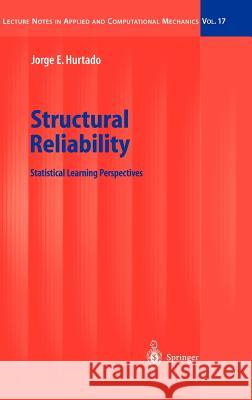
Structural Reliability: Statistical Learning Perspectives Hurtado, Jorge Eduardo 9783540219637 Springer - książkaWidoczna okładka, to zdjęcie poglądowe, a rzeczywista szata graficzna może różnić się od prezentowanej.

Structural Reliability: Statistical Learning Perspectives

ISBN-13: 9783540219637 / Angielski / Twarda / 2004 / 257 str.

Jorge E. Hurtado; J. E. Hurtado
cena 605,23 zł
(netto: 576,41 VAT:  5%)

Najniższa cena z 30 dni: 578,30 zł
Termin realizacji zamówienia:
ok. 22 dni roboczych
Bez gwarancji dostawy przed świętami

Darmowa dostawa!

The last decades have witnessed the development of methods for solving struc- tural reliability problems, which emerged from the efforts of numerous re- searchers all over the world. For the specific and most common problem of determining the probability of failure of a structural system in which the limit state function g( x) = 0 is only implicitly known, the proposed methods can be grouped into two main categories: - Methods based on the Taylor expansion of the performance function g(x) about the most likely failure point (the design point), which is determined in the solution process. These methods are known as FORM and SORM (First- and Second Order Reliability Methods, respectively). - Monte Carlo methods, which require repeated calls of the numerical (nor- mally finite element) solver of the structural model using a random real- ization of the basic variable set x each time. In the first category of methods only SORM can be considered of a wide applicability. However, it requires the knowledge of the first and second deriva- tives of the performance function, whose calculation in several dimensions either implies a high computational effort when faced with finite difference techniques or special programs when using perturbation techniques, which nevertheless require the use of large matrices in their computations. In or- der to simplify this task, use has been proposed of techniques that can be regarded as variants of the Response Surface Method.


Kategorie:
Technologie
Kategorie BISAC:
Technology & Engineering > Mechanical
Computers > Artificial Intelligence - General
Technology & Engineering > Engineering (General)
Wydawca:
Springer
Seria wydawnicza:
Lecture Notes
Język:
Angielski
ISBN-13:
9783540219637
Rok wydania:
2004
Wydanie:
2004
Numer serii:
000013113
Ilość stron:
257
Waga:
1.25 kg
Wymiary:
23.5 x 15.5
Oprawa:
Twarda
Wolumenów:
01

From the reviews:

"The methods presented and exemplified in the book are what in the statistical world would be called nonlinear and nonparametric regression or pattern recognition techniques ... . The book is written from an algorithmic perspective ... . the book is a valuable overview of problems and techniques used in structural safety analysis." (Georg Lindgren, Mathematical Reviews, Issue 2006 h)

1 A Discussion on Structural Reliability Methods.- 1.1 Performance and Limit State Functions.- 1.2 Methods Based on the Limit State Function.- 1.3 Transformation of Basic Variables.- 1.3.1 Normal Variables.- 1.3.2 Normal Translation.- 1.3.3 Rosenblatt Transformation.- 1.3.4 Nataf Transformation.- 1.3.5 Polynomial Chaoses.- 1.4 FORM and SORM.- 1.4.1 Basic Equations.- 1.4.2 Discussion.- 1.5 Monte Carlo Methods.- 1.5.1 Importance Sampling.- 1.5.2 Directional Simulation.- 1.5.3 General Characteristics of Simulation Methods.- 1.6 Solver Surrogate Methods.- 1.6.1 Response Surface Method.- 1.6.2 Neural Networks and Support Vector Machines.- 1.6.3 Characteristics of the Response Surface Method.- 1.7 Regression and Classification.- 1.8 FORM and SORM Approximations with Statistical Learning Devices.- 1.9 Methods Based on the Performance Function.- 1.10 Summary.- 2 Fundamental Concepts of Statistical Learning.- 2.1 Introduction.- 2.2 The Basic Learning Problem.- 2.3 Cost and Risk Functions.- 2.4 The Regularization Principle.- 2.5 Complexity and Vapnik-Chervonenkis Dimension.- 2.6 Error Bounds and Structured Risk Minimization.- 2.7 Risk Bounds for Regression.- 2.8 Stringent and Adaptive Models.- 2.9 The Curse of Dimensionality.- 2.10 Dimensionality Increase.- 2.11 Sample Complexity.- 2.12 Selecting a Learning Method in Reliability Analysis.- 2.12.1 Classification Techniques.- 2.12.2 Remarks on Probability Density Estimation.- 2.12.3 Characteristics of Samples in Structural Reliability.- 2.12.4 A Look from the Viewpoint of Information Theory.- 2.12.5 Recommended Methods.- 3 Dimension Reduction and Data Compression.- 3.1 Introduction.- 3.2 Principal Component Analysis.- 3.3 Kernel PCA.- 3.3.1 Basic Equations.- 3.3.2 Kernel Properties and Construction.- 3.3.3 Example 1: Structure of a Monte Carlo Cloud..- 3.3.4 Example 2: Transformation of Reliability Problems.- 3.4 Karhunen-Loève Expansion.- 3.5 Discrete Wavelet Transform..- 3.6 Data Compression Techniques..- 3.6.1 Vector Quantization.- 3.6.2 Expectation-Maximization..- 4 Classification Methods I — Neural Networks.- 4.1 Introduction.- 4.2 Probabilistic and Euclidean methods.- 4.2.1 Bayesian Classification.- 4.2.2 Classification Trees.- 4.2.3 Concluding Remarks.- 4.3 Multi-Layer Perceptrons..- 4.3.1 Hyperplane Discrimination.- 4.3.2 Polyhedral Discrimination.- 4.4 General Nonlinear Two-Layer Perceptrons.- 4.4.1 Training Algorithms.- 4.4.2 Example.- 4.4.3 Complexity and Dimensionality Issues.- 4.5 Radial Basis Function Networks.- 4.5.1 Approximation Properties.- 4.5.2 A First Comparison of MLP and RBFN.- 4.6 Elements of a General Training Algorithm.- 5 Classification Methods II — Support Vector Machines.- 5.1 Introduction.- 5.2 Support Vector Machines.- 5.2.1 Linearly Separable Classes..- 5.2.2 Nonlinear Separation.- 5.2.3 Solution of the Optimization Problem..- 5.3 A Remark on Polynomial Chaoses.- 5.4 Genetic Algorithm..- 5.4.1 General Considerations..- 5.4.2 Algorithm.- 5.5 Active Learning Algorithms.- 5.5.1 Algorithm Based on Margin Shrinking.- 5.5.2 Algorithm Based on Version Space Shrinking.- 5.6 A Comparison with Neural Classifiers.- 5.7 Complexity, Dimensionality and Induction of SV Machines.- 5.8 Application Examples.- 5.8.1 Parabolic Limit State Function.- 5.8.2 A Linear Limit State Function with Nonlinear Performance Function.- 5.8.3 Two- and Twenty-Dimensional SORM Functions.- 5.8.4 Ten Dimensional Problem.- 5.8.5 An Application of the Version Space Algorithm.- 5.8.6 Bound of the VC Dimension of the SORM Function.- 5.9 An Application to Stochastic Stability.- 5.9.1 Asymptotic Moment Stability.- 5.9.2 Numerical Example.- 5.10 Other Kernel Classification Algorithms.- 6 Regression Methods.- 6.1 Introduction.- 6.2 The Response Surface Method Revisited.- 6.2.1 Dimensionality Problems.- 6.2.2 Performance Function Approximation.- 6.2.3 Naive Inductive Principle.- 6.3 Neural Networks.- 6.3.1 Boosting.- 6.3.2 A Second Comparison of MLP and RBFN.- 6.3.3 Example: Full Probabilistic Analysis with Stochastic Finite Elements.- 6.4 Support Vector Regression.- 6.4.1 Support Vector Approach to Non-Separable Classes.- 6.4.2 Extension to Function Approximation..- 6.4.3 Example: Random Eigenvalues of a Frame.- 6.5 Time-Dependent MLP for Random Vibrations.- 7 Classification Approaches to Reliability Indexation.- 7.1 Introduction.- 7.2 A Discussion on Reliability Indices.- 7.3 A Comparison of Hyperplane Approximations.- 7.4 Secant Hyperplane Reliability Index.- 7.4.1 Index Properties.- 7.5 Volumetric Reliability Index.- 7.5.1 Derivation of the Index.- 7.5.2 Index Properties.- References.- Essential Symbols.

This monograph presents an original approach to Structural Reliability from the perspective of Statistical Learning Theory. It proposes new methods for solving the reliability problem utilizing the recent developments in Computational Learning Theory, such as Neural Networks and Support Vector machines. It also demonstrates important issues on the management of samples in Monte Carlo simulation for structural reliability analysis purposes and examines the treatment of the structural reliability problem as a pattern recognition or classification task. This carefully written monograph is aiming at researchers and students in civil and mechanical engineering, especially in reliability engineering, structural analysis, or statistical learning.


Udostępnij

Facebook - konto krainaksiazek.pl


Opinie o Krainaksiazek.pl na Opineo.pl

Partner Mybenefit

Krainaksiazek.pl w programie rzetelna firma Krainaksiaze.pl - płatności przez paypal

Czytaj nas na:

Facebook - krainaksiazek.pl
  • książki na zamówienie
  • granty
  • książka na prezent
  • kontakt
  • pomoc
  • opinie
  • regulamin
  • polityka prywatności

Zobacz:

  • Księgarnia czeska

  • Wydawnictwo Książkowe Klimaty

1997-2025 DolnySlask.com Agencja Internetowa

© 1997-2022 krainaksiazek.pl
     
KONTAKT | REGULAMIN | POLITYKA PRYWATNOŚCI | USTAWIENIA PRYWATNOŚCI
Zobacz: Księgarnia Czeska | Wydawnictwo Książkowe Klimaty | Mapa strony | Lista autorów
KrainaKsiazek.PL - Księgarnia Internetowa

Polityka prywatnosci - link
Krainaksiazek.pl - płatnośc Przelewy24
Przechowalnia Przechowalnia





