• Wyszukiwanie zaawansowane
  • Kategorie
  • Kategorie BISAC
  • Książki na zamówienie
  • Promocje
  • Granty
  • Książka na prezent
  • Opinie
  • Pomoc
  • Załóż konto
  • Zaloguj się

Stream Ecology: Structure and Function of Running Waters » książka


zaloguj się | załóż konto
Logo Krainaksiazek.pl

koszyk

konto

szukaj
topmenu
Księgarnia internetowa
Szukaj
Książki na zamówienie
Promocje
Granty
Książka na prezent
Moje konto
Pomoc
 
 
Wyszukiwanie zaawansowane
Pusty koszyk
Bezpłatna dostawa dla zamówień powyżej 20 złBezpłatna dostawa dla zamówień powyżej 20 zł

Kategorie główne

• Nauka
 [2949965]
• Literatura piękna
 [1857847]

  więcej...
• Turystyka
 [70818]
• Informatyka
 [151303]
• Komiksy
 [35733]
• Encyklopedie
 [23180]
• Dziecięca
 [617748]
• Hobby
 [139972]
• AudioBooki
 [1650]
• Literatura faktu
 [228361]
• Muzyka CD
 [398]
• Słowniki
 [2862]
• Inne
 [444732]
• Kalendarze
 [1620]
• Podręczniki
 [167233]
• Poradniki
 [482388]
• Religia
 [509867]
• Czasopisma
 [533]
• Sport
 [61361]
• Sztuka
 [243125]
• CD, DVD, Video
 [3451]
• Technologie
 [219309]
• Zdrowie
 [101347]
• Książkowe Klimaty
 [123]
• Zabawki
 [2362]
• Puzzle, gry
 [3791]
• Literatura w języku ukraińskim
 [253]
• Art. papiernicze i szkolne
 [7933]
Kategorie szczegółowe BISAC

Stream Ecology: Structure and Function of Running Waters

ISBN-13: 9781402055829 / Angielski / Miękka / 2007 / 452 str.
J. David Allan
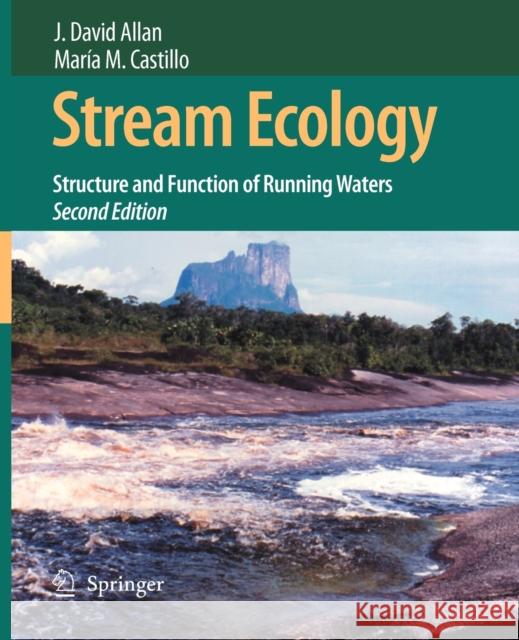
Stream Ecology: Structure and Function of Running Waters Allan, J. David 9781402055829  - książkaWidoczna okładka, to zdjęcie poglądowe, a rzeczywista szata graficzna może różnić się od prezentowanej.

Stream Ecology: Structure and Function of Running Waters

ISBN-13: 9781402055829 / Angielski / Miękka / 2007 / 452 str.

J. David Allan
cena 403,47 zł
(netto: 384,26 VAT:  5%)

Najniższa cena z 30 dni: 385,52 zł
Termin realizacji zamówienia:
ok. 22 dni roboczych
Bez gwarancji dostawy przed świętami

Darmowa dostawa!

Stream Ecology by Allan and Castillo is extensively revised and updated from the successful first edition to include major developments over the past decade. Although the subject matter is relatively advanced, this book has been written with the express goal of being accessible to students with only modest backgrounds in ecology and aquatic sciences. The First Edition was widely praised for its readability, and that emphasis is retained. The second edition opens with a new introductory chapter that sets the stage for what follows. The treatment of geomorphology and hydrology are greatly expanded from the first edition, and have been split into two, more substantial chapters. Basal energy resources, trophic roles and food web interactions are retained but thoroughly updated, particularly to include recent advances in microbial ecology and the synergies between producers and decomposers. The discussion of species interactions has been re-organized so that modern topics receive more emphasis, including trophic cascades, subsidies and food web structure. Chapters on organic matter dynamics and nutrient cycling have been substantially re-written to reflect the enormous growth in knowledge of stream metabolism and nutrient processes, the core of ecosystem functioning. The closing chapter on human impacts summarizes the status of river ecosystems and principal threats, and new material that describes advances in river management including the science of environmental flows, the successes and failures of river restoration, and the potential for ecosystem-based catchment management.


Kategorie:
Nauka, Biologia i przyroda
Kategorie BISAC:
Science > Life Sciences - Ecology
Science > Earth Sciences - Limnology
Język:
Angielski
ISBN-13:
9781402055829
Rok wydania:
2007
Ilość stron:
452
Waga:
0.77 kg
Wymiary:
23.37 x 19.05 x 2.79
Oprawa:
Miękka
Wolumenów:
01
Dodatkowe informacje:
Bibliografia
Wydanie ilustrowane

From the reviews of the second edition:

"There is a continual need for current introductory material in key ecological areas. ... This is an interesting text. It has a wealth of detail ... that means it is for the more 'advanced' beginner. ... However, it does provide both teachers and field study centres with a much-needed overview of stream ecology. ... Overall, a must for the field centre and a good starter text in stream ecology." (TEN News, October, 2007)

"Allan and Castillo offer this superb compilation of both the latest and time-honored concepts of the ecology of fluvial systems at scales ranging from small mountain brooks to large, continental- sized river basins. Richly illustrated and with more than 1,500 reference citations, the book is divided into 14 chapters ... . Best of all, the book is written in a lively, engaging manner and with remarkable clarity, given the technical nature of the material. Summing Up: Highly recommended. Upper-division undergraduates through faculty." (P. R. Pinet, CHOICE, Vol. 45 (7), 2008)

"The second edition of the book 'Stream Ecology' covers the key ecological factors and processes in a very variable ecosystem ... . I recommend 'Stream Ecology' to people with knowledge of the basics of ecology, e.g., graduates and advanced undergraduates ... . To my knowledge, there is no other book available, which gives such a good overview of the issue. One gets a very good, fluidly readable book which contains the latest key scientific knowledge of the ecology of running waters." (Daniel Graeber, International Review of Hydrobiology, Vol. 94 (2), 2009)

1 An Introduction to Fluvial Ecosystems An overview of the diversity of rivers and streams, including some of the causes of this diversity, and some of the consequences. The intent is to provide a roadmap for the individual chapters that follow, rather than define terms and explain principles in any detail. 2 Streamflow Fluvial ecosystems exhibit tremendous variability in the quantity, timing and temporal patterns of river flow, and this profoundly influences their physical, chemical and biological condition. This chapter covers the essentials of hydrology, from the global water cycle to the myriad ways that humans alter water flowpaths and river flow. 3 Fluvial Geomorphology Fluvial geomorphology emphasizes the dynamic interplay between rivers and landscapes in the shaping of river channels and drainage networks. It includes study of the linkages among channel, floodplain, network and catchment and helps make sense of the enormous variety exhibited among fluvial systems, and thus the habitat and environmental conditions experienced by the biota. 4 Streamwater Chemistry The constituents of river water include suspended inorganic matter, dissolved major ions, dissolved nutrients, suspended and dissolved organic matter, gases, and trace metals. River chemistry changes temporally under the multiple influences of seasonal changes in discharge regime, precipitation inputs, and biological activity; and usually is greatly altered owing to direct and indirect human influences. 5 The Abiotic Environment The abiotic environment includes all physical and chemical variables that influence the distribution and abundance of organisms. Current, substrate and temperature often are the most important variables in fluvial environments, and all organisms show adaptations that limit them to a subset of conditions. Species differ in the specific conditions under which they thrive, and whether those conditionsare narrow or comparatively broad. 6 Primary Producers Primary producers acquire their energy from sunlight and their materials from nonliving sources. The major autotrophs of running waters include the benthic algae and macrophytes; in larger rivers, phytoplankton also can be important. Benthic algae occur in intimate association with heterotrophic microbes within an extracellular matrix, referred to as biofilm. Benthic algae are important in fluvial food webs, especially in headwater and midsized streams, and also influence the benthic habitat and nutrient cycling. 7 Detrital Energy Sources Particulate and dissolved organic matter originating both within the stream and in the surrounding landscape is an important basal resource to fluvial food webs. Detritus-based energy pathways can be particularly important, relative to pathways originating from living primary producers, in small streams shaded by a terrestrial canopy and in large, turbid rivers with extensive floodplains. Recent advances in microbial ecology have greatly expanded our understanding of the synergies between autotrophs and heterotrophs. 8 Trophic Relationships The network of consumers and resources that constitute fluvial food webs is supported by a diverse mix of energy supplies that originate within the stream and beyond its banks. These include the living resources of algae and macrophytes, and the non-living resources of particulate and dissolved organic matter. Microorganisms are important mediators of organic matter availability and there is increasing evidence of their importance as a resource to both small and large consumers. Additionally, energy subsidies in the form of falling terrestrial arthropods and the eggs and carcasses of migrating fish contribute to the support of many stream-dwellers. 9 Species interactions The basal resources of algae and detritus and associated microorganisms sustain higher consumers includin

Stream Ecology: Structure and Function of Running Waters is designed to serve as a textbook for advanced undergraduate and graduate students, and as a reference source for specialists in stream ecology and related fields. The Second Edition is thoroughly updated and expanded to incorporate significant advances in our understanding of environmental factors, biological interactions, and ecosystem processes, and how these vary with hydrological, geomorphological, and landscape setting.

The broad diversity of running waters – from torrential mountain brooks, to large, lowland rivers, to great river systems whose basins occupy sub-continents – makes river ecosystems appear overwhelming complex. A central theme of this book is that although the settings are often unique, the processes at work in running waters are general and increasingly well understood.

Even as our scientific understanding of stream ecosystems rapidly advances, the pressures arising from diverse human activities continue to threaten the health of rivers worldwide. This book presents vital new findings concerning human impacts, and the advances in pollution control, flow management, restoration, and conservation planning that point to practical solutions.

Reviews of the first edition:

".. an unusually lucid and judicious reassessment of the state of stream ecology"
Science Magazine

"..provides an excellent introduction to the area for advanced undergraduates and graduate students…" Limnology & Oceanography

"… a valuable reference for all those interested in the ecology of running waters."
Transactions of the American Fisheries Society


Udostępnij

Facebook - konto krainaksiazek.pl


Opinie o Krainaksiazek.pl na Opineo.pl

Partner Mybenefit

Krainaksiazek.pl w programie rzetelna firma Krainaksiaze.pl - płatności przez paypal

Czytaj nas na:

Facebook - krainaksiazek.pl
  • książki na zamówienie
  • granty
  • książka na prezent
  • kontakt
  • pomoc
  • opinie
  • regulamin
  • polityka prywatności

Zobacz:

  • Księgarnia czeska

  • Wydawnictwo Książkowe Klimaty

1997-2025 DolnySlask.com Agencja Internetowa

© 1997-2022 krainaksiazek.pl
     
KONTAKT | REGULAMIN | POLITYKA PRYWATNOŚCI | USTAWIENIA PRYWATNOŚCI
Zobacz: Księgarnia Czeska | Wydawnictwo Książkowe Klimaty | Mapa strony | Lista autorów
KrainaKsiazek.PL - Księgarnia Internetowa

Polityka prywatnosci - link
Krainaksiazek.pl - płatnośc Przelewy24
Przechowalnia Przechowalnia






