• Wyszukiwanie zaawansowane
  • Kategorie
  • Kategorie BISAC
  • Książki na zamówienie
  • Promocje
  • Granty
  • Książka na prezent
  • Opinie
  • Pomoc
  • Załóż konto
  • Zaloguj się

Stochastic Processes in Demography and Their Computer Implementation » książka


zaloguj się | załóż konto
Logo Krainaksiazek.pl

koszyk

konto

szukaj
topmenu
Księgarnia internetowa
Szukaj
Książki na zamówienie
Promocje
Granty
Książka na prezent
Moje konto
Pomoc
 
 
Wyszukiwanie zaawansowane
Pusty koszyk
Bezpłatna dostawa dla zamówień powyżej 20 złBezpłatna dostawa dla zamówień powyżej 20 zł

Kategorie główne

• Nauka
 [2950560]
• Literatura piękna
 [1849509]

  więcej...
• Turystyka
 [71097]
• Informatyka
 [151150]
• Komiksy
 [35848]
• Encyklopedie
 [23178]
• Dziecięca
 [617388]
• Hobby
 [139064]
• AudioBooki
 [1657]
• Literatura faktu
 [228597]
• Muzyka CD
 [383]
• Słowniki
 [2855]
• Inne
 [445295]
• Kalendarze
 [1464]
• Podręczniki
 [167547]
• Poradniki
 [480102]
• Religia
 [510749]
• Czasopisma
 [516]
• Sport
 [61293]
• Sztuka
 [243352]
• CD, DVD, Video
 [3414]
• Technologie
 [219456]
• Zdrowie
 [101002]
• Książkowe Klimaty
 [124]
• Zabawki
 [2311]
• Puzzle, gry
 [3459]
• Literatura w języku ukraińskim
 [254]
• Art. papiernicze i szkolne
 [8079]
Kategorie szczegółowe BISAC

Stochastic Processes in Demography and Their Computer Implementation

ISBN-13: 9783642823244 / Angielski / Miękka / 2011 / 390 str.
C. J. Mode
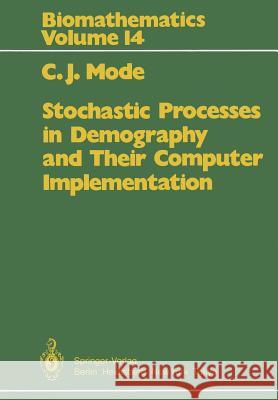
Stochastic Processes in Demography and Their Computer Implementation C. J. Mode 9783642823244 Springer - książkaWidoczna okładka, to zdjęcie poglądowe, a rzeczywista szata graficzna może różnić się od prezentowanej.

Stochastic Processes in Demography and Their Computer Implementation

ISBN-13: 9783642823244 / Angielski / Miękka / 2011 / 390 str.

C. J. Mode
cena 201,24
(netto: 191,66 VAT:  5%)

Najniższa cena z 30 dni: 192,74
Termin realizacji zamówienia:
ok. 22 dni roboczych
Dostawa w 2026 r.

Darmowa dostawa!

According to a recent report of the United States Census Bureau, world population as of June 30, 1983, was estimated at about 4. 7 billion people; of this total, an estimated 82 million had been added in the previous year. World population in 1950 was estimated at about 2. 5 billion; consequently, if 82 million poeple are added to the world population in each of the coming four years, population size will be double that of 1950. Another way of viewing the yearly increase in world population is to compare it to 234 million, the estimated current population of the United States. If the excess of births over deaths continues, a group of young people equivalent to the population of the United States will be added to the world population about every 2. 85 years. Although the rate of increase in world population has slowed since the midsixties, it seems likely that large numbers of infants will be added to the population each year for the foreseeable future. A large current world population together with a high likelihood of sub stantial increments in size every year has prompted public and scholarly recognition of population as a practical problem. Tangible evidence in the public domain that population is being increasingly viewed as a problem is provided by the fact that many governments around the world either have or plan to implement policies regarding population. Evidence of scholarly concern is provided by an increasing flow of publications dealing with population."


Kategorie:
Nauka, Matematyka
Kategorie BISAC:
Mathematics > Matematyka stosowana
Social Science > Ludność i demografia
Wydawca:
Springer
Seria wydawnicza:
Biomathematics
Język:
Angielski
ISBN-13:
9783642823244
Rok wydania:
2011
Wydanie:
Softcover Repri
Numer serii:
000042237
Ilość stron:
390
Waga:
0.71 kg
Wymiary:
24.4 x 17.0
Oprawa:
Miękka
Wolumenów:
01

1. Fecundability.- 1.1 Introduction.- 1.2 A Model of Constant Fecundability — The Geometric Distribution.- 1.3 Applying the Geometric Distribution to Data.- 1.4 A Model of Heterogeneous Fecundability.- 1.5 Some Properties of the Beta-Geometric Distribution.- 1.6 Applying the Beta-Geometric Distribution to Data.- 1.7 An Investigation of Selectivity.- 1.8 Fecundability as a Function of Coital Pattern.- 1.9 A Distribution on the Set of Coital Patterns.- 1.10 Some Implications of Markov Chain Model of Coital Patterns.- 1.11 Computer Implementation and Numerical Examples.- 1.12 Conclusions and Further Research Directions.- Problems and Miscellaneous Complements.- References.- 2. Human Survivorship.- 2.1 Introduction.- 2.2 Mortality in a Cohort.- 2.3 Simple Parametric Examples of the Force of Mortality.- Examples: 2.3.1 The Exponential Distribution 37. — 2.3.2 The Weibull Distribution 38. — 2.3.3 The Gompertz Distribution.- 2.4 Period Mortality — A Simple Algorithm.- 2.5 Transforming Central Death Rates into Probabilities and Expectations.- 2.6 Evolutionary Changes in Expectation of Life.- 2.7 An Evolutionary Process Governing Survivorship.- 2.8 Historical Attempts at Modeling Survivorship.- 2.9 Modeling a Force of Mortality for the Whole of Life.- 2.10 Computer Experiments in Fitting Survivorship Models to Swedish Historical Data.- 2.11 Heterogeneity in Survivorship.- 2.12 Further Reading.- Problems and Miscellaneous Complements.- References.- 3. Theories of Competing Risks and Multiple Decrement Life Tables.- 3.1 Introduction.- 3.2 Mortality in a Cohort with Competing Risks of Death.- 3.3 Models of Competing Risks Based on Latent Life Spans.- 3.4 Simple Parametric Models of Competing Risks.- Examples: 3.4.1 Constant Forces of Mortality 81. — 3.4.2 A Survival Function on R3+.- 3.5 Equivalent Models of Competing Risks.- 3.6 Eliminating Causes of Death and Nonidentifiability.- Examples: 3.6.1 A Case where the Functions S (3, x) and S0 (3, x) Differ 86. — 3.6.2 A Graphical Example Comparing the Survival Functions S (x), S (3, x), and S0 (3, x).- 3.7 Estimating a Multiple Decrement Life Table from Period Data.- 3.8 Estimating Single Decrement Life Tables from Multiple Decrement Life Tables.- 3.9 Evolutionary Changes in the Structure of Causes of Death.- 3.10 Graphs of Multiple Decrement Life Tables — A Study of Proportional Forces of Mortality.- 3.11 Graphs of Single Decrement Life Tables Associated with Multiple Decrement Tables.- 3.12 Graphs of Latent Survival Functions and Forces of Mortality.- 3.13 An Evolutionary Model of Competing Risks.- Problems and Miscellaneous Complements.- References.- 4. Models of Maternity Histories and Age-Specific Birth Rates.- 4.1 Introduction.- 4.2 A Potential Birth Process.- 4.3 Cohort Net and Gross Maternity Functions.- 4.4 Parity Progression Ratios.- 4.5 Parametric Distributions of Waiting Times Among Live Births.- Examples: 4.5.1 Applications of the Exponential Distribution 122. — 4.5.2 A Simplified Model Based on the Exponential Distribution 123. — 4.5.3 A Double Exponential Distribution 124. — 4.5.4 Distributions Based on Risk Functions.- 4.6 Parametric Forms of the Distribution of Age at First Marriage in a Cohort.- Examples: 4.6.1 A Model Based on a Double Exponential Risk Function 128. — 4.6.2 A Model Based on the Lognormal Distribution 129. — 4.6.3 Validation of Lognormal 130. — 4.6.4 On the Joint Distribution of the Ages of Brides and Grooms — The Bivariate Lognormal.- 4.7 Heterogeneity in Waiting Times Among Live Births.- Examples: 4.7.1 Gamma Mixtures of Gamma Distributions 137. — 4.7.2 Variances, Covariances, and Correlations of Waiting Times Among Live Births 140. — 4.7.3 Conditional Distributions of the Random Variable A 141. — 4.7.4 Distribution of Waiting Times to n-th. Live Birth.- 4.8 An Age-Dependent Potential Birth Process.- Example: 4.8.1 Maternity Histories in a Nineteenth Century Belgian Commune — La Hulpe.- 4.9 An Evolutionary Potential Birth Process.- 4.10 The Evolution of Period Fertility in Sweden — 1780 to 1975.- 4.11 Further Reading.- Problems and Miscellaneous Complements.- References.- 5. A Computer Software Design Implementing Models of Maternity Histories.- 5.1 Introduction.- 5.2 Semi-Markov Processes in Discrete Time with Stationary Transition Probabilities.- 5.3 A Decomposition of Birth Intervals.- 5.4 On Choosing Component Functions of the Model.- 5.5 An Overview of MATHIST — A Computer Simulation System.- 5.6 Applications of MATHIST — Two Simulation Runs in Class One.- 5.7 A Factorial Experiment Based on Class Two Runs in MATHIST.- 5.7.1 An Overview of Computer Input.- 5.7.2 Phenomenological and Population Policy Implications of Simulated Cohort Total Fertility Rates and Their Variances.- 5.7.2.1 Phenomenological Implications.- 5.7.2.2 Implications for Population Policy.- 5.7.3 Comparisons of Simulated Cohort and Period Age — Specific Fertility Rates.- 5.7.3.1 Comparisons of Total Fertility Rates.- 5.7.3.2 Comparisons of Birth Rates for the Age Group [15, 20).- 5.7.3.3 Comparisons of Age Groups with Maximum Birth Rates.- 5.7.3.4 On the Plausibility of the Mathematical Assumptions Underlying MATHIST.- 5.7.4 Computer Generated Graphs of Selected Output from MATHIST.- 5.8 A Stochastic Model of Anovulatory Sterile Periods Following Live Births.- Example: 5.8.1 Numerical Examples Based on a Parametric Model.- 5.9 A Semi-Markovian Model for Waiting Times to Conception Under Contraception.- Examples: 5.9.1 A One-Step Transition Matrix of Density Functions for Spacers 231. — 5.9.2 A One-Step Transition Matrix of Density Functions for Limiters.- 5.10 Notes on Cohort and Period Projections of Fertility.- 5.11 Further Reading.- Problems and Miscellaneous Complements.- References.- 6. Age-Dependent Models of Maternity Histories Based on Data Analyses.- 6.1 Introduction.- 6.2 Age-Dependent Semi-Markov Processes in Discrete Time with Stationary Transition Probabilities.- 6.3 An Age-Dependent Semi-Markovian Model of Maternity Histories.- 6.4 On Choosing Computer Input for an Age-Dependent Model of Maternity Histories.- 6.5 Estimates of Fecundability Functions Based on Null Segments and Other Computer Input.- 6.6 Numerical Specifications of Four Computer Runs with Inputs Based on Survey Data.- 6.7 Computer Output Based on Survey Data.- 6.8 Further Assessment of the Quality of Calculations in Sect. 6.7 and Conclusions.- 6.9 A Non-Markovian Model for the Taichung Medical IUD Experiment.- 6.10 Estimates of Transition Functions Associated with First IUD Segment in Taichung Model.- 6.11 Validation of Taichung Model.- 6.12 State and Fertility Profiles for Taichung Limiters.- 6.13 Implications of the Taichung Experiment for Evaluating Family Planning Programs.- 6.14 On Measuring the Fertility Impact of Family Planning Programs.- 6.15 Conclusions and Further Reading.- Problems and Miscellaneous Complements.- References.- 7. Population Projection Methodology Based on Stochastic Population Processes.- 7.1 Introduction.- 7.2 Basic Functions Underlying a Branching Process.- 7.3 Basic Random Functions and Their Means.- 7.4 Explicit Formulas for Mean Functions.- 7.5 Leslie Matrix Type Recursive Formulas for Mean Functions.- 7.6 A Brief Review of Literature.- 7.7 Stochastic Variability in Population Structure as a Gaussian Process.- 7.8 A Representation of Population Structure Based on Birth Cohorts.- 7.9 Covariance Functions for the Birth Process and Live Individuals.- 7.10 Product Moments of the Actual and Potential Birth Processes.- 7.11 Product Moment Functions as Solutions of Renewal Equations.- 7.12 Asymptotic Formulas for Mean and Covariance Functions in the Time Homogeneous Case.- 7.13 Period Demographic Indicators in Populations with Time Inhomogeneous Laws of Evolution.- 7.14 Asymptotic Formulas for Period Demographic Indicators in the Time Homogeneous Case.- 7.15 A Female Dominant Two-Sex Population Process.- 7.16 An Overview of a Computer Software Design Implementing Population Projection Systems.- 7.17 Four Computer Runs in the Time Homogeneous Case — A Study of Population Momentum.- 7.17.1 Guidelines for Interpreting Graphs of Period Mean Total Population.- 7.17.2 Guidelines for Interpreting Graphs of Period Rates of Population Growth, Crude Birth Rates, and Crude Death Rates.- 7.17.3 Guidelines for Interpreting Graphs of Distances of Period Age Distributions from Their Asymptotic Stable Forms.- 7.17.4 Implications for Population Policy.- 7.18 A Study of Changing Mortality and Constant Fertility in the Time Inhomogeneous Case.- 7.18.1 Guidelines for Interpreting Mean Total Population and Mean Total Births and Deaths.- 7.18.2 Guidelines for Interpreting Period Crude Birth and Death Rates and Rates of Population Growth.- 7.18.3 Guidelines for Interpreting Period Age Densities in the Time Inhomogeneous Run.- 7.19 Further Reading.- Problems and Miscellaneous Complements.- References.- Author Index.


Udostępnij

Facebook - konto krainaksiazek.pl


Opinie o Krainaksiazek.pl na Opineo.pl

Partner Mybenefit

Krainaksiazek.pl w programie rzetelna firma Krainaksiaze.pl - płatności przez paypal

Czytaj nas na:

Facebook - krainaksiazek.pl
  • książki na zamówienie
  • granty
  • książka na prezent
  • kontakt
  • pomoc
  • opinie
  • regulamin
  • polityka prywatności

Zobacz:

  • Księgarnia czeska

  • Wydawnictwo Książkowe Klimaty

1997-2025 DolnySlask.com Agencja Internetowa

© 1997-2022 krainaksiazek.pl
     
KONTAKT | REGULAMIN | POLITYKA PRYWATNOŚCI | USTAWIENIA PRYWATNOŚCI
Zobacz: Księgarnia Czeska | Wydawnictwo Książkowe Klimaty | Mapa strony | Lista autorów
KrainaKsiazek.PL - Księgarnia Internetowa

Polityka prywatnosci - link
Krainaksiazek.pl - płatnośc Przelewy24
Przechowalnia Przechowalnia






