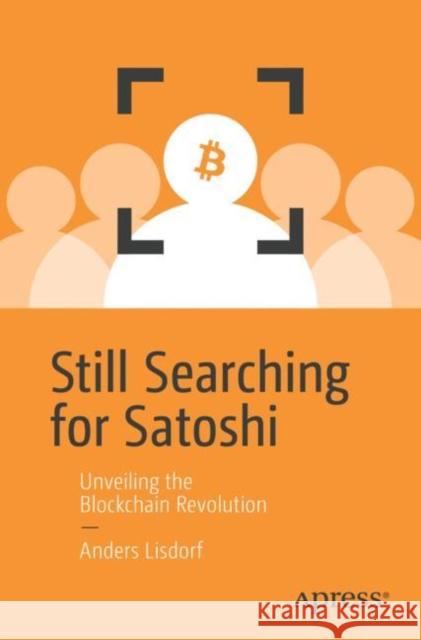
Still Searching for Satoshi » książka





(netto: 181,46 VAT: 5%)
Najniższa cena z 30 dni: 187,38
ok. 16-18 dni roboczych.
Darmowa dostawa!
Wydanie ilustrowane
Introduction
Part 1 - Genealogy of bitcoin technology
The technological developments leading to bitcoin. This part is a technological history that reviews the technological developments that Bitcoin builds on. There are a few strands that developed more or less independently that combine into Bitcoin. Once they are explained it is possible to give a deeper explanation of how Bitcoin works. This understanding will inform the remaining parts of the book.
Chapter 1: Cryptography
The purpose of cryptography is to keep information private by preserving confidentiality, integrity and access to it.
Public private key encryptionHashing
Zero knowledge proof
Chapter 2: Virtual Money
In this chapter we will go into the history of electronic or virtual money before bitcoin.
Digicash
E gold
Bitgold
b Money
Hash cash
Chapter 3: Peer-to-peer technology
The internet of today is a centralized type of computing working through a number of web servers that function in a hierarchy.
Properties of p2p networksDiscovering a peer
Secure sharing
File Sharing from Napster to BitTorrent
Chapter 4: Proof of work
An inherent problem with the networked world is that accessing and processing information is essentially free, which makes certain types of disruptive behavior easy, which we see in denial of service attacks, spam mail and robocalling. This brings new problems that did not exist when it cost significant money to send a letter, read a paper or book or make a phone call.
DDoS
Spam
Money transactions
Chapter 5: Public record
Since the time of the code of Hammurabi, the purpose of a public record has been clear: to establish indisputable truth. While this is seemingly the opposite of the privacy and confidentiality entailed by cryptography it serves the purpose of making information shared and immutable.
Historical technologies of public record
The purpose of public records
The accounting revolution and the development of ledgers, double entry bookkeeping to triple entry bookkeeping
Chapter 6: Bitcoin
From the previous chapters we are now able to piece together how bitcoin and the block chain works.
Virtual money - The BitcoinEncrypting for privacy - The Wallet
Public record - The Blockchain
Peer to peer network - The Miners
Proof of work - Transactions (cryptographic proof and the consensus algorithm)
Part 2 - Still searching for Satoshi - who is the historical Satoshi Nakamoto?
Much writing about Bitcoin has focused on who the historical person or persons behind Satoshi Nakamoto is. This part will apply a historical critical perspective to this question and sift through the evidence in order to create a better understanding of what we can and cannot say about the identity of Satoshi Nakamoto.
Chapter 7: Who dunnit?
A review of previous identifications of the person behind Satoshi. This has previously taken the shape of investigative journalism in the style of true crime reporting
Joshua Davis, The New Yorker 2011
Adam Penenberg, Fast Company 2011
Alec Liu, Vice 2013
John Markoff, New York Times 2013
Andy Greenberg, Forbes 2014
Leah McGrath Goodman, Newsweek 2014
Skye Grey, blog 2014
Dominic Frisby, Bitcoin the future of money 2014
Nathaniel Popper, New York Time 2015
Andy Greenberg, Gwern Branwen, Wired 2015
Sam Biddle, Gizmodo 2015
Izabella Kasminska, Financial Times 2016
Evan Ratliff, Wired 2019
Other sources - twitter, youtube, tv
Chapter 8: Ad fontes-What do the sources say?
By focusing on the sources we are able to extract a number of key characteristics to look for:
Historical analysis - establishes a couple of key points for historical analysis
The bitcoin whitepaper - the most crucial piece of evidence
The forums - the p2p forum and later the bitcoin forum are sources where Satoshi discussed with peers about bitcoinThe code - the code in itself may also contain clues
The blockchain - the record of transactions also provides an insight into the origin of bitcoin
Summary - what can the sources tell us?
Chapter 9: Motives
What were the motives behind the creation of bitcoin
Ideology - what can be said about the ideology of the author based on extant sources?
Why the synonym? - what could be the reason for the initial and continued secrecy surrounding the inventor?
Summary - why did the inventor invent bitcoin and in this particular way?
Chapter 10: The social network of early bitcoin
Who were the people involved in the beginning of Bitcoin
p2p forum communication
Bitcoin forum communication
Blockchain transactions
Summary - what can we learn from looking at the bitcoin initial network
Chapter 11: The usual suspects?
Rather than pointing definitively to one or another suspect we will try to integrate the knowledge we have gained with the list of known suspects.
An evaluation framework - developing an evaluation framework against which to measure the likelihood of any candidate being Satoshi NakamotoPrime suspects - the suspects that have gained most attention
· Hal Finney
· Nick Szabo
· Dorian Sakamoto
· Craig Wright and David Kleiman
· Paul Leroux
Secondary suspects - suspects that have gained some attention
· Vili Lehdonum and Michael Clear
· Neal King, Vladimir Oksman, Charles Bry
· Hal Finney, Nick Szabo and Adam Back
· Shinichi Mochizuki
· Ross Ulbricht
· Adam Back· Gavin Andresen
· Jed McCaleb
· Elon Musk
· Len Sassaman
· Someone else
A new primary suspect - as in the movie The Usual Suspects, careful analysis points towards a surprising suspect who is not in the primary field of suspects.
Part 3 - Bitcoin in context
How is bitcoin viewed in the wider context of human civilization? Bitcoin does not exist in a technological bubble addressing only technological issues. It is firmly situated in a web of themes that are and have been central to human civilization. This may account for its notoriety but needs to be put in context.
Chapter 12: Money
Since prehistoric times humans have engaged in exchange. This falls in a continuum from barter, through intermediaries as cowry shells, gold and silver coins to purely symbolic means of exchange.
The history of money
Medium of exchange
Unit of account
Standard of deferred payment
Store of value
Types of money
· Commodity· Representative money
· Fiat
· Digital money
· Deposits
The politics of money
Money as a bridge between domains of value
Chapter 13: Ownership
Proving that you own something has been a central feature of human societies for millenia and disputes have fueled more than its share of violence and conflict.
Owners
· Private
· Public
· Corporate
· CommunalProperty
· Tangible
· Intangible
Establishing and policing ownership
· National
· Transnational
Chapter 14: Social organization
Human societies have always been characterized by some sort of social organization. The different options have been debated since classical antiquity. This chapter will take a look at the space of social organization and narrow it down to the particular types associated with bitcoin and blockchain.
An ancient discussion: Monarchy, Oligarchy and Democracy - and anarchy
Centralization vs decentralization
Types of social organization in human groups
Open source
Cypher punks
Chapter 15: Religion
A rarely debated issue are the religious aspects surrounding Bitcoin and the blockchain movement. But these aspects are nothing new when it comes to human cultures. Understanding this helps explain a lot of the seemingly strange behavior of bitcoin believers without claiming that Bitcoin is an actual religion.
The prophet - Satoshi Nakamoto
Sacred scriptures- The Bitcoin whitepaper and the forum posts
Believers and heathens
Cargo cults
Millenarianism
Part 4 - Blockchain and the future
Where can blockchain technology be applied? Where, if anywhere, might we see cryptocurrencies and the blockchain in the future and how might it affect our lives? A case could be made that we are only in the beginning phases of the blockchain now, sometimes called Web3, where the worst of the teething problems are gone and the wild west ethos is receding.Where not to use blockchain - First let us consider a number of areas where blockchain is currently suggested that might not be particularly relevant.
Parameters to be tweaked - Bitcoin was the first version of blockchain technology and certain choices were made. But subsequent and future blockchains need not make the same choices. We need to understand how this can be done in order to ascertain the future utility of the blockchain.
Transaction speed
Energy consumption
Degree of centralizationPublic availability
Mining rewards
Banking - even though Bitcoin at its outset was antithetical to the banking industry there are particularly good use cases here.
Payment - bitcoin may not in itself have been very successful as a payments solution so far but there is no reason why another cryptocurrency will not be. Current payment systems are slow and expensive compared to what the blockchain can offer.
International payments
Remittance
Peer to peer payments
Micropayments
Certification - building on the ability to serve as a public record there are good reasons that a blockchain can serve as a public record for information about ownership
NFTs
Real estate
Media
Contracts - the ability to establish indisputable truth makes it possible to build contracts that automatically execute according to some logic. This can be used for escrow services and delivery of other services as well as insurance.
Regulatory compliance - the immutability of the blockchain makes it good for a great number of use cases where fraud has previously been an issue
Forensics - the public nature of the blockchain makes it a valuable tool for law enforcement, especially international law enforcement, which has already proven its worth in a number of high profile cases.
Supply chain - the blockchain is well suited for keeping track of things movement across time and place.
Health - keeping track of health trackers and personal health records could be done on a blockchain
Government - in government there are also areas where blockchain may be useful
Special purpose tokens
Voting
Identity
Glossary
Key concepts described
Although originally trained as a classical scholar with a PhD in Roman history, Anders Lisdorf has been working in the tech industry for decades bringing innovative technologies forth to solve real world problems. With an experience across many different industries, public as well as private, he has a wide interest in how we can make use of technology and data to improve the lives of everyone. As an entrepreneur he has started multiple tech companies and as an Enterprise Architect he has been responsible for modernization and development of the Data Services of the City of New York. Anders is the author of Cloud Basics and Demystifying Smart Cities (Apress).




Czytaj nas na:
1997-2026 DolnySlask.com Agencja Internetowa
KrainaKsiazek.PL - Księgarnia Internetowa


