• Wyszukiwanie zaawansowane
  • Kategorie
  • Kategorie BISAC
  • Książki na zamówienie
  • Promocje
  • Granty
  • Książka na prezent
  • Opinie
  • Pomoc
  • Załóż konto
  • Zaloguj się

Statistics for Health Data Science: An Organic Approach » książka


zaloguj się | załóż konto
Logo Krainaksiazek.pl

koszyk

konto

szukaj
topmenu
Księgarnia internetowa
Szukaj
Książki na zamówienie
Promocje
Granty
Książka na prezent
Moje konto
Pomoc
 
 
Wyszukiwanie zaawansowane
Pusty koszyk
Bezpłatna dostawa dla zamówień powyżej 20 złBezpłatna dostawa dla zamówień powyżej 20 zł

Kategorie główne

• Nauka
 [2949965]
• Literatura piękna
 [1857847]

  więcej...
• Turystyka
 [70818]
• Informatyka
 [151303]
• Komiksy
 [35733]
• Encyklopedie
 [23180]
• Dziecięca
 [617748]
• Hobby
 [139972]
• AudioBooki
 [1650]
• Literatura faktu
 [228361]
• Muzyka CD
 [398]
• Słowniki
 [2862]
• Inne
 [444732]
• Kalendarze
 [1620]
• Podręczniki
 [167233]
• Poradniki
 [482388]
• Religia
 [509867]
• Czasopisma
 [533]
• Sport
 [61361]
• Sztuka
 [243125]
• CD, DVD, Video
 [3451]
• Technologie
 [219309]
• Zdrowie
 [101347]
• Książkowe Klimaty
 [123]
• Zabawki
 [2362]
• Puzzle, gry
 [3791]
• Literatura w języku ukraińskim
 [253]
• Art. papiernicze i szkolne
 [7933]
Kategorie szczegółowe BISAC

Statistics for Health Data Science: An Organic Approach

ISBN-13: 9783030598884 / Angielski / Twarda / 2021 / 222 str.
Ruth Etzioni; Micha Mandel; Roman Gulati
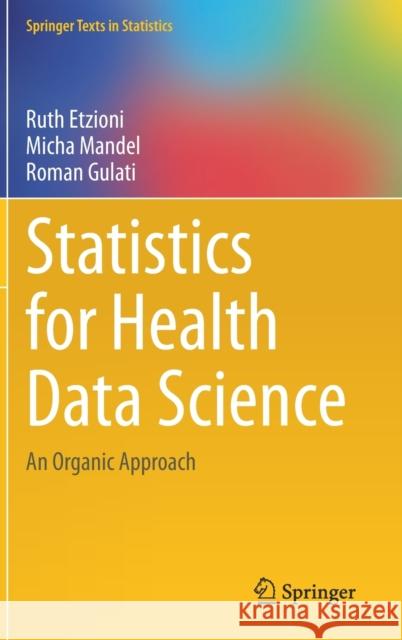
Statistics for Health Data Science: An Organic Approach Ruth Etzioni Micha Mandel Roman Gulati 9783030598884 Springer Nature Switzerland AG - książkaWidoczna okładka, to zdjęcie poglądowe, a rzeczywista szata graficzna może różnić się od prezentowanej.

Statistics for Health Data Science: An Organic Approach

ISBN-13: 9783030598884 / Angielski / Twarda / 2021 / 222 str.

Ruth Etzioni; Micha Mandel; Roman Gulati
cena 403,47 zł
(netto: 384,26 VAT:  5%)

Najniższa cena z 30 dni: 385,52 zł
Termin realizacji zamówienia:
ok. 22 dni roboczych
Bez gwarancji dostawy przed świętami

Darmowa dostawa!
inne wydania
Kategorie:
Nauka, Medycyna
Kategorie BISAC:
Medical > Biostatistics
Science > Life Sciences - General
Business & Economics > Industries - Computers & Information Technology
Wydawca:
Springer Nature Switzerland AG
Seria wydawnicza:
Springer Texts in Statistics
Język:
Angielski
ISBN-13:
9783030598884
Rok wydania:
2021
Wydanie:
2020
Numer serii:
000022139
Ilość stron:
222
Waga:
0.52 kg
Wymiary:
23.39 x 15.6 x 1.6
Oprawa:
Twarda
Wolumenów:
01
Dodatkowe informacje:
Wydanie ilustrowane

Chapter 1: Introduction: Data science, statistics, and big data in health
Examples of the “new” health services, delivery and outcomes data including surveys, claims and EMR’s. Examples of the big questions that can be addressed. Data Science versus statistics, big databases versus big data, prediction versus inference. Characteristics of health care utilization data. What does health care cost? Different ways of quantifying health care costs. Characteristics of health cost data. 

Chapter 2: The new health care data: surveys, medical claims and EMR’s
Surveys, Medical Claims, EMR’s: characteristics and challenges. Examples of studies based on the different types of data resources. Strengths and weaknesses of each.  Tips for quality control. Possibly: An overview of issues in processing unstructured data and linking databases

Chapter 3: Basic statistical background useful for analysis of health care costs and utilization
The generic inference problem. Some useful statistical distributions. Conditional and marginal probability. Least squares and maximum likelihood. Hypothesis testing and discussion about p-values. Statistical power.

Chapter 4: Conceptual models for health care utilization and costs 
Anderson-Newman model, variants and extensions. 

Chapter 5: Linear regression for observational studies
Confounding, Mediation and Moderation. Difference in difference models. Impact of violating OLS assumptions

Chapter 6: Nonlinear models 1: Binary outcomes and choice models 
Probit models. Logistic models  and conditional logistic models. Multinomial logit regression models and ordered logit models. The method of recycled predictions.

Chapter 7: Nonlinear models 2: Models for count outcomes 
Log-linear models for count outcomes. Poisson and negative binomial regression. Models for individual and population counts. Zero-inflated and zero-truncated models. Generalized Linear Models. 

Chapter 8: Risk adjustment
Constructing comorbidity and risk adjustment variables using claims data. Computing Q/E ratios. Using O/E ratios for profiling facilities. 

Chapter 9: Models for skewed health costs
Log-normal models for skewed costs. Duan’s method of smearing for lognormal data. The difference between modeling the log of Y (lognormal models for costs) and log(E(Y)) log-linear models for count outcomes.  Gamma models as an alternative to lognormal models for cost data. Cross-validation for model selection. 

Chapter 10: Two-part models for costs and counts
Zero-inflated Poisson and negative binomial models. Two part models (logit-normal or logit-gamma) for cost outcomes. Cross-validation for model selection. 

Chapter 11: The bootstrap: General principles and use in variance estimation for two-part models
Does the normality assumption matter? Using the bootstrap to examine the properties of regression coefficient estimates in large sample. Different types of bootstrap confidence intervals. Extending the bootstrap to compute the variance of the marginal effects in the two-part model. 

Chapter 12: Survey data analysis
Examples of Health Surveys. Complexity of Health Surveys. Simple Random Sampling. Stratified Sampling. Post-Stratification. Other methods for dealing with missing data. Cluster Sampling.  Sample Weights: when to use or not to use? Ratio estimation, linearization and variance estimation

Chapter 13: Machine learning methods for prediction
Predictive analytics versus statistical inference. Simple classification and discrimination algorithms. Trees, bagged models, random forests and boosting. Adjustments for rare outcomes. Regularization. Penalized regression and the LASSO.  Prediction versus estimation versus inference. 

Chapter 14: Comparative Effectiveness and causal inference. 
Defining comparative effectiveness. The problem of selection bias or confounding by indication. General framework for causal inference. Inverse probability weighting and its applications. Instrumental variables, their potential and their limitations

Ruth Etzioni, PhD has been on the faculty at the Fred Hutchinson Cancer Research Center since 1991 and is an affiliate professor of biostatistics and health services at the University of Washington. She develops statistical models and methods for health policy and is a member of national cancer policy panels including the American Cancer Society and the National Comprehensive Cancer Network.  She has developed and taught a new curriculum in statistical methods for graduate students in the School of Public Health at the University of Washington; the course focuses on health care analytics using contemporary, publicly available data resources. The popularity of this course led her to conceive of and develop the proposed text. Dr. Etzioni received her undergraduate degree in Computer Science and Operations Research from the University of Cape Town and her PhD in Statistics from Carnegie-Mellon University.

Micha Mandel, PhD, is professor of statistics at the Hebrew University of Jerusalem. Micha has vast experience teaching at all levels from undergraduate to PhD students, and has been engaged with a wide range of problems in medicine and health care. His interaction with students and researchers from different fields led him to develop tools to explain sophisticated statistical concepts and methods in ways that are accessible to many audiences. His main areas of research include biased sampling, survival analysis, and forensic statistics, but he continues to expand his reach, most recently to the estimation of COVID-19 natural history. He has published in many high-profile statistical journals including Biometrics, Biometrika, Journal of the American Statistical Association, and Statistics in Medicine. Micha received his PhD in Statistics from the Hebrew University of Jerusalem.

Roman Gulati, MS, has been a senior statistical analyst at the Fred Hutchinson Cancer Research Center since 2005. Mr. Gulati is a designer, developer, and analyst of statistical models to investigate population impacts of national clinical practice patterns and cancer control policies. He has led or contributed to many independent and collaborative modeling studies for the Cancer Intervention and Surveillance Modeling Network of the National Cancer Institute. He is also chief biostatistician for the prostate cancer research program at the Fred Hutch and the University of Washington, supporting many molecular, preclinical, and clinical research studies. Mr. Gulati received graduate training first in mathematics and then in Chinese before earning his MS in Statistics from Oregon State University.

Students and researchers in the health sciences are faced with greater opportunity and challenge than ever before. The opportunity stems from the explosion in publicly available data that simultaneously informs and inspires new avenues of investigation. The challenge is that the analytic tools required go far beyond the standard methods and models of basic statistics. This textbook aims to equip health care researchers with the most important elements of a modern health analytics toolkit, drawing from the fields of statistics, health econometrics, and data science.

This textbook is designed to overcome students’ anxiety about data and statistics and to help them to become confident users of appropriate analytic methods for health care research studies. Methods are presented organically, with new material building naturally on what has come before. Each technique is motivated by a topical research question, explained in non-technical terms, and accompanied by engaging explanations and examples. In this way, the authors cultivate a deep (“organic”) understanding of a range of analytic techniques, their assumptions and data requirements, and their advantages and limitations. They illustrate all lessons via analyses of real data from a variety of publicly available databases, addressing relevant research questions and comparing findings to those of published studies. Ultimately, this textbook is designed to cultivate health services researchers that are thoughtful and well informed about health data science, rather than data analysts.  

This textbook differs from the competition in its unique blend of methods and its determination to ensure that readers gain an understanding of how, when, and why to apply them. It provides the public health researcher with a way to think analytically about scientific questions, and it offers well-founded guidance for pairing data with methods for valid analysis. Readers should feel emboldened to tackle analysis of real public datasets using traditional statistical models, health econometrics methods, and even predictive algorithms.

Accompanying code and data sets are provided in an author site: https://roman-gulati.github.io/statistics-for-health-data-science/


Udostępnij

Facebook - konto krainaksiazek.pl


Opinie o Krainaksiazek.pl na Opineo.pl

Partner Mybenefit

Krainaksiazek.pl w programie rzetelna firma Krainaksiaze.pl - płatności przez paypal

Czytaj nas na:

Facebook - krainaksiazek.pl
  • książki na zamówienie
  • granty
  • książka na prezent
  • kontakt
  • pomoc
  • opinie
  • regulamin
  • polityka prywatności

Zobacz:

  • Księgarnia czeska

  • Wydawnictwo Książkowe Klimaty

1997-2025 DolnySlask.com Agencja Internetowa

© 1997-2022 krainaksiazek.pl
     
KONTAKT | REGULAMIN | POLITYKA PRYWATNOŚCI | USTAWIENIA PRYWATNOŚCI
Zobacz: Księgarnia Czeska | Wydawnictwo Książkowe Klimaty | Mapa strony | Lista autorów
KrainaKsiazek.PL - Księgarnia Internetowa

Polityka prywatnosci - link
Krainaksiazek.pl - płatnośc Przelewy24
Przechowalnia Przechowalnia






