• Wyszukiwanie zaawansowane
  • Kategorie
  • Kategorie BISAC
  • Książki na zamówienie
  • Promocje
  • Granty
  • Książka na prezent
  • Opinie
  • Pomoc
  • Załóż konto
  • Zaloguj się

Statistics for Epidemiology » książka


zaloguj się | załóż konto
Logo Krainaksiazek.pl

koszyk

konto

szukaj
topmenu
Księgarnia internetowa
Szukaj
Książki na zamówienie
Promocje
Granty
Książka na prezent
Moje konto
Pomoc
 
 
Wyszukiwanie zaawansowane
Pusty koszyk
Bezpłatna dostawa dla zamówień powyżej 20 złBezpłatna dostawa dla zamówień powyżej 20 zł

Kategorie główne

• Nauka
 [2946600]
• Literatura piękna
 [1856966]

  więcej...
• Turystyka
 [72221]
• Informatyka
 [151456]
• Komiksy
 [35826]
• Encyklopedie
 [23190]
• Dziecięca
 [619653]
• Hobby
 [140543]
• AudioBooki
 [1577]
• Literatura faktu
 [228355]
• Muzyka CD
 [410]
• Słowniki
 [2874]
• Inne
 [445822]
• Kalendarze
 [1744]
• Podręczniki
 [167141]
• Poradniki
 [482898]
• Religia
 [510455]
• Czasopisma
 [526]
• Sport
 [61590]
• Sztuka
 [243598]
• CD, DVD, Video
 [3423]
• Technologie
 [219201]
• Zdrowie
 [101638]
• Książkowe Klimaty
 [124]
• Zabawki
 [2473]
• Puzzle, gry
 [3898]
• Literatura w języku ukraińskim
 [254]
• Art. papiernicze i szkolne
 [8170]
Kategorie szczegółowe BISAC

Statistics for Epidemiology

ISBN-13: 9781584884330 / Angielski / Twarda / 2003 / 350 str.
USA) Jewell Berkeley Nicholas P. (University of California
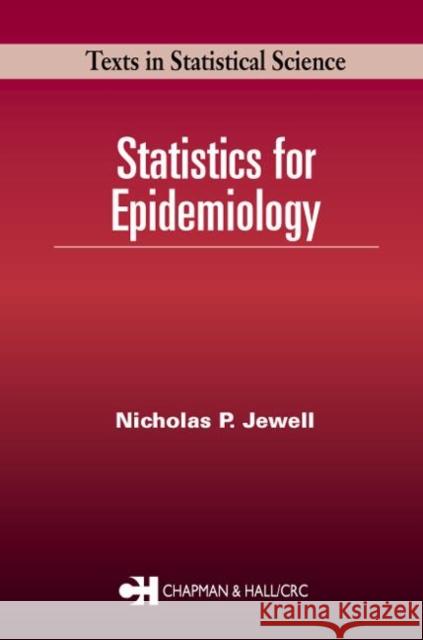
Statistics for Epidemiology Nicholas P. (University of California, Berkeley, USA) Jewell 9781584884330 Chapman & Hall/CRC - książkaWidoczna okładka, to zdjęcie poglądowe, a rzeczywista szata graficzna może różnić się od prezentowanej.

Statistics for Epidemiology

ISBN-13: 9781584884330 / Angielski / Twarda / 2003 / 350 str.

USA) Jewell Berkeley Nicholas P. (University of California
cena 560,94 zł
(netto: 534,23 VAT:  5%)

Najniższa cena z 30 dni: 554,12 zł
Termin realizacji zamówienia:
ok. 22 dni roboczych
Bez gwarancji dostawy przed świętami

Darmowa dostawa!

Statistical ideas have been integral to the development of epidemiology and continue to provide the tools needed to interpret epidemiological studies. Although epidemiologists do not need a highly mathematical background in statistical theory to conduct and interpret such studies, they do need more than an encyclopedia of "recipes." Statistics for Epidemiology achieves just the right balance between the two approaches, building an intuitive understanding of the methods most important to practitioners and the skills to use them effectively. It develops the techniques for analyzing simple risk factors and disease data, with step-by-step extensions that include the use of binary regression. It covers the logistic regression model in detail and contrasts it with the Cox model for time-to-incidence data. The author uses a few simple case studies to guide readers from elementary analyses to more complex regression modeling. Following these examples through several chapters makes it easy to compare the interpretations that emerge from varying approaches. Written by one of the top biostatisticians in the field, Statistics for Epidemiology stands apart in its focus on interpretation and in the depth of understanding it provides. It lays the groundwork that all public health professionals, epidemiologists, and biostatisticians need to successfully design, conduct, and analyze epidemiological studies.


Kategorie:
Nauka, Medycyna
Kategorie BISAC:
Medical > Biostatistics
Medical > Epidemiologia
Mathematics > Prawdopodobieństwo i statystyka
Wydawca:
Chapman & Hall/CRC
Seria wydawnicza:
CRC/C&H Texts in Statistical Science (Hardcover)
Język:
Angielski
ISBN-13:
9781584884330
Rok wydania:
2003
Numer serii:
000023708
Ilość stron:
350
Waga:
0.63 kg
Wymiary:
24.28 x 15.44 x 2.34
Oprawa:
Twarda
Wolumenów:
01
Dodatkowe informacje:
Bibliografia
Glosariusz/słownik
Wydanie ilustrowane

"Jewell's book can certainly be included in any group of useful books on statistics in epidemiology. It actually might be the one with which I would start."
-Technometrics, February 2005, Vol. 47, No. 1

"This is a useful and thought-provoking book written by an expert in the field, providing a very valuable supplement to more introductory texts as well as a guide to more advanced sources. "
-Journal of the Royal Statistics Society

"…It is a good companion text … The numerous worked examples and references to further reading at the end of each chapter are very good … I would find the book a useful reference for the teacher of statistical methods for epidemiology …"
-Statistics in Medicine, 2005

"Good points of the book are the exercises, comments and further reading at the end of each chapter, the availability of the data sets used … and the extensive discussion of confounding … this is a good, well-written piece of work."
-Pharmaceutical Statistics, 2004

"This book is excellent; a real breakthrough in texts on statistics in epidemiology, especially in its attention to causation and bias."
-Sander Greenland, Department of Epidemiology, UCLA

"Using examples, this experienced statistician identifies scientific issues and clearly links them to statistical approaches. Statistical theory and formality are grounded in manageable yet realistic examples. Coverage includes the basics and important topics such as measurement error and causal analysis. The book has excellent references, an informative index and glossary."
-ISI Short Book Reviews, August 2004

INTRODUCTIONDisease ProcessesStatistical Approaches to Epidemiological DataCausalityOverviewMEASURES OF DISEASE OCCURRENCEPrevalence and IncidenceDisease ratesTHE ROLE OF PROBABILITY IN OBSERVATIONAL STUDIESSimple Random SamplesProbability and the Incidence ProportionInference Based on an Estimated ProbabilityConditional ProbabilitiesExample of Conditional Probabilities-Berkson's BiasMEASURES OF DISEASE-EXPOSURE ASSOCIATIONRelative Risk Odds RatioThe Odds Ratio as an Approximation to the Relative RiskSymmetry of Roles of Disease and Exposure in the Odds RatioRelative Hazard Excess Risk Attributable Risk STUDY DESIGNSPopulation-Based Studies Exposure-Based Sampling-Cohort Studies Disease-Based Sampling-Case-Control Studies Key Variants of the Case-Control Design ASSESSING SIGNIFICANCE IN A 2 x 2 TABLEPopulation-Based Designs Cohort Designs Case-Control Designs ESTIMATION AND INFERENCE FOR MEASURES OF ASSOCIATIONThe Odds Ratio The Relative Risk The Excess Risk The Attributable Risk CAUSAL INFERENCE AND EXTRANEOUS FACTORS: CONFOUNDING AND INTERACTIONCausal Inference Causal Graphs Controlling Confounding in Causal Graphs Collapsibility over Strata CONTROL OF EXTRANEOUS FACTORSSummary Test of Association in a Series of 2 x 2 Tables Summary Estimates and Confidence Intervals for the Odds Ratio, Adjusting for confounding Factors Summary Estimates and Confidence Intervals for the Relative Risk, Adjusting for Confounding Factors Summary Estimates and Confidence Intervals for the Excess Risk, Adjusting for Confounding Factors Further Discussion of Confounding INTERACTIONMultiplicative and Additive Interaction Interaction and Counterfactuals Test of Consistency of Association across Strata Example of Extreme Interaction EXPOSURES AT SEVERAL DISCRETE LEVELSOverall Test of Association Example-Coffee Drinking and Pancreatic Cancer: Part 3 A Test for Trend in Risk Example-The Western Collaborative Group Study: Part 6 Example-Coffee Drinking and Pancreatic Cancer: Part 4 Adjustment for Confounding, Exact Tests, and Interaction REGRESSION MODELS RELATING EXPOSURE TO DISEASESome Introductory Regression Models The Log Linear Model The Probit Model The Simple Logistic Regression Model Simple Examples of the Models with a Binary Exposure Multiple Logistic Regression Model ESTIMATION OF LOGISTIC REGRESSION MODEL PARAMETERSThe Likelihood Function Example-The Western Collaborative Group Study: Part 7 Logistic Regression with Case-Control Data Example-Coffee Drinking and Pancreatic Cancer: Part 5 CONFOUNDING AND INTERACTION WITHIN LOGISTIC REGRESSION MODELSAssessment of Confounding Using Logistic Regression Models Introducing Interaction into the Multiple Logistic Regression Model Example-Coffee Drinking and Pancreatic Cancer: Part 6 Example-The Western Collaborative Group Study: Part 9 Collinearity and Centering Variables Restrictions on Effective Use of Maximum Likelihood TechniquesGOODNESS OF FIT TESTS FOR LOGISTIC REGRESSION MODELS AND MODEL BUILDINGChoosing the Scale of an Exposure Variable Model Building Goodness of Fit MATCHED STUDIESFrequency Matching Pair Matching Example-Pregnancy and Spontaneous Abortion in Relation to Coronary Heart Disease in Women Confounding and Interaction Effects The Logistic Regression Model for Matched Data Example-The Effect of Birth Order on Respiratory Distress Syndrome in Twins ALTERNATIVES AND EXTENSIONS TO THE LOGISTIC REGRESSION MODELFlexible Regression Model Beyond Binary Outcomes and Independent Observations Introducing General Risk Factors into Formulation of the Relative Hazard-The Cox Model Fitting the Cox Regression Model When Does Time at Risk Confound an Exposure-Disease Relationship? EPILOGUE: THE EXAMPLESREFERENCESGLOSSARY OF COMMON TERMS AND ABBREVIATIONSINDEXEach chapter also contains sections of Problems and Further Reading.

Nicholas P. Jewell


Udostępnij

Facebook - konto krainaksiazek.pl


Opinie o Krainaksiazek.pl na Opineo.pl

Partner Mybenefit

Krainaksiazek.pl w programie rzetelna firma Krainaksiaze.pl - płatności przez paypal

Czytaj nas na:

Facebook - krainaksiazek.pl
  • książki na zamówienie
  • granty
  • książka na prezent
  • kontakt
  • pomoc
  • opinie
  • regulamin
  • polityka prywatności

Zobacz:

  • Księgarnia czeska

  • Wydawnictwo Książkowe Klimaty

1997-2025 DolnySlask.com Agencja Internetowa

© 1997-2022 krainaksiazek.pl
     
KONTAKT | REGULAMIN | POLITYKA PRYWATNOŚCI | USTAWIENIA PRYWATNOŚCI
Zobacz: Księgarnia Czeska | Wydawnictwo Książkowe Klimaty | Mapa strony | Lista autorów
KrainaKsiazek.PL - Księgarnia Internetowa

Polityka prywatnosci - link
Krainaksiazek.pl - płatnośc Przelewy24
Przechowalnia Przechowalnia





