• Wyszukiwanie zaawansowane
  • Kategorie
  • Kategorie BISAC
  • Książki na zamówienie
  • Promocje
  • Granty
  • Książka na prezent
  • Opinie
  • Pomoc
  • Załóż konto
  • Zaloguj się

Statistical Methods in Spatial Epidemiology » książka


zaloguj się | załóż konto
Logo Krainaksiazek.pl

koszyk

konto

szukaj
topmenu
Księgarnia internetowa
Szukaj
Książki na zamówienie
Promocje
Granty
Książka na prezent
Moje konto
Pomoc
 
 
Wyszukiwanie zaawansowane
Pusty koszyk
Bezpłatna dostawa dla zamówień powyżej 20 złBezpłatna dostawa dla zamówień powyżej 20 zł

Kategorie główne

• Nauka
 [2946600]
• Literatura piękna
 [1856966]

  więcej...
• Turystyka
 [72221]
• Informatyka
 [151456]
• Komiksy
 [35826]
• Encyklopedie
 [23190]
• Dziecięca
 [619653]
• Hobby
 [140543]
• AudioBooki
 [1577]
• Literatura faktu
 [228355]
• Muzyka CD
 [410]
• Słowniki
 [2874]
• Inne
 [445822]
• Kalendarze
 [1744]
• Podręczniki
 [167141]
• Poradniki
 [482898]
• Religia
 [510455]
• Czasopisma
 [526]
• Sport
 [61590]
• Sztuka
 [243598]
• CD, DVD, Video
 [3423]
• Technologie
 [219201]
• Zdrowie
 [101638]
• Książkowe Klimaty
 [124]
• Zabawki
 [2473]
• Puzzle, gry
 [3898]
• Literatura w języku ukraińskim
 [254]
• Art. papiernicze i szkolne
 [8170]
Kategorie szczegółowe BISAC

Statistical Methods in Spatial Epidemiology

ISBN-13: 9780470014844 / Angielski / Twarda / 2006 / 424 str.
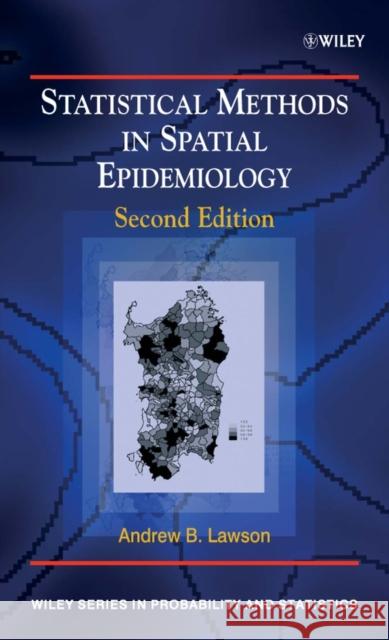
Andrew B. Lawson
Statistical Methods in Spatial Epidemiology Andrew B. Lawson 9780470014844 John Wiley & Sons - książkaWidoczna okładka, to zdjęcie poglądowe, a rzeczywista szata graficzna może różnić się od prezentowanej.

Statistical Methods in Spatial Epidemiology

ISBN-13: 9780470014844 / Angielski / Twarda / 2006 / 424 str.

Andrew B. Lawson
cena 594,13 zł
(netto: 565,84 VAT:  5%)

Najniższa cena z 30 dni: 589,26 zł
Termin realizacji zamówienia:
ok. 30 dni roboczych
Bez gwarancji dostawy przed świętami

Darmowa dostawa!

Spatial epidemiology is the description and analysis of the geographical distribution of disease. It is more important now than ever, with modern threats such as bio-terrorism making such analysis even more complex. This second edition of Statistical Methods in Spatial Epidemiology is updated and expanded to offer a complete coverage of the analysis and application of spatial statistical methods. The book is divided into two main sections: Part 1 introduces basic definitions and terminology, along with map construction and some basic models. This is expanded upon in Part II by applying this knowledge to the fundamental problems within spatial epidemiology, such as disease mapping, ecological analysis, disease clustering, bio-terrorism, space-time analysis, surveillance and infectious disease modelling.

  • Provides a comprehensive overview of the main statistical methods used in spatial epidemiology.
  • Updated to include a new emphasis on bio-terrorism and disease surveillance.
  • Emphasizes the importance of space-time modelling and outlines the practical application of the method.
  • Discusses the wide range of software available for analyzing spatial data, including WinBUGS, SaTScan and R, and features an accompanying website hosting related software.
  • Contains numerous data sets, each representing a different approach to the analysis, and provides an insight into various modelling techniques.
This text is primarily aimed at medical statisticians, researchers and practitioners from public health and epidemiology. It is also suitable for postgraduate students of statistics and epidemiology, as well professionals working in government agencies.

Kategorie:
Nauka, Medycyna
Kategorie BISAC:
Medical > Biostatistics
Medical > Epidemiologia
Wydawca:
John Wiley & Sons
Seria wydawnicza:
Wiley Series in Probability and Statistics
Język:
Angielski
ISBN-13:
9780470014844
Rok wydania:
2006
Numer serii:
000033279
Ilość stron:
424
Waga:
0.71 kg
Wymiary:
23.29 x 16.36 x 2.77
Oprawa:
Twarda
Wolumenów:
01
Dodatkowe informacje:
Bibliografia
Wydanie ilustrowane

"…the second edition is a substantial improvement on what was already a valuable, well structured and comprehensive reference…" ( Biometrics, September 2007)

Preface and Acknowledgements to Second Edition.

Preface and Acknowledgements.

I: The Nature of Spatial Epidemiology.

1. Definitions, Terminolgy and Data Sets.

1.1 Map Hypotheses and Modelling Approaches.

1.2 Definitions and Data Examples.

1.3 Further definitions.

1.4 Some Data Examples.

2.Scales of Measurement and Data Availability.

2.1 Small Scale.

2.2 Large Scale.

2.3 Rate Dependence.

2.4 DataQuality and the Ecological Fallacy.

2.5 Edge E.ects.

3.Geographical Representation and Mapping.

3.1 Introduction and Definitions.

3.2 Maps and Mapping.

3.3 Statistical Accuracy.

3.4 Aggregation.

3.5 Mapping Issues related toAggregated Data.

3.6 Conclusions.

4.Basic Models.

4.1 Sampling Considerations.

4.2 Likelihood–based and Bayesian Approaches.

4.3 Point EventModels.

4.4 CountModels.

5.Exploratory Approaches, Parametric Estimation and Inference.

5.1 ExploratoryMethods.

5.2 Parameter Estimation.

5.3 Residual Diagnostics.

5.4 Hypothesis Testing.

5.5 Edge E.ects.

II:Important Problems in Spatial Epidemiology.

6.Small Scale: Disease Clustering.

6.1 Definition of Clusters and Clustering.

6.2 Modelling Issues.

6.3 Hypothesis Tests for Clustering.

6.4 Space–Time Clustering.

6.5 Clustering Examples.

6.6 OtherMethods related to clustering.

7.Small Scale: Putative Sources of Hazard.

7.1 Introduction.

7.2 StudyDesign.

7.3 Problems of Inference.

7.4 Modelling the Hazard Exposure Risk.

7.5 Models for Case Event Data.

7.6 ACase Event Example.

7.7 Models for CountData.

7.8 ACountData Example.

7.9 OtherDirections.

8. Large Scale: Disease Mapping.

8.1 Introduction.

8.2 Simple Statistical Representation.

8.3 BasicModels.

8.4 AdvancedMethods.

8.5 Model Variants and Extensions.

8.6 ApproximateMethods.

8.7 MultivariateMethods.

8.8 Evaluation ofModel Performance.

8.9 Hypothesis Testing in DiseaseMapping.

8.10 Space–Time DiseaseMapping.

8.11 Spatial Survival and longitudinal data.

8.12 DiseaseMapping: Case Studies.

9.Ecological Analysis and Scale Change.

9.1 Ecological Analysis: Introduction.

9.2 Small–ScaleModelling Issues.

9.3 Changes of Scale andMAUP.

9.4 A Simple Example: Sudden Infant Death in North Carolina.

9.5 ACase Study: Malaria and IDDM.

10.Infectious Disease Modelling.

10.1 Introduction.

10.2 GeneralModelDevelopment.

10.3 SpatialModelDevelopment.

10.4 Modelling Special Cases for Individual Level Data.

10.5 Survival Analysis with spatial dependence.

10.6 Individual level data example.

10.7 Underascertainment and Censoring.

10.8 Conclusions.

11.Large Scale: Surveillance.

11.1 Process ControlMethodology.

11.2 Spatio–Temporal Modelling.

11.3 Spatio–TemporalMonitoring.

11.4 Syndromic Surveillance.

11.5 Multivariate–Mulitfocus Surveillance.

11.6 Bayesian Approaches.

11.7 Computational Considerations.

11.8 Infectious Diseases.

11.9 Conclusions.

Appendix A:Monte Carlo Testing, Parametric Bootstrap and Simulation Envelopes.

Appendix B:Markov ChainMonte Carlo Methods.

Appendix C:Algorithms and Software.

Appendix D: Glossary of Estimators.

Appendix E:Software.

Bibliography.

Index.

Professor Andrew B. Lawson is a respected and well–known academic. He has published many papers in leading journals, and a number of books on spatial statistics, including five for Wiley.

Spatial epidemiology is the description and analysis of the geographical distribution of disease. It is more important now than ever, with modern threats such as bio–terrorism making such analysis even more complex. This second edition of Statistical Methods in Spatial Epidemiology is updated and expanded to offer a complete coverage of the analysis and application of spatial statistical methods. The book is divided into two main sections: Part 1 introduces basic definitions and terminology, along with map construction and some basic models. This is expanded upon in Part II by applying this knowledge to the fundamental problems within spatial epidemiology, such as disease mapping, ecological analysis, disease clustering, bio–terrorism, space–time analysis, surveillance and infectious disease modelling.

  • Provides a comprehensive overview of the main statistical methods used in spatial epidemiology.
  • Updated to include a new emphasis on bio–terrorism and disease surveillance.
  • Emphasizes the importance of space–time modelling and outlines the practical application of the method.
  • Discusses the wide range of software available for analyzing spatial data, including WinBUGS, SaTScan and R, and features an accompanying website hosting related software.
  • Contains numerous data sets, each representing a different approach to the analysis, and provides an insight into various modelling techniques.


This text is primarily aimed at medical statisticians, researchers and practitioners from public health and epidemiology. It is also suitable for postgraduate students of statistics and epidemiology, as well professionals working in government agencies.

Lawson, Andrew B. Professor Andrew B. Lawson is a respected and well... więcej >


Udostępnij

Facebook - konto krainaksiazek.pl


Opinie o Krainaksiazek.pl na Opineo.pl

Partner Mybenefit

Krainaksiazek.pl w programie rzetelna firma Krainaksiaze.pl - płatności przez paypal

Czytaj nas na:

Facebook - krainaksiazek.pl
  • książki na zamówienie
  • granty
  • książka na prezent
  • kontakt
  • pomoc
  • opinie
  • regulamin
  • polityka prywatności

Zobacz:

  • Księgarnia czeska

  • Wydawnictwo Książkowe Klimaty

1997-2025 DolnySlask.com Agencja Internetowa

© 1997-2022 krainaksiazek.pl
     
KONTAKT | REGULAMIN | POLITYKA PRYWATNOŚCI | USTAWIENIA PRYWATNOŚCI
Zobacz: Księgarnia Czeska | Wydawnictwo Książkowe Klimaty | Mapa strony | Lista autorów
KrainaKsiazek.PL - Księgarnia Internetowa

Polityka prywatnosci - link
Krainaksiazek.pl - płatnośc Przelewy24
Przechowalnia Przechowalnia





