• Wyszukiwanie zaawansowane
  • Kategorie
  • Kategorie BISAC
  • Książki na zamówienie
  • Promocje
  • Granty
  • Książka na prezent
  • Opinie
  • Pomoc
  • Załóż konto
  • Zaloguj się

Statistical Inference: Theory and Practice » książka


zaloguj się | załóż konto
Logo Krainaksiazek.pl

koszyk

konto

szukaj
topmenu
Księgarnia internetowa
Szukaj
Książki na zamówienie
Promocje
Granty
Książka na prezent
Moje konto
Pomoc
 
 
Wyszukiwanie zaawansowane
Pusty koszyk
Bezpłatna dostawa dla zamówień powyżej 20 złBezpłatna dostawa dla zamówień powyżej 20 zł

Kategorie główne

• Nauka
 [2948695]
• Literatura piękna
 [1824038]

  więcej...
• Turystyka
 [70868]
• Informatyka
 [151073]
• Komiksy
 [35227]
• Encyklopedie
 [23181]
• Dziecięca
 [621575]
• Hobby
 [138961]
• AudioBooki
 [1642]
• Literatura faktu
 [228651]
• Muzyka CD
 [371]
• Słowniki
 [2933]
• Inne
 [445341]
• Kalendarze
 [1243]
• Podręczniki
 [164416]
• Poradniki
 [479493]
• Religia
 [510449]
• Czasopisma
 [502]
• Sport
 [61384]
• Sztuka
 [243086]
• CD, DVD, Video
 [3417]
• Technologie
 [219673]
• Zdrowie
 [100865]
• Książkowe Klimaty
 [124]
• Zabawki
 [2168]
• Puzzle, gry
 [3372]
• Literatura w języku ukraińskim
 [260]
• Art. papiernicze i szkolne
 [7838]
Kategorie szczegółowe BISAC

Statistical Inference: Theory and Practice

ISBN-13: 9789401067461 / Angielski / Miękka / 2011 / 320 str.
Tadeusz Bromek; Elzbieta Pleszczynska
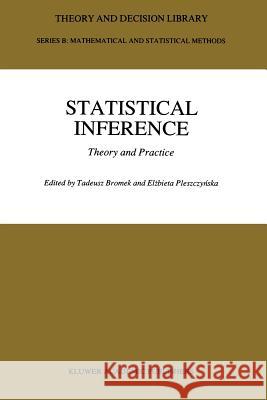
Statistical Inference: Theory and Practice Bromek, Tadeusz 9789401067461 Springer - książkaWidoczna okładka, to zdjęcie poglądowe, a rzeczywista szata graficzna może różnić się od prezentowanej.

Statistical Inference: Theory and Practice

ISBN-13: 9789401067461 / Angielski / Miękka / 2011 / 320 str.

Tadeusz Bromek; Elzbieta Pleszczynska
cena 201,72
(netto: 192,11 VAT:  5%)

Najniższa cena z 30 dni: 192,74
Termin realizacji zamówienia:
ok. 22 dni roboczych.

Darmowa dostawa!

Use and misuse of statistics seems to be the signum temporis of past decades. But nowadays this practice seems slowly to be wearing away, and common sense and responsibility recapturing their position. It is our contention that little by little statistics should return to its starting point, i.e., to formalizing and analyzing empirical phenomena. This requires the reevalu ation of many traditions and the rejection of many myths. We hope that our book would go some way towards this aim. We show the sharp conflict between what is needed and what is feasible. Moreover, we show how slender are the links between theory and practice in statistical inference, links which are sometimes no more than mutual inspiration. In Part One we present the consecutive stages of formalization of statistical problems, i.e., the description of the experiment, the presentation of the aim of the investigation, and of the constraints put upon the decision rules. We stress the fact that at each of these stages there is room for arbitrariness. We prove that the links between the real problem and its formal counterpart are often so weak that the solution of the formal problem may have no rational interpretation at the practical level. We give a considerable amount of thought to the reduction of statistical problems."


Kategorie:
Nauka, Matematyka
Kategorie BISAC:
Mathematics > Prawdopodobieństwo i statystyka
Mathematics > Matematyka stosowana
Science > Life Sciences - Genetics & Genomics
Wydawca:
Springer
Seria wydawnicza:
Theory and Decision Library B
Język:
Angielski
ISBN-13:
9789401067461
Rok wydania:
2011
Wydanie:
1991
Numer serii:
000340999
Ilość stron:
320
Waga:
0.45 kg
Wymiary:
23.39 x 15.6 x 1.75
Oprawa:
Miękka
Wolumenów:
01

One. Formalization of statistical problems.- 1 Statistical description of empirical phenomena.- 1.1. Statistical spaces.- 1.2. Parameters and indices of probability distributions.- 1.3. Random variables and statistics.- 1.4. Observable events.- 1.5. Final remarks.- 2. A scheme of statistical problems.- 2.1. Formalization of the goal of research.- 2.2. Decision rules.- 2.3. Standard classes of statistical problems.- 2.4. Sufficient and prediction sufficient statistics.- 2.5. Reduction of a statistical problem.- 2.6. Final remarks.- Two. Selected theoretical topics.- 3. Discriminant analysis.- 3.1. Introduction.- 3.2. Probabilistic problems.- 3.3. Statistical problems.- 3.4. Class separability measures.- 3.5. Final remarks.- 4. Screening problems.- 4.1. Introduction.- 4.2.Probabilistic screening problems.- 4.3.Statistical screening problems in a normal model.- 4.4. Screening in a nonparametric model.- 4.5. Final remarks.- 5. Evaluation of stochastic dependence.- 5.1. Introduction.- 5.2. Dependence between two binary random variables.- 5.3. Dependence in case of bivariate distributions.- 5.4. Monotone dependence function.- 5.5. Codependence in a pair of random variables.- 5.6. Final remarks.- Three. Selected practical problems.- 6. Statistical problems of population genetics.- 6.1. Introduction.- 6.2. The genetic structure of man and its relations with the phenotype.- 6.3. Genetic parameters of the human population.- 6.4. Estimation of gene probabilities for a single locus.- 6.5. Testing the Hardy-Weinberg hypothesis.- 6.6. Final remarks.- 7. Paternity proving.- 7.1. Introduction.- 7.2. Schemes of paternity recognition.- 7.3. A study of blood group traits.- 7.4. Anthropological evidence.- 7.5. Final remarks.- 8. Studies on sister cells.- 8.1. Introduction.- 8.2. Study of a population of pairs of objects.- 8.3. Sister cells as an experimental system.- 8.4. Investigation of Chilodonella steini (Ciliata, Kinetophragminophora)sister cells.- 8.5. Sister systems in investigations of the cell cycle.- 8.6. Final remarks.- 9. Survival analysis for censored data.- 9.1. Introduction.- 9.2. A model of random censorship.- 9.3. The Kaplan—Meier estimator.- 9.4. Main asymptotic properties of the K—M estimator.- 9.5. A two-sample problem for censored data.- 9.6. Final remarks.- 10. Latent variables in experimental psychology.- 10.1. Introduction.- 10.2. Typical experimental schemes.- 10.3. Inference in parametric models.- 10.4. Inference in nonparametric models.- 10.5. Final remarks.- 11. Queueing models of computer systems.- 11.1. Introduction.- 11.2. A queueing model.- 11.3. Analysis of the model.- 11.4. System parameter estimation.- 11.5. Final remarks.- Closing remarks.- Appendix. Algorithms for evaluating monotone dependence function and screening threshold.- A.1. Introduction.- A.2. Algorithm for evaluating monotone dependence function for a bivariate discrete distribution /J. ?wik, A. Kowalski.- A.3. Algorithm for evaluating monotone dependence function for an empiricaldistribution based on a raw sample /J. ?wik, A. Kowalski.- A.4. Algorithm for evaluating screening threshold /J. ?wik.- References.


Udostępnij

Facebook - konto krainaksiazek.pl


Opinie o Krainaksiazek.pl na Opineo.pl

Partner Mybenefit

Krainaksiazek.pl w programie rzetelna firma Krainaksiaze.pl - płatności przez paypal

Czytaj nas na:

Facebook - krainaksiazek.pl
  • książki na zamówienie
  • granty
  • książka na prezent
  • kontakt
  • pomoc
  • opinie
  • regulamin
  • polityka prywatności

Zobacz:

  • Księgarnia czeska

  • Wydawnictwo Książkowe Klimaty

1997-2026 DolnySlask.com Agencja Internetowa

© 1997-2022 krainaksiazek.pl
     
KONTAKT | REGULAMIN | POLITYKA PRYWATNOŚCI | USTAWIENIA PRYWATNOŚCI
Zobacz: Księgarnia Czeska | Wydawnictwo Książkowe Klimaty | Mapa strony | Lista autorów
KrainaKsiazek.PL - Księgarnia Internetowa

Polityka prywatnosci - link
Krainaksiazek.pl - płatnośc Przelewy24
Przechowalnia Przechowalnia






