• Wyszukiwanie zaawansowane
  • Kategorie
  • Kategorie BISAC
  • Książki na zamówienie
  • Promocje
  • Granty
  • Książka na prezent
  • Opinie
  • Pomoc
  • Załóż konto
  • Zaloguj się

Statistical Analysis in Microbiology: Statnotes » książka


zaloguj się | załóż konto
Logo Krainaksiazek.pl

koszyk

konto

szukaj
topmenu
Księgarnia internetowa
Szukaj
Książki na zamówienie
Promocje
Granty
Książka na prezent
Moje konto
Pomoc
 
 
Wyszukiwanie zaawansowane
Pusty koszyk
Bezpłatna dostawa dla zamówień powyżej 20 złBezpłatna dostawa dla zamówień powyżej 20 zł

Kategorie główne

• Nauka
 [2944077]
• Literatura piękna
 [1814251]

  więcej...
• Turystyka
 [70679]
• Informatyka
 [151074]
• Komiksy
 [35590]
• Encyklopedie
 [23169]
• Dziecięca
 [611005]
• Hobby
 [136031]
• AudioBooki
 [1718]
• Literatura faktu
 [225599]
• Muzyka CD
 [379]
• Słowniki
 [2916]
• Inne
 [443741]
• Kalendarze
 [1187]
• Podręczniki
 [166463]
• Poradniki
 [469211]
• Religia
 [506887]
• Czasopisma
 [481]
• Sport
 [61343]
• Sztuka
 [242115]
• CD, DVD, Video
 [3348]
• Technologie
 [219293]
• Zdrowie
 [98602]
• Książkowe Klimaty
 [124]
• Zabawki
 [2385]
• Puzzle, gry
 [3504]
• Literatura w języku ukraińskim
 [260]
• Art. papiernicze i szkolne
 [7151]
Kategorie szczegółowe BISAC

Statistical Analysis in Microbiology: Statnotes

ISBN-13: 9780470559307 / Angielski / Miękka / 2010 / 192 str.
Richard A Armstrong
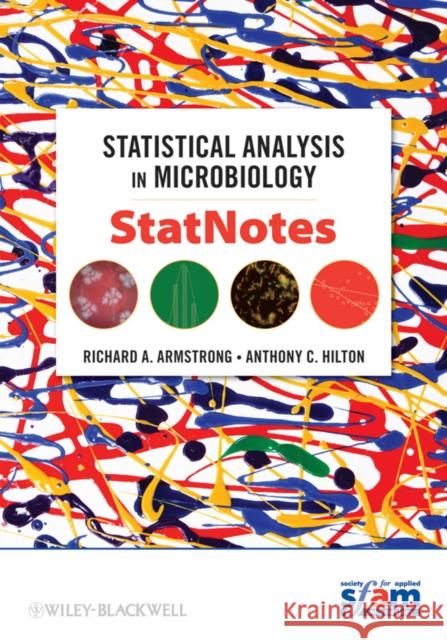
Statistical Analysis in Microbiology: Statnotes Armstrong, Richard A. 9780470559307  - książkaWidoczna okładka, to zdjęcie poglądowe, a rzeczywista szata graficzna może różnić się od prezentowanej.

Statistical Analysis in Microbiology: Statnotes

ISBN-13: 9780470559307 / Angielski / Miękka / 2010 / 192 str.

Richard A Armstrong
cena 267,82
(netto: 255,07 VAT:  5%)

Najniższa cena z 30 dni: 264,56
Termin realizacji zamówienia:
ok. 30 dni roboczych.

Darmowa dostawa!

This book is aimed primarily at microbiologists who are undertaking research, and who require a basic knowledge of statistics to analyse their experimental data. Computer software employing a wide range of data analysis methods is widely available to experimental scientists. The availability of this software, however, makes it even more essential that microbiologists understand the basic principles of statistics. Statistical analysis of data can be complex with many different methods of approach, each of which applies in a particular experimental circumstance. In addition, most statistical software commercially available is complex and difficult to use. Hence, it is easy to apply an incorrect statistical method to data and to draw the wrong conclusions from an experiment. The purpose of this book is an attempt to present the basic logic of statistics as clearly as possible and therefore, to dispel some of the myths that often surround the subject. The book is presented as a series of 2018Statnotes', many of which were originally published in the 2018Microbiologist' by the Society for Applied Microbiology, each of which deals with various topics including the nature of variables, comparing the means of two or more groups, non-parametric statistics, analysis of variance, correlating variables, and more complex methods such as multiple linear regression and factor analysis. In each case, the relevant statistical methods are illustrated with scenarios and real experimental data drawn from experiments in microbiology. The text will incorporate a glossary of the most commonly used statistical terms and a section to aid the investigator to select the most appropriate test.


Kategorie:
Nauka, Biologia i przyroda
Kategorie BISAC:
Science > Mikrobiologia
Język:
Angielski
ISBN-13:
9780470559307
Rok wydania:
2010
Ilość stron:
192
Waga:
0.34 kg
Wymiary:
24.89 x 17.53 x 1.78
Oprawa:
Miękka
Wolumenów:
01
Dodatkowe informacje:
Bibliografia

Preface.

Acknowledgments.

Note on Statistical Software.

1 ARE THE DATA NORMALLY DISTRIBUTED?

1.1 Introduction.

1.2 Types of Data and Scores.

1.3 Scenario.

1.4 Data.

1.5 Analysis: Fitting the Normal Distribution.

1.6 Conclusion.

2 DESCRIBING THE NORMAL DISTRIBUTION.

2.1 Introduction.

2.2 Scenario.

2.3 Data.

2.4 Analysis: Describing the Normal Distribution.

2.5 Analysis: Is a Single Observation Typical of the Population?

2.6 Analysis: Describing the Variation of Sample Means.

2.7 Analysis: How to Fit Confidence Intervals to a Sample Mean.

2.8 Conclusion.

3 TESTING THE DIFFERENCE BETWEEN TWO GROUPS.

3.1 Introduction.

3.2 Scenario.

3.3 Data.

3.4 Analysis: The Unpaired t Test.

3.5 One–Tail and Two–Tail Tests.

3.6 Analysis: The Paired t Test.

3.7 Unpaired versus the Paired Design.

3.8 Conclusion.

4 WHAT IF THE DATA ARE NOT NORMALLY DISTRIBUTED?

4.1 Introduction.

4.2 How to Recognize a Normal Distribution.

4.3 Nonnormal Distributions.

4.4 Data Transformation.

4.5 Scenario.

4.6 Data.

4.7 Analysis: Mann Whitney U test (for Unpaired Data).

4.8 Analysis: Wilcoxon Signed–Rank Test (for Paired Data).

4.9 Comparison of Parametric and Nonparametric Tests.

4.10 Conclusion.

5 CHI–SQUARE CONTINGENCY TABLES.

5.1 Introduction.

5.2 Scenario.

5.3 Data.

5.4 Analysis: 2 x 2 Contingency Table.

5.5 Analysis: Fisher′s 2 x 2 Exact Test.

5.6 Analysis: Rows x Columns (R x C) Contingency Tables.

5.7 Conclusion.

6 ONE–WAY ANALYSIS OF VARIANCE (ANOVA).

6.1 Introduction.

6.2 Scenario.

6.3 Data.

6.4 Analysis.

6.5 Assumptions of ANOVA.

6.6 Conclusion.

7 POST HOC TESTS.

7.1 Introduction.

7.2 Scenario.

7.3 Data.

7.4 Analysis: Planned Comparisons between the Means.

7.5 Analysis: Post Hoc Tests.

7.6 Conclusion.

8 IS ONE SET OF DATA MORE VARIABLE THAN ANOTHER?

8.1 Introduction.

8.2 Scenario.

8.3 Data.

8.4 Analysis of Two Groups: Variance Ratio Test.

8.5 Analysis of Three or More Groups: Bartlett′s Test.

8.6 Analysis of Three or More Groups: Levene′s Test.

8.7 Analysis of Three or More Groups: Brown Forsythe Test.

8.8 Conclusion.

9 STATISTICAL POWER AND SAMPLE SIZE.

9.1 Introduction.

9.2 Calculate Sample Size for Comparing Two Independent Treatments.

9.3 Implications of Sample Size Calculations.

9.4 Calculation of the Power (P ) of a Test.

9.5 Power and Sample Size in Other Designs.

9.6 Power and Sample Size in ANOVA.

9.7 More Complex Experimental Designs.

9.8 Simple Rule of Thumb.

9.9 Conclusion.

10 ONE–WAY ANALYSIS OF VARIANCE (RANDOM EFFECTS MODEL): THE NESTED OR HIERARCHICAL DESIGN.

10.1 Introduction.

10.2 Scenario.

10.3 Data.

10.4 Analysis.

10.5 Distinguish Random– and Fixed–Effect Factors.

10.6 Conclusion.

11 TWO–WAY ANALYSIS OF VARIANCE.

11.1 Introduction.

11.2 Scenario.

11.3 Data.

11.4 Analysis.

11.5 Conclusion.

12 TWO–FACTOR ANALYSIS OF VARIANCE.

12.1 Introduction.

12.2 Scenario.

12.3 Data.

12.4 Analysis.

12.5 Conclusion.

13 SPLIT–PLOT ANALYSIS OF VARIANCE.

13.1 Introduction.

13.2 Scenario.

13.3 Data.

13.4 Analysis.

13.5 Conclusion.

14 REPEATED–MEASURES ANALYSIS OF VARIANCE.

14.1 Introduction.

14.2 Scenario.

14.3 Data.

14.4 Analysis.

14.5 Conclusion.

15 CORRELATION OF TWO VARIABLES.

15.1 Introduction.

15.2 Naming Variables.

15.3 Scenario.

15.4 Data.

15.5 Analysis.

15.6 Limitations of r.

15.7 Conclusion.

16 LIMITS OF AGREEMENT.

16.1 Introduction.

16.2 Scenario.

16.3 Data.

16.4 Analysis.

16.5 Conclusion.

17 NONPARAMETRIC CORRELATION COEFFICIENTS.

17.1 Introduction.

17.2 Bivariate Normal Distribution.

17.3 Scenario.

17.4 Data.

17.5 Analysis: Spearman′s Rank Correlation ( , rs).

17.6 Analysis: Kendall s Rank Correlation ( ).

17.7 Analysis: Gamma ( ).

17.8 Conclusion.

18 FITTING A REGRESSION LINE TO DATA.

18.1 Introduction.

18.2 Line of Best Fit.

18.3 Scenario.

18.4 Data.

18.5 Analysis: Fitting the Line.

18.6 Analysis: Goodness of Fit of the Line to the Points.

18.7 Conclusion.

19 USING A REGRESSION LINE FOR PREDICTION AND CALIBRATION.

19.1 Introduction.

19.2 Types of Prediction Problem.

19.3 Scenario.

19.4 Data.

19.5 Analysis.

19.6 Conclusion.

20 COMPARISON OF REGRESSION LINES.

20.1 Introduction.

20.2 Scenario.

20.3 Data.

20.4 Analysis.

20.5 Conclusion.

21 NONLINEAR REGRESSION: FITTING AN EXPONENTIAL CURVE.

21.1 Introduction.

21.2 Common Types of Curve.

21.3 Scenario.

21.4 Data.

21.5 Analysis.

21.6 Conclusion.

22 NONLINEAR REGRESSION: FITTING A GENERAL POLYNOMIAL–TYPE CURVE.

22.1 Introduction.

22.2 Scenario A: Does a Curve Fit Better Than a Straight Line?

22.3 Data.

22.4 Analysis.

22.5 Scenario B: Fitting a General Polynomial–Type Curve.

22.6 Data.

22.7 Analysis.

22.8 Conclusion.

23 NONLINEAR REGRESSION: FITTING A LOGISTIC GROWTH CURVE.

23.1 Introduction.

23.2 Scenario.

23.3 Data.

23.4 Analysis: Nonlinear Estimation Methods.

23.6 Conclusion.

24 NONPARAMETRIC ANALYSIS OF VARIANCE.

24.1 Introduction.

24.2 Scenario.

24.3 Analysis: Kruskal Wallis Test.

24.4 Analysis: Friedmann′s Test.

24.5 Conclusion.

25 MULTIPLE LINEAR REGRESSION.

25.1 Introduction.

25.2 Scenario.

25.3 Data.

25.4 Analysis.

25.5 Conclusion.

26 STEPWISE MULTIPLE REGRESSION.

26.1 Introduction.

26.2 Scenario.

26.3 Data.

22.4 Analysis by the Step–Up Method.

26.5 Conclusion.

27 CLASSIFICATION AND DENDROGRAMS.

27.1 Introduction.

27.2 Scenario.

27.3 Data.

27.4 Analysis.

27.5 Conclusion.

28 FACTOR ANALYSIS AND PRINCIPAL COMPONENTS ANALYSIS.

28.1 Introduction.

28.2 Scenario.

28.3 Data.

28.4 Analysis: Theory.

28.5 Analysis: How Is the Analysis Carried Out?

28.6 Conclusion.

References.

Appendix 1 Which Test to Use: Table.

Appendix 2 Which Test to Use: Key.

Appendix 3 Glossary of Statistical Terms and Their Abbreviations.

Appendix 4 Summary of Sample Size Procedures for Different Statistical Tests.

Index of Statistical Tests and Procedures.

Statistical Analysis in Microbiology: StatNotes has been designed specifically for microbiologists who are involved in experimental research and need to draw accurate conclusions from their findings. It features twenty–eight StatNotes that together enable you to understand the basic principles of statistics, choose the correct statistical methods to analyze your experimental data, and work with a variety of commercially available statistical software packages. These StatNotes are based on a series of popular articles published in Microbiologist, the official magazine of the Society for Applied Microbiology. They explore a variety of topics in statistics that are essential for analyzing experimental data, including:

  • Nature of variables

  • Comparison of means of two or more groups

  • Non–parametric statistics

  • Analysis of variance

  • Correlation of variables

  • Multiple linear regression and factor analysis

Throughout the book, the logic and mechanics of each statistical test presented are carefully explained. Moreover, each statistical test is illustrated with examples drawn from actual experiments and research data in microbiology. As a result, you can clearly see how each test is interpreted and what types of conclusions can be drawn from the research data.

In the back of the book, you′ll find a glossary of statistical terms and their abbreviations as well as a summary of sample size calculations. You′ll also find two appendices that help you select the most appropriate statistical tests based on the type of research you′re conducting and the type of data that you′re gathering.

Given the wide variety of statistical software packages, it′s essential that you understand the underlying principles and purpose of each statistical method; applying an inappropriate statistical test can easily lead to the wrong conclusions. Written specifically for microbiologists, the highly acclaimed and popular StatNotes enable you to choose which statistical methods should be applied to analyze and draw correct conclusions from your experimental data.


Udostępnij

Facebook - konto krainaksiazek.pl


Opinie o Krainaksiazek.pl na Opineo.pl

Partner Mybenefit

Krainaksiazek.pl w programie rzetelna firma Krainaksiaze.pl - płatności przez paypal

Czytaj nas na:

Facebook - krainaksiazek.pl
  • książki na zamówienie
  • granty
  • książka na prezent
  • kontakt
  • pomoc
  • opinie
  • regulamin
  • polityka prywatności

Zobacz:

  • Księgarnia czeska

  • Wydawnictwo Książkowe Klimaty

1997-2026 DolnySlask.com Agencja Internetowa

© 1997-2022 krainaksiazek.pl
     
KONTAKT | REGULAMIN | POLITYKA PRYWATNOŚCI | USTAWIENIA PRYWATNOŚCI
Zobacz: Księgarnia Czeska | Wydawnictwo Książkowe Klimaty | Mapa strony | Lista autorów
KrainaKsiazek.PL - Księgarnia Internetowa

Polityka prywatnosci - link
Krainaksiazek.pl - płatnośc Przelewy24
Przechowalnia Przechowalnia





