• Wyszukiwanie zaawansowane
  • Kategorie
  • Kategorie BISAC
  • Książki na zamówienie
  • Promocje
  • Granty
  • Książka na prezent
  • Opinie
  • Pomoc
  • Załóż konto
  • Zaloguj się

Statistical Analysis in Forensic Science: Evidential Value of Multivariate Physicochemical Data » książka


zaloguj się | załóż konto
Logo Krainaksiazek.pl

koszyk

konto

szukaj
topmenu
Księgarnia internetowa
Szukaj
Książki na zamówienie
Promocje
Granty
Książka na prezent
Moje konto
Pomoc
 
 
Wyszukiwanie zaawansowane
Pusty koszyk
Bezpłatna dostawa dla zamówień powyżej 20 złBezpłatna dostawa dla zamówień powyżej 20 zł

Kategorie główne

• Nauka
 [2949524]
• Literatura piękna
 [1817948]

  więcej...
• Turystyka
 [70715]
• Informatyka
 [151291]
• Komiksy
 [35671]
• Encyklopedie
 [23176]
• Dziecięca
 [612440]
• Hobby
 [136066]
• AudioBooki
 [1740]
• Literatura faktu
 [226030]
• Muzyka CD
 [378]
• Słowniki
 [2918]
• Inne
 [445441]
• Kalendarze
 [1181]
• Podręczniki
 [166545]
• Poradniki
 [469898]
• Religia
 [508035]
• Czasopisma
 [502]
• Sport
 [61392]
• Sztuka
 [242759]
• CD, DVD, Video
 [3348]
• Technologie
 [219537]
• Zdrowie
 [98738]
• Książkowe Klimaty
 [124]
• Zabawki
 [2382]
• Puzzle, gry
 [3543]
• Literatura w języku ukraińskim
 [259]
• Art. papiernicze i szkolne
 [7107]
Kategorie szczegółowe BISAC

Statistical Analysis in Forensic Science: Evidential Value of Multivariate Physicochemical Data

ISBN-13: 9780470972106 / Angielski / Twarda / 2014 / 336 str.
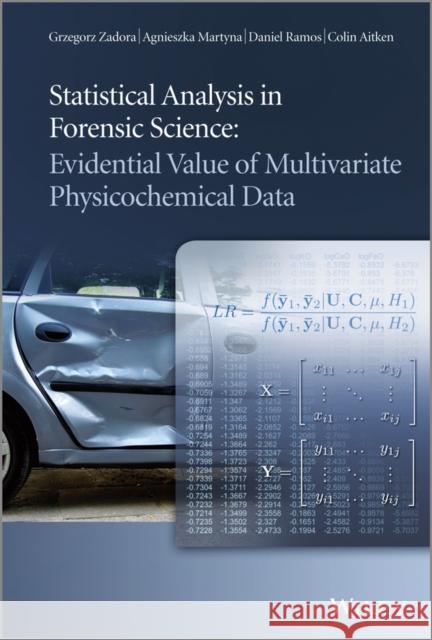
Grzegorz Zadora; Agnieszka Martyna; Daniel Ramos
Statistical Analysis in Forensic Science: Evidential Value of Multivariate Physicochemical Data Martyna, Agnieszka 9780470972106 John Wiley & Sons - książkaWidoczna okładka, to zdjęcie poglądowe, a rzeczywista szata graficzna może różnić się od prezentowanej.

Statistical Analysis in Forensic Science: Evidential Value of Multivariate Physicochemical Data

ISBN-13: 9780470972106 / Angielski / Twarda / 2014 / 336 str.

Grzegorz Zadora; Agnieszka Martyna; Daniel Ramos
cena 396,71
(netto: 377,82 VAT:  5%)

Najniższa cena z 30 dni: 391,87
Termin realizacji zamówienia:
ok. 30 dni roboczych.

Darmowa dostawa!

A practical guide for determining the evidential value of physicochemical data Microtraces of various materials (e.g. glass, paint, fibres, and petroleum products) are routinely subjected to physicochemical examination by forensic experts, whose role is to evaluate such physicochemical data in the context of the prosecution and defence propositions. Such examinations return various kinds of information, including quantitative data. From the forensic point of view, the most suitable way to evaluate evidence is the likelihood ratio. This book provides a collection of recent approaches to the determination of likelihood ratios and describes suitable software, with documentation and examples of their use in practice. The statistical computing and graphics software environment R, pre-computed Bayesian networks using Hugin Researcher and a new package, calcuLatoR, for the computation of likelihood ratios are all explored. Statistical Analysis in Forensic Science will provide an invaluable practical guide for forensic experts and practitioners, forensic statisticians, analytical chemists, and chemometricians. Key features include:

  • Description of the physicochemical analysis of forensic trace evidence.
  • Detailed description of likelihood ratio models for determining the evidential value of multivariate physicochemical data.
  • Detailed description of methods, such as empirical cross-entropy plots, for assessing the performance of likelihood ratio-based methods for evidence evaluation.
  • Routines written using the open-source R software, as well as Hugin Researcher and calcuLatoR.
  • Practical examples and recommendations for the use of all these methods in practice.

This book provides the methods and software to enable statisticians and forensic experts to work effectively with evidence evaluation methods. It also covers a collection of recent likelihood ratio (LR) approaches, explores suitable software toolboxes, and includes documentation and examples about how to use them in practice.


Kategorie:
Nauka, Matematyka
Kategorie BISAC:
Medical > Forensic Medicine
Mathematics > Prawdopodobieństwo i statystyka
Wydawca:
John Wiley & Sons
Język:
Angielski
ISBN-13:
9780470972106
Rok wydania:
2014
Ilość stron:
336
Waga:
0.68 kg
Wymiary:
24.64 x 17.02 x 2.29
Oprawa:
Twarda
Wolumenów:
01
Dodatkowe informacje:
Bibliografia

Preface xiii

1 Physicochemical data obtained in forensic science laboratories 1

1.1 Introduction 1

1.2 Glass 2

1.3 Flammable liquids: ATD–GC/MS technique 8

1.4 Car paints: Py–GC/MS technique 10

1.5 Fibres and inks: MSP–DAD technique 13

References 15

2 Evaluation of evidence in the form of physicochemical data 19

2.1 Introduction 19

2.2 Comparison problem 21

2.3 Classification problem 27

2.4 Likelihood ratio and Bayes theorem 31

References 32

3 Continuous data 35

3.1 Introduction 35

3.2 Data transformations 37

3.3 Descriptive statistics 39

3.4 Hypothesis testing 59

3.5 Analysis of variance 78

3.6 Cluster analysis 85

3.7 Dimensionality reduction 92

References 105

4 Likelihood ratio models for comparison problems 107

4.1 Introduction 107

4.2 Normal between–object distribution 108

4.3 Between–object distribution modelled by kernel density estimation 110

4.4 Examples 112

4.5 R Software 140

References 149

5 Likelihood ratio models for classification problems 151

5.1 Introduction 151

5.2 Normal between–object distribution 152

5.3 Between–object distribution modelled by kernel density estimation 155

5.4 Examples 157

5.5 R software 172

References 179

6 Performance of likelihood ratio methods 181

6.1 Introduction 181

6.2 Empirical measurement of the performance of likelihood ratios 182

6.3 Histograms and Tippett plots 183

6.4 Measuring discriminating power 186

6.5 Accuracy equals discriminating power plus calibration: Empirical cross–entropy plots 192

6.6 Comparison of the performance of different methods for LR computation 200

6.7 Conclusions: What to measure, and how 214

6.8 Software 215

References 216

Appendix A Probability 218

A.1 Laws of probability 218

A.2 Bayes theorem and the likelihood ratio 222

A.3 Probability distributions for discrete data 225

A.4 Probability distributions for continuous data 227

References 227

Appendix B Matrices: An introduction to matrix algebra 228

B.1 Multiplication by a constant 228

B.2 Adding matrices 229

B.3 Multiplying matrices 230

B.4 Matrix transposition 232

B.5 Determinant of a matrix 232

B.6 Matrix inversion 233

B.7 Matrix equations 235

B.8 Eigenvectors and eigenvalues 237

Reference 239

Appendix C Pool adjacent violators algorithm 240

References 243

Appendix D Introduction to R software 244

D.1 Becoming familiar with R 244

D.2 Basic mathematical operations in R 246

D.3 Data input 252

D.4 Functions in R 254

D.5 Dereferencing 255

D.6 Basic statistical functions 257

D.7 Graphics with R 258

D.8 Saving data 266

D.9 R codes used in Chapters 4 and 5 266

D.10 Evaluating the performance of LR models 289

Reference 293

Appendix E Bayesian network models 294

E.1 Introduction to Bayesian networks 294

E.2 Introduction to Hugin ResearcherTM software 296

References 308

Appendix F Introduction to calcuLatoR software 309

F.1 Introduction 309

F.2 Manual 309

Reference 314

Index 315

Grzegorz Zadora, Institute of Forensic Research, Krakow, Poland.

Daniel Ramos, Telecommunication Engineering, Universidad Autonoma de Madrid, Spain.

A practical guide for determining the evidential value of physicochemical data

Microtraces of various materials (e.g. glass, paint, fibres, and petroleum products) are routinely subjected to physicochemical examination by forensic experts, whose role is to evaluate such physicochemical data in the context of the prosecution and defence propositions. Such examinations return various kinds of information, including quantitative data. From the forensic point of view, the most suitable way to evaluate evidence is the likelihood ratio. This book provides a collection of recent approaches to the determination of likelihood ratios and describes suitable software, with documentation and examples of their use in practice. The statistical computing and graphics software environment R, pre–computed Bayesian networks using Hugin Researcher and a new package, calcuLatoR, for the computation of likelihood ratios are all explored.

Statistical Analysis in Forensic Science will provide an invaluable practical guide for forensic experts and practitioners, forensic statisticians, analytical chemists, and chemometricians.

Key features include:

  • Description of the physicochemical analysis of forensic trace evidence.
  • Detailed description of likelihood ratio models for determining the evidential value of multivariate  physicochemical data.
  • Detailed description of methods, such as empirical cross–entropy plots, for assessing the performance of likelihood ratio–based methods for evidence evaluation.
  • Routines written using the open–source R software, as well as Hugin Researcher and calcuLatoR.
  • Practical examples and recommendations for the use of all these methods in practice.


Udostępnij

Facebook - konto krainaksiazek.pl


Opinie o Krainaksiazek.pl na Opineo.pl

Partner Mybenefit

Krainaksiazek.pl w programie rzetelna firma Krainaksiaze.pl - płatności przez paypal

Czytaj nas na:

Facebook - krainaksiazek.pl
  • książki na zamówienie
  • granty
  • książka na prezent
  • kontakt
  • pomoc
  • opinie
  • regulamin
  • polityka prywatności

Zobacz:

  • Księgarnia czeska

  • Wydawnictwo Książkowe Klimaty

1997-2026 DolnySlask.com Agencja Internetowa

© 1997-2022 krainaksiazek.pl
     
KONTAKT | REGULAMIN | POLITYKA PRYWATNOŚCI | USTAWIENIA PRYWATNOŚCI
Zobacz: Księgarnia Czeska | Wydawnictwo Książkowe Klimaty | Mapa strony | Lista autorów
KrainaKsiazek.PL - Księgarnia Internetowa

Polityka prywatnosci - link
Krainaksiazek.pl - płatnośc Przelewy24
Przechowalnia Przechowalnia






