• Wyszukiwanie zaawansowane
  • Kategorie
  • Kategorie BISAC
  • Książki na zamówienie
  • Promocje
  • Granty
  • Książka na prezent
  • Opinie
  • Pomoc
  • Załóż konto
  • Zaloguj się

Speaking Truth to Power - A Theory of Whistleblowing » książka


zaloguj się | załóż konto
Logo Krainaksiazek.pl

koszyk

konto

szukaj
topmenu
Księgarnia internetowa
Szukaj
Książki na zamówienie
Promocje
Granty
Książka na prezent
Moje konto
Pomoc
 
 
Wyszukiwanie zaawansowane
Pusty koszyk
Bezpłatna dostawa dla zamówień powyżej 20 złBezpłatna dostawa dla zamówień powyżej 20 zł

Kategorie główne

• Nauka
 [2949965]
• Literatura piękna
 [1857847]

  więcej...
• Turystyka
 [70818]
• Informatyka
 [151303]
• Komiksy
 [35733]
• Encyklopedie
 [23180]
• Dziecięca
 [617748]
• Hobby
 [139972]
• AudioBooki
 [1650]
• Literatura faktu
 [228361]
• Muzyka CD
 [398]
• Słowniki
 [2862]
• Inne
 [444732]
• Kalendarze
 [1620]
• Podręczniki
 [167233]
• Poradniki
 [482388]
• Religia
 [509867]
• Czasopisma
 [533]
• Sport
 [61361]
• Sztuka
 [243125]
• CD, DVD, Video
 [3451]
• Technologie
 [219309]
• Zdrowie
 [101347]
• Książkowe Klimaty
 [123]
• Zabawki
 [2362]
• Puzzle, gry
 [3791]
• Literatura w języku ukraińskim
 [253]
• Art. papiernicze i szkolne
 [7933]
Kategorie szczegółowe BISAC

Speaking Truth to Power - A Theory of Whistleblowing

ISBN-13: 9783319907215 / Angielski / Twarda / 2018 / 190 str.
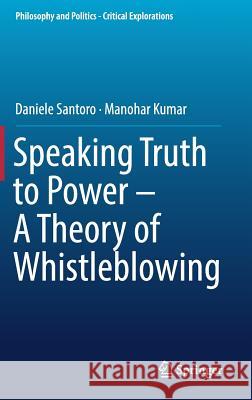
Daniele Santoro; Manohar Kumar
Speaking Truth to Power - A Theory of Whistleblowing Santoro, Daniele; Kumar, Manohar 9783319907215 Springer - książkaWidoczna okładka, to zdjęcie poglądowe, a rzeczywista szata graficzna może różnić się od prezentowanej.

Speaking Truth to Power - A Theory of Whistleblowing

ISBN-13: 9783319907215 / Angielski / Twarda / 2018 / 190 str.

Daniele Santoro; Manohar Kumar
cena 342,95 zł
(netto: 326,62 VAT:  5%)

Najniższa cena z 30 dni: 327,68 zł
Termin realizacji zamówienia:
ok. 22 dni roboczych
Bez gwarancji dostawy przed świętami

Darmowa dostawa!

Whistleblowing is the public disclosure of information with the purpose of revealing wrongdoings and abuses of power that harm the public interest. This book presents a comprehensive theory of whistleblowing: it defines the concept, reconstructs its origins, discusses it within the current ethical debate, and elaborates a justification of unauthorized disclosures. Its normative proposal is based on three criteria of permissibility: the communicative constraints, the intent, and the public interest conditions. The book distinguishes between two forms of whistleblowing, civic and political, showing how they apply in the contexts of corruption and government secrecy.The book articulates a conception of public interest as a claim concerning the presumptive interest of the public. It argues that public interest is defined in opposition to corporate powers and its core content identified by the rights that are all-purposive for the distribution of social benefits. A crucial part of the proposal is dedicated to the impact of security policies and government secrecy on civil liberties. It argues that unrestrained secrecy limits the epistemic entitlement of citizens to know under which conditions their rights are limited by security policies and corporate interests. When citizens are denied the right to assess when these policies are prejudicial to their freedoms, whistleblowing represents a legitimate form of political agency that safeguards the fundamental rights of citizens against the threat of unrestrained secrecy by government power.Finally, the book contributes to shifting the attention of democratic theory from the procedures of consent formation to the mechanisms that guarantee the expression of dissent. It argues that whistleblowing is a distinctive form of civil dissent that contributes to the demands of institutional transparency in constitutional democracies and explores the idea that the way institutions are responsive to dissent determines the robustness of democracy, and ultimately, its legitimacy. What place dissenters have within a society, whether they enjoy personal safety, legal protection, and safe channels for their disclosure, are hallmarks of a good democracy, and of its sense of justice.


Kategorie:
Nauka, Filozofia
Kategorie BISAC:
Philosophy > Political
Political Science > History & Theory - General
Law > Reference
Wydawca:
Springer
Seria wydawnicza:
Philosophy and Politics - Critical Explorations
Język:
Angielski
ISBN-13:
9783319907215
Rok wydania:
2018
Wydanie:
2018
Ilość stron:
190
Waga:
0.46 kg
Wymiary:
23.39 x 15.6 x 1.27
Oprawa:
Twarda
Wolumenów:
01
Dodatkowe informacje:
Wydanie ilustrowane

"Speaking Truth to Power is organized like an essay collection. Each chapter has its own abstract, keywords and reference list. ... The book, nevertheless, represents the most important contribution on the theme, pregnant with important consequences concerning non-ideal democratic theory and the criteria of public interest." (Rúben Batista, Ethical Perspectives, Vol. 27 (1), 2020)

Preface.- Acknowledgments.- 1. Introduction.- 2. What is Whistleblowing?.- 3. Public Interest and the Threat of Corruption. A Case for Civic Whistleblowing.- 4. Liberty, Security, and the Threat of Secrecy.- 5. A Justification of Political Whistleblowing.- 6. Charting Dissent: Whistleblowing, Civil Disobedience, and Conscientious Objection.- 7.  Conclusion.- Index.

Daniele Santoro is Researcher at the Center for Ethics, Politics, and Society (CEPS) of the University of Minho - Portugal. His interests lie in the ethics of dissent, secrecy, constitutional rights, the epistemic aspects of rights and justice, and the pragmatic analysis of legal concepts. His works on these and related subjects have appeared, among others, for Social Epistemology, Philosophy and Social Criticism, Philosophical Topics, Philosophia and in edited volumes for Routledge and Continuum.

He holds a PhD in Philosophy of Law from the University of Padua. In recent year he held research fellowships at the National Research Council of Italy (CNR-IRPPS), the Luiss University of Rome (where he taught for several years), the Institute for Advanced Studies of Aix-Marseille, and the Hoover Chair at UC Louvain.

Manohar Kumar is Assistant Professor of IT and Society at the Indraprastha Institute of Information Technology (IIIT) Delhi. His current research interests are around questions of civil disobedience, democratic secrecy, digital dissent, and epistemic injustice. His works have appeared in Philosophy and Social Criticism, and in edited volumes of Routledge. He holds a PhD in Political Theory from LUISS University, Rome and has held post-doctoral positions at Indian Institute of Technology Delhi, and at Aix Marseille School of Economics, Aix Marseille University, where this book was completed.

Whistleblowing is the public disclosure of information with the purpose of revealing wrongdoings and abuses of power that harm the public interest. This book presents a comprehensive theory of whistleblowing: it defines the concept, reconstructs its origins, discusses it within the current ethical debate, and elaborates a justification of unauthorized disclosures. Its normative proposal is based on three criteria of permissibility: the communicative constraints, the intent, and the public interest conditions. The book distinguishes between two forms of whistleblowing, civic and political, showing how they apply in the contexts of corruption and government secrecy.

The book articulates a conception of public interest as a claim concerning the presumptive interest of the public. It argues that public interest is defined in opposition to corporate powers and its core content identified by the rights that are all-purposive for the distribution of social benefits.  

A crucial part of the proposal is dedicated to the impact of security policies and government secrecy on civil liberties. It argues that unrestrained secrecy limits the epistemic entitlement of citizens to know under which conditions their rights are limited by security policies and corporate interests. When citizens are denied the right to assess when these policies are prejudicial to their freedoms, whistleblowing represents a legitimate form of political agency that safeguards the fundamental rights of citizens against the threat of unrestrained secrecy by government power.

Finally, the book contributes to shifting the attention of democratic theory from the procedures of consent formation to the mechanisms that guarantee the expression of dissent. It argues that whistleblowing is a distinctive form of civil dissent that contributes to the demands of institutional transparency in constitutional democracies and explores the idea that the way institutions are responsive to dissent determines the robustness of democracy, and ultimately, its legitimacy. What place dissenters have within a society, whether they enjoy personal safety, legal protection, and safe channels for their disclosure, are hallmarks of a good democracy, and of its sense of justice.    



Udostępnij

Facebook - konto krainaksiazek.pl


Opinie o Krainaksiazek.pl na Opineo.pl

Partner Mybenefit

Krainaksiazek.pl w programie rzetelna firma Krainaksiaze.pl - płatności przez paypal

Czytaj nas na:

Facebook - krainaksiazek.pl
  • książki na zamówienie
  • granty
  • książka na prezent
  • kontakt
  • pomoc
  • opinie
  • regulamin
  • polityka prywatności

Zobacz:

  • Księgarnia czeska

  • Wydawnictwo Książkowe Klimaty

1997-2025 DolnySlask.com Agencja Internetowa

© 1997-2022 krainaksiazek.pl
     
KONTAKT | REGULAMIN | POLITYKA PRYWATNOŚCI | USTAWIENIA PRYWATNOŚCI
Zobacz: Księgarnia Czeska | Wydawnictwo Książkowe Klimaty | Mapa strony | Lista autorów
KrainaKsiazek.PL - Księgarnia Internetowa

Polityka prywatnosci - link
Krainaksiazek.pl - płatnośc Przelewy24
Przechowalnia Przechowalnia





