• Wyszukiwanie zaawansowane
  • Kategorie
  • Kategorie BISAC
  • Książki na zamówienie
  • Promocje
  • Granty
  • Książka na prezent
  • Opinie
  • Pomoc
  • Załóż konto
  • Zaloguj się

Spatial Reasoning and Planning: Geometry, Mechanism, and Motion » książka


zaloguj się | załóż konto
Logo Krainaksiazek.pl

koszyk

konto

szukaj
topmenu
Księgarnia internetowa
Szukaj
Książki na zamówienie
Promocje
Granty
Książka na prezent
Moje konto
Pomoc
 
 
Wyszukiwanie zaawansowane
Pusty koszyk
Bezpłatna dostawa dla zamówień powyżej 20 złBezpłatna dostawa dla zamówień powyżej 20 zł

Kategorie główne

• Nauka
 [2946600]
• Literatura piękna
 [1856966]

  więcej...
• Turystyka
 [72221]
• Informatyka
 [151456]
• Komiksy
 [35826]
• Encyklopedie
 [23190]
• Dziecięca
 [619653]
• Hobby
 [140543]
• AudioBooki
 [1577]
• Literatura faktu
 [228355]
• Muzyka CD
 [410]
• Słowniki
 [2874]
• Inne
 [445822]
• Kalendarze
 [1744]
• Podręczniki
 [167141]
• Poradniki
 [482898]
• Religia
 [510455]
• Czasopisma
 [526]
• Sport
 [61590]
• Sztuka
 [243598]
• CD, DVD, Video
 [3423]
• Technologie
 [219201]
• Zdrowie
 [101638]
• Książkowe Klimaty
 [124]
• Zabawki
 [2473]
• Puzzle, gry
 [3898]
• Literatura w języku ukraińskim
 [254]
• Art. papiernicze i szkolne
 [8170]
Kategorie szczegółowe BISAC

Spatial Reasoning and Planning: Geometry, Mechanism, and Motion

ISBN-13: 9783540406709 / Angielski / Twarda / 2003 / 180 str.
Laeeque K. Daneshmend; Jiming Liu
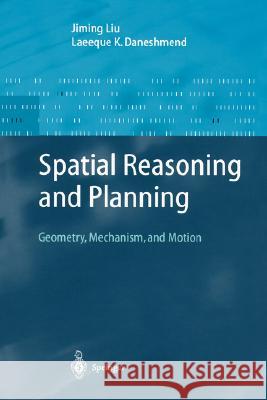
Spatial Reasoning and Planning: Geometry, Mechanism, and Motion Liu, Jiming 9783540406709 Springer - książkaWidoczna okładka, to zdjęcie poglądowe, a rzeczywista szata graficzna może różnić się od prezentowanej.

Spatial Reasoning and Planning: Geometry, Mechanism, and Motion

ISBN-13: 9783540406709 / Angielski / Twarda / 2003 / 180 str.

Laeeque K. Daneshmend; Jiming Liu
cena 403,47 zł
(netto: 384,26 VAT:  5%)

Najniższa cena z 30 dni: 385,52 zł
Termin realizacji zamówienia:
ok. 22 dni roboczych
Bez gwarancji dostawy przed świętami

Darmowa dostawa!

Spatial reasoning and planning is a core constituent in robotics, graphics, computer-aided design, and geographic information systems. After a review of previous work in the related areas, Liu and Daneshmend present here a unified framework for qualitative spatial representation and reasoning, which enables the generation of solutions to spatial problems where the geometric knowledge is imprecise. The approach utilizes qualitative spatial representation and reasoning integrated with a quantitative search procedure based on simulated annealing. Many graphical illustrations and detailed algorithm descriptions help the readers to comprehend the solution paths and to develop their own applications. The book is written as a self-contained text for researchers and graduate students in computer science and related engineering disciplines. The methodologies, algorithmic details, and case studies presented can be used as course material as well as a convenient reference.


Kategorie:
Informatyka, Bazy danych
Kategorie BISAC:
Computers > Artificial Intelligence - Computer Vision & Pattern Recognition
Computers > Data Science - General
Mathematics > Matematyka stosowana
Wydawca:
Springer
Seria wydawnicza:
Advanced Information Processing
Język:
Angielski
ISBN-13:
9783540406709
Rok wydania:
2003
Wydanie:
2004
Numer serii:
000253025
Ilość stron:
180
Waga:
1.01 kg
Wymiary:
23.5 x 15.5
Oprawa:
Twarda
Wolumenów:
01
Dodatkowe informacje:
Bibliografia
Wydanie ilustrowane

From the reviews:

"This book especially deals with the problems of spatial reasoning and planning which are especially important for design stages of mechanical systems where system parameters have not yet been specified ... . The presentation of the material is very interesting and will be an excellent example for further work at similar problems. ... This book can be used for graduate students in several areas, but also ... for the continuous education of people that are already working in a given field." (Christian Posthoff, Zentralblatt MATH, Vol. 1054, 2005)

1 Introduction.- 1.1 Motivation.- 1.2 Issues.- 1.3 Scope of the Book.- 1.4 Organization of the Book.- 2 Overview of Spatial Reasoning and Planning Techniques.- 2.1 Computer-Aided Kinematic Design of Mechanisms.- 2.2 Geometric Path Planning.- 2.2.1 Path Search in Configuration Space.- 2.2.2 Path Finding Based on Direct Free-Space Characterization.- 2.2.3 Local Path Planning.- 2.3 Qualitative Reasoning.- 2.3.1 Qualitative Mechanism Analysis.- 2.3.2 Qualitative Spatial Reasoning.- 2.3.3 Qualitative Robotics.- 2.3.4 Qualitative Physics.- 2.4 Simulated Annealing.- 3 Interesting Problems in Spatial Reasoning and Planning.- 3.1 Terminology and Notation.- 3.2 The Problems.- 3.3 Assumptions.- 4 How to Represent Qualitative Spatial Relationships.- 4.1 Qualitative Distance.- 4.2 Qualitative Angle.- 4.3 Notes on Label-Based Distance and Angle Descriptions.- 4.4 Completeness.- 4.5 Minimum-Spanning Edge (m-Edge) between Two Polygons.- 4.6 Qualitative Location in a Convex Polygonal Environment.- 4.6.1 Qualitative Location.- 4.7 Graphic Representation of the m-Edge Partitioned Free-Space.- 4.8 Notes on Qualitative Location.- 5 Methodology of Spatial Reasoning and Planning.- 5.1 Spatial Inferencing.- 5.1.1 Qualitative Trigonometry (QT ).- 5.1.2 Qualitative Arithmetic (QA) and Propagation.- 5.1.3 Inferencing.- 5.2 Envisionments.- 5.3 Spatial Planning in Q-Space.- 5.3.1 Qualitative Route.- 5.3.2 Clearance Measurements of a Qualitative Route.- 5.4 Quantitative Configuration Generation with Simulated Annealing.- 6 How to Reason about Mechanism Configurations.- 6.1 An Overview of the Method.- 6.2 Qualitative Configuration Analysis.- 6.2.1 Examples.- 6.3 Quantitative Configuration Generation.- 6.3.1 Examples.- 6.4 Discussions.- 6.4.1 Features and Advantages.- 6.4.2 Limitations.- 6.5 Kinematic State Transitions in CSV Mechanisms.- 6.5.1 Vertex-Contact Configurations of CSV Mechanisms.- 6.5.2 Placement of Vertices in VC Configurations.- 6.5.3 Identification of Kinematic State Transitions.- 6.6 Summary.- 7 How to Reason about Velocity Relationships.- 7.1 Instantaneous Rotation Center.- 7.2 Velocity Relationship Analysis.- 7.3 Examples.- 7.4 Notes on the Application of Velocity Analysis.- 7.5 Relative Motion Method of Analyzing Velocities.- 7.5.1 Axioms and Theorems in Revolute or Prismatic-Pairing Body Motion.- 7.5.2 Kinematic Modeling.- 7.6 Qualitative Analysis of Relative Velocities.- 7.6.1 Solving Velocity Constraint Equations.- 7.6.2 An Algorithm for Determining Linear Velocities.- 7.7 An Example.- 7.8 Summary.- 8 How to Plan Robot Motions.- 8.1 An Overview of the Method.- 8.2 Qualitative Route Planning in the m-Edge Partitioned Euclidean Free-Space.- 8.2.1 Eliminating Dead-End Regions.- 8.2.2 Representing Path-Segment Invariants.- 8.2.3 An Algorithm for Finding Qualitative Routes.- 8.3 Constructing Exact Paths from Qualitative Routes.- 8.3.1 The Composition of an Exact Path.- 8.3.2 Randomized Search for Exact Path Segments.- 8.3.3 An Algorithm for Computing Exact Path Segments.- 8.4 Graphical Simulations.- 8.4.1 Examples.- 8.5 Discussions.- 8.5.1 Efficiency.- 8.5.2 Near-Obstacle Paths.- 8.5.3 Comparison with Other Free-Space-Based Approaches.- 8.5.4 Comparison with Other Monte-Carlo Path-Planning Approaches.- 8.5.5 Limitations.- 9 How to Make Spatial Measurements and Maps.- 9.1 Mapping.- 9.2 m-Uncertainty and FS Theory.- 9.3 Incorporating m-Uncertainty.- 9.4 Collective Spatial Map Construction.- 9.4.1 Related Work on Spatial Map Construction.- 9.4.2 The Problem.- 9.5 Self-Organization of a Potential Map.- 9.5.1 Coordinate Systems for an Agent.- 9.5.2 Proximity Measurements.- 9.5.3 Distance Association within a Neighboring Region.- 9.5.4 Incremental Self-Organization of a Potential Map.- 9.6 Experiments.- 9.6.1 Experimental Design.- 9.6.2 Comparison with a Non-Adaptive Mode.- 9.6.3 Experimental Results and Comparisons.- 9.7 Summary.- 10 Concluding Remarks.- 10.1 Key Concepts Revisited.- 10.2 Practical Application.- 10.2.1 Computer-Aided Mechanism Analysis.- 10.2.2 Robot Compliant Task Analysis.- 10.2.3 Robot Path Planning.- 10.3 Limitations.- 10.4 Future Challenges.- 10.4.1 Simulated Annealing.- 10.4.2 Local Path Planning near m-Edges.- 10.4.3 Other Heuristic Search Strategies for Qualitative Route Planning.- 10.4.4 Incorporating a Continuous Manipulator Model.- 10.4.5 Extensions to Complex Mechanisms and Non-Convex Obstacles.- Appendices.- B The Boltzmann Distribution in Simulated Annealing.- C Qualitative Route Search Based on A. Algorithm.- References.

Liu, Jiming Ning Zhong is currently head of Knowledge Informat... więcej >


Udostępnij

Facebook - konto krainaksiazek.pl


Opinie o Krainaksiazek.pl na Opineo.pl

Partner Mybenefit

Krainaksiazek.pl w programie rzetelna firma Krainaksiaze.pl - płatności przez paypal

Czytaj nas na:

Facebook - krainaksiazek.pl
  • książki na zamówienie
  • granty
  • książka na prezent
  • kontakt
  • pomoc
  • opinie
  • regulamin
  • polityka prywatności

Zobacz:

  • Księgarnia czeska

  • Wydawnictwo Książkowe Klimaty

1997-2025 DolnySlask.com Agencja Internetowa

© 1997-2022 krainaksiazek.pl
     
KONTAKT | REGULAMIN | POLITYKA PRYWATNOŚCI | USTAWIENIA PRYWATNOŚCI
Zobacz: Księgarnia Czeska | Wydawnictwo Książkowe Klimaty | Mapa strony | Lista autorów
KrainaKsiazek.PL - Księgarnia Internetowa

Polityka prywatnosci - link
Krainaksiazek.pl - płatnośc Przelewy24
Przechowalnia Przechowalnia





