• Wyszukiwanie zaawansowane
  • Kategorie
  • Kategorie BISAC
  • Książki na zamówienie
  • Promocje
  • Granty
  • Książka na prezent
  • Opinie
  • Pomoc
  • Załóż konto
  • Zaloguj się

Spatial Ecology Via Reaction-Diffusion Equations » książka


zaloguj się | załóż konto
Logo Krainaksiazek.pl

koszyk

konto

szukaj
topmenu
Księgarnia internetowa
Szukaj
Książki na zamówienie
Promocje
Granty
Książka na prezent
Moje konto
Pomoc
 
 
Wyszukiwanie zaawansowane
Pusty koszyk
Bezpłatna dostawa dla zamówień powyżej 20 złBezpłatna dostawa dla zamówień powyżej 20 zł

Kategorie główne

• Nauka
 [2946912]
• Literatura piękna
 [1852311]

  więcej...
• Turystyka
 [71421]
• Informatyka
 [150889]
• Komiksy
 [35717]
• Encyklopedie
 [23177]
• Dziecięca
 [617324]
• Hobby
 [138808]
• AudioBooki
 [1671]
• Literatura faktu
 [228371]
• Muzyka CD
 [400]
• Słowniki
 [2841]
• Inne
 [445428]
• Kalendarze
 [1545]
• Podręczniki
 [166819]
• Poradniki
 [480180]
• Religia
 [510412]
• Czasopisma
 [525]
• Sport
 [61271]
• Sztuka
 [242929]
• CD, DVD, Video
 [3371]
• Technologie
 [219258]
• Zdrowie
 [100961]
• Książkowe Klimaty
 [124]
• Zabawki
 [2341]
• Puzzle, gry
 [3766]
• Literatura w języku ukraińskim
 [255]
• Art. papiernicze i szkolne
 [7810]
Kategorie szczegółowe BISAC

Spatial Ecology Via Reaction-Diffusion Equations

ISBN-13: 9780471493013 / Angielski / Twarda / 2003 / 432 str.
Robert Stephen Cantrell; Chris Cosner
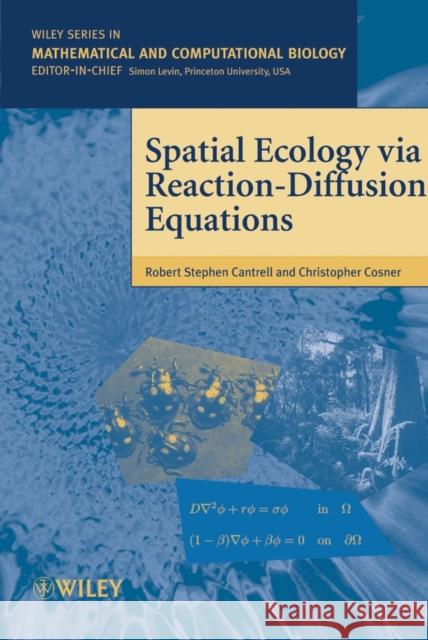
Spatial Ecology Via Reaction-Diffusion Equations Cantrell, Robert Stephen 9780471493013 John Wiley & Sons - książkaWidoczna okładka, to zdjęcie poglądowe, a rzeczywista szata graficzna może różnić się od prezentowanej.

Spatial Ecology Via Reaction-Diffusion Equations

ISBN-13: 9780471493013 / Angielski / Twarda / 2003 / 432 str.

Robert Stephen Cantrell; Chris Cosner
cena 902,98
(netto: 859,98 VAT:  5%)

Najniższa cena z 30 dni: 899,26
Termin realizacji zamówienia:
ok. 30 dni roboczych
Bez gwarancji dostawy przed świętami

Darmowa dostawa!

Many ecological phenomena may be modelled using apparently random processes involving space (and possibly time). Such phenomena are classified as spatial in their nature and include all aspects of pollution. This book addresses the problem of modelling spatial effects in ecology and population dynamics using reaction-diffusion models.
* Rapidly expanding area of research for biologists and applied mathematicians
* Provides a unified and coherent account of methods developed to study spatial ecology via reaction-diffusion models
* Provides the reader with the tools needed to construct and interpret models
* Offers specific applications of both the models and the methods
* Authors have played a dominant role in the field for years
Essential reading for graduate students and researchers working with spatial modelling from mathematics, statistics, ecology, geography and biology.


Kategorie:
Nauka, Matematyka
Kategorie BISAC:
Science > Life Sciences - Ecology
Mathematics > Matematyka stosowana
Wydawca:
John Wiley & Sons
Seria wydawnicza:
Wiley Series in Mathematical and Computational Biology
Język:
Angielski
ISBN-13:
9780471493013
Rok wydania:
2003
Numer serii:
000174079
Ilość stron:
432
Waga:
0.94 kg
Wymiary:
25.15 x 17.37 x 2.84
Oprawa:
Twarda
Wolumenów:
01
Dodatkowe informacje:
Bibliografia
Wydanie ilustrowane

" particularly attractive and useful for graduate students and other researchers who are interested in studying applications of reaction–diffusion theory to spatial ecology." ( Mathematical Reviews, Issue 2007a)

" I would recommend this book to anyone who wants a well supported journey into the modern theory of partial differential equations and dynamic systems " (The Mathematical Gazette, March 2005)

Preface.

Series Preface.

1 Introduction.

1.1 Introductory Remarks.

1.2 Nonspatial Models for a Single Species.

1.3 Nonspatial Models For Interacting Species.

1.3.1 Mass–Action and Lotka–Volterra Models.

1.3.2 Beyond Mass–Action: The Functional Response.

1.4 Spatial Models: A General Overview.

1.5 Reaction–Diffusion Models.

1.5.1 Deriving Diffusion Models.

1.5.2 Diffusion Models Via Interacting Particle Systems: The Importance of Being Smooth.

1.5.3 What Can Reaction–Diffusion Models Tell Us?

1.5.4 Edges, Boundary Conditions, and Environmental Heterogeneity.

1.6 Mathematical Background.

1.6.1 Dynamical Systems.

1.6.2 Basic Concepts in Partial Differential Equations: An Example.

1.6.3 Modern Approaches to Partial Differential Equations: Analogies with Linear Algebra and Matrix Theory.

1.6.4 Elliptic Operators: Weak Solutions, State Spaces, and Mapping Properties.

1.6.5 Reaction–Diffusion Models as Dynamical Systems.

1.6.6 Classical Regularity Theory for Parabolic Equations.

1.6.7 Maximum Principles and Monotonicity.

2 Linear Growth Models for a Single Species: Averaging Spatial Effects Via Eigenvalues.

2.1 Eigenvalues, Persistence, and Scaling in Simple Models.

2.1.1 An Application: Species–Area Relations.

2.2 Variational Formulations of Eigenvalues: Accounting for Heterogeneity.

2.3 Effects of Fragmentation and Advection/Taxis in Simple Linear Models.

2.3.1 Fragmentation.

2.3.2 Advection/Taxis.

2.4 Graphical Analysis in One Space Dimension.

2.4.1 The Best Location for a Favorable Habitat Patch.

2.4.2 Effects of Buffer Zones and Boundary Behavior.

2.5 Eigenvalues and Positivity.

2.5.1 Advective Models.

2.5.2 Time Periodicity.

2.5.3 Additional Results on Eigenvalues and Positivity.

2.6 Connections with Other Topics and Models.

2.6.1 Eigenvalues, Solvability, and Multiplicity.

2.6.2 Other Model Types: Discrete Space and Time.

Appendix.

3 Density Dependent Single–Species Models.

3.1 The Importance of Equilibria in Single Species Models.

3.2 Equilibria and Stability: Sub– and Supersolutions.

3.2.1 Persistence and Extinction.

3.2.2 Minimal Patch Sizes.

3.2.3 Uniqueness of Equilibria.

3.3 Equilibria and Scaling: One Space Dimension.

3.3.1 Minimum Patch Size Revisited.

3.4 Continuation and Bifurcation of Equilibria.

3.4.1 Continuation.

3.4.2 Bifurcation Results.

3.4.3 Discussion and Conclusions.

3.5 Applications and Properties of Single Species Models.

3.5.1 How Predator Incursions Affect Critical Patch Size.

3.5.2 Diffusion and Allee Effects.

3.5.3 Properties of Equilibria.

3.6 More General Single Species Models.

Appendix.

4 Permanence.

4.1 Introduction.

4.1.1 Ecological Overview.

4.1.2 ODEModels as Examples.

4.1.3 A Little Historical Perspective.

4.2 Definition of Permanence.

4.2.1 Ecological Permanence.

4.2.2 Abstract Permanence.

4.3 Techniques for Establishing Permanence.

4.3.1 Average Lyapunov Function Approach.

4.3.2 Acyclicity Approach.

4.4 Invasibility Implies Coexistence.

4.4.1 Acyclicity and an ODE Competition Model.

4.4.2 A Reaction–Diffusion Analogue.

4.4.3 Connection to Eigenvalues.

4.5 Permanence in Reaction–Diffusion Models for Predation.

4.6 Ecological Permanence and Equilibria.

4.6.1 Abstract Permanence Implies Ecological Permanence.

4.6.2 Permanence Implies the Existence of a Componentwise Positive Equilibrium.

Appendix.

5 Beyond Permanence: More Persistence Theory.

5.1 Introduction.

5.2 Compressivity.

5.3 Practical Persistence.

5.4 Bounding Transient Orbits.

5.5 Persistence in Nonautonomous Systems.

5.6 Conditional Persistence.

5.7 Extinction Results.

Appendix.

6 Spatial Heterogeneity in Reaction–Diffusion Models.

6.1 Introduction.

6.2 Spatial Heterogeneity within the Habitat Patch.

6.2.1 How Spatial Segregation May Facilitate Coexistence.

6.2.2 Some Disparities Between Local and Global Competition.

6.2.3 Coexistence Mediated by the Shape of the Habitat Patch.

6.3 Edge Mediated Effects.

6.3.1 A Note About Eigenvalues.

6.3.2 Competitive Reversals Inside Ecological Reserves Via External Habitat Degradation: Effects of Boundary Conditions.

6.3.3 Cross–Edge Subsidies and the Balance of Competition in Nature Preserves.

6.3.4 Competition Mediated by Pathogen Transmission.

6.4 Estimates and Consequences.

Appendix.

7 Nonmonotone Systems.

7.1 Introduction.

7.2 Predator Mediated Coexistence.

7.3 Three Species Competition.

7.3.1 How Two Dominant Competitors May Mediate the Persistence of an Inferior Competitor.

7.3.2 The May–Leonard Example Revisited.

7.4 Three Trophic Level Models.

Appendix.

References.

Index.

Many ecological phenomena involve space as well as time and arise from a combination of random and deterministic processes. Such phenomena include the effects of habitat fragmentation, which is a common result of human activity and a major problem in biological conservation. Reaction–diffusion models provide one approach to describing how random movements and deterministic interactions between individuals combine to influence the dynamics of populations and the structure of ecological communities. Spatial Ecology via Reaction–Diffusion Equations addresses the problem of modeling spatial effects in ecology and population dynamics using reaction–diffusion models.

  • Provides broad coverage of a rapidly expanding area of research for ecologists and applied mathematicians.
  • Provides a unified and coherent account of methods developed to study spatial ecology via reaction–diffusion models.
  • Provides the reader with the tools needed to construct and interpret models.
  • Includes specific applications of both the models and the methods described.

Spatial Ecology via Reaction–Diffusion Equations provides a practical introduction to the subject for graduate students and researchers working in spatial modeling from mathematics, statistics, ecology, geography and biology.



Udostępnij

Facebook - konto krainaksiazek.pl


Opinie o Krainaksiazek.pl na Opineo.pl

Partner Mybenefit

Krainaksiazek.pl w programie rzetelna firma Krainaksiaze.pl - płatności przez paypal

Czytaj nas na:

Facebook - krainaksiazek.pl
  • książki na zamówienie
  • granty
  • książka na prezent
  • kontakt
  • pomoc
  • opinie
  • regulamin
  • polityka prywatności

Zobacz:

  • Księgarnia czeska

  • Wydawnictwo Książkowe Klimaty

1997-2025 DolnySlask.com Agencja Internetowa

© 1997-2022 krainaksiazek.pl
     
KONTAKT | REGULAMIN | POLITYKA PRYWATNOŚCI | USTAWIENIA PRYWATNOŚCI
Zobacz: Księgarnia Czeska | Wydawnictwo Książkowe Klimaty | Mapa strony | Lista autorów
KrainaKsiazek.PL - Księgarnia Internetowa

Polityka prywatnosci - link
Krainaksiazek.pl - płatnośc Przelewy24
Przechowalnia Przechowalnia





