• Wyszukiwanie zaawansowane
  • Kategorie
  • Kategorie BISAC
  • Książki na zamówienie
  • Promocje
  • Granty
  • Książka na prezent
  • Opinie
  • Pomoc
  • Załóż konto
  • Zaloguj się

Space Systems Failures: Disasters and Rescues of Satellites, Rocket and Space Probes » książka


zaloguj się | załóż konto
Logo Krainaksiazek.pl

koszyk

konto

szukaj
topmenu
Księgarnia internetowa
Szukaj
Książki na zamówienie
Promocje
Granty
Książka na prezent
Moje konto
Pomoc
 
 
Wyszukiwanie zaawansowane
Pusty koszyk
Bezpłatna dostawa dla zamówień powyżej 20 złBezpłatna dostawa dla zamówień powyżej 20 zł

Kategorie główne

• Nauka
 [2946600]
• Literatura piękna
 [1856966]

  więcej...
• Turystyka
 [72221]
• Informatyka
 [151456]
• Komiksy
 [35826]
• Encyklopedie
 [23190]
• Dziecięca
 [619653]
• Hobby
 [140543]
• AudioBooki
 [1577]
• Literatura faktu
 [228355]
• Muzyka CD
 [410]
• Słowniki
 [2874]
• Inne
 [445822]
• Kalendarze
 [1744]
• Podręczniki
 [167141]
• Poradniki
 [482898]
• Religia
 [510455]
• Czasopisma
 [526]
• Sport
 [61590]
• Sztuka
 [243598]
• CD, DVD, Video
 [3423]
• Technologie
 [219201]
• Zdrowie
 [101638]
• Książkowe Klimaty
 [124]
• Zabawki
 [2473]
• Puzzle, gry
 [3898]
• Literatura w języku ukraińskim
 [254]
• Art. papiernicze i szkolne
 [8170]
Kategorie szczegółowe BISAC

Space Systems Failures: Disasters and Rescues of Satellites, Rocket and Space Probes

ISBN-13: 9780387215198 / Angielski / Miękka / 2005 / 370 str.
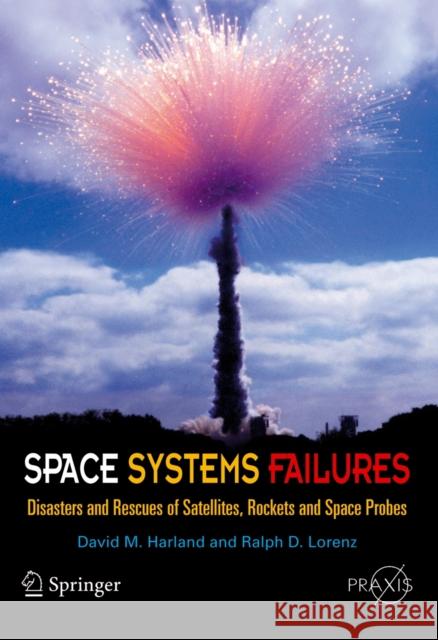
David M. Harland; Ralph Lorenz
Space Systems Failures: Disasters and Rescues of Satellites, Rocket and Space Probes Harland, David M. 9780387215198 Springer-Praxis - książkaWidoczna okładka, to zdjęcie poglądowe, a rzeczywista szata graficzna może różnić się od prezentowanej.

Space Systems Failures: Disasters and Rescues of Satellites, Rocket and Space Probes

ISBN-13: 9780387215198 / Angielski / Miękka / 2005 / 370 str.

David M. Harland; Ralph Lorenz
cena 221,90 zł
(netto: 211,33 VAT:  5%)

Najniższa cena z 30 dni: 192,74 zł
Termin realizacji zamówienia:
ok. 22 dni roboczych
Bez gwarancji dostawy przed świętami

Darmowa dostawa!

In the 1960s and 1970s deep space missions were dispatched in pairs in case one was lost in launch or failed during its journey. Following the triumphs of the Viking landings on Mars in 1976 and both Voyagers spacecraft successfully surveying the outer giant planets of the Solar System, it was decided by NASA to cut costs and send out just a single probe. Although Magellan successfully mapped Venus by radar, it suffered from problems during the flight. Then came the loss of Mars Observer, whose engine exploded as it was preparing to enter Mars orbit because it was using technology designed for Earth s satellites and the engine was not suited to spending several months in space. Later came the high-profile losses of Mars Climate Observer and Mars Polar Lander - a consequence of the faster, better, cheaper philosophy introduced by Dan Goldin in 1993. Even the highly successful Galileo mission suffered a major setback when its high-gain antenna (also based on satellite mission suffered a major setback when its high-gain antenna (also based on satellite communication technology) failed to deploy fully, greatly diminishing the craft s radio transmission capabilities, forcing the ground crew to re-programme the on-board computer to enable it to fulfil its mission and provide stunning images of Jupiter and its moons. In Space Systems Failures, David Harland (here working with co-author Ralph Lorenz) describes the many quite fascinating tales of woe involving failures of rockets, satellites and deep space missions in his inimitable style, providing a unique insight into the trials and tribulations of exploration at the high frontier."


Kategorie:
Nauka, Fizyka
Kategorie BISAC:
Science > Astrofizyka
Technology & Engineering > Aeronautics & Astronautics
Science > Astronomia, przestrzeń i czas
Wydawca:
Springer-Praxis
Seria wydawnicza:
Springer Praxis Books in Space Exploration (Paperback)
Język:
Angielski
ISBN-13:
9780387215198
Rok wydania:
2005
Numer serii:
000225858
Ilość stron:
370
Waga:
0.67 kg
Wymiary:
24.4 x 17.1 x 2.0
Oprawa:
Miękka
Wolumenów:
01
Dodatkowe informacje:
Bibliografia
Wydanie ilustrowane

From the reviews:

"Harland (space historian) and Lorenz (Univ. of Arizona, Tucson), using occasional flashes of humor, explore in depth the wide variety of causes of failure of space systems ... . The material is very practical, punchy, and straightforward, presented in a refreshing writing style. The book contains many ... illustrations, extensive references at the end of each chapter and a full 14-page index. ... it is a must for scientists and engineers engaged in or planning a career in space systems. Summing Up: Recommended." (W. E. Howard, CHOICE, November, 2005)

"This book is the literary equivalent of the 'tell-all' TV documentary and should meet most of its readers' vicarious interests in what can go wrong in - or on the way to -space. ... The book is pretty well encyclopaedic ... . The book is illustrated with black-and-white photos and diagrams ... . On balance, this book is well researched and referenced ... . Anyone involved in the design, manufacturing and operation of spacecraft and launch vehicles should read this book ... and learn." (satellite-evolution.com, May/June, 2007)

Launch vehicles.- The missiles.- The Shuttle.- Back to expendables.- Heavyweights.- Lightweights.- Boom and bust.- The Chinese experience.- The current crop.- Satellites and space probes.- Failure and redundancy.- Propulsion system failures.- Attitude control system failures.- Electrical failures.- Environmental failures.- Structural failures.- Failures on the ground.- Operator and software errors.- Conclusions.

There have been many remarkable achievements, such as the Galileo probe which parachuted into Jupiter's atmosphere, to the joy of the engineers who built it. But there have also been many humiliating failures. Sometimes the cause is a silly procedural error, such as a minus sign instead of a plus sign in a computer program, or a mix up between Imperial and Metric units. The Russian craft Phobos 1 was lost en route to Mars after being sent an incorrect command, because the spacecraft's computer was insufficiently robust to reject it. More recently, NASA has suffered the loss of several missions to Mars, including one due to a simple computer programming error. In Space Systems Failures, David Harland (here working with co-author Ralph Lorenz) describes the many quite fascinating tales of woe involving failures of rockets, satellites and deep space missions in his inimitable style, providing a unique insight into the trials and tribulations of exploration at the high frontier.

Harland, David M. Saturn, the a ~ringed planeta (TM), was first insp... więcej >
Lorenz, Ralph Ralph Lorenz trained as an engineer and worked for... więcej >


Udostępnij

Facebook - konto krainaksiazek.pl


Opinie o Krainaksiazek.pl na Opineo.pl

Partner Mybenefit

Krainaksiazek.pl w programie rzetelna firma Krainaksiaze.pl - płatności przez paypal

Czytaj nas na:

Facebook - krainaksiazek.pl
  • książki na zamówienie
  • granty
  • książka na prezent
  • kontakt
  • pomoc
  • opinie
  • regulamin
  • polityka prywatności

Zobacz:

  • Księgarnia czeska

  • Wydawnictwo Książkowe Klimaty

1997-2025 DolnySlask.com Agencja Internetowa

© 1997-2022 krainaksiazek.pl
     
KONTAKT | REGULAMIN | POLITYKA PRYWATNOŚCI | USTAWIENIA PRYWATNOŚCI
Zobacz: Księgarnia Czeska | Wydawnictwo Książkowe Klimaty | Mapa strony | Lista autorów
KrainaKsiazek.PL - Księgarnia Internetowa

Polityka prywatnosci - link
Krainaksiazek.pl - płatnośc Przelewy24
Przechowalnia Przechowalnia





