• Wyszukiwanie zaawansowane
  • Kategorie
  • Kategorie BISAC
  • Książki na zamówienie
  • Promocje
  • Granty
  • Książka na prezent
  • Opinie
  • Pomoc
  • Załóż konto
  • Zaloguj się

Software Paradigms » książka


zaloguj się | załóż konto
Logo Krainaksiazek.pl

koszyk

konto

szukaj
topmenu
Księgarnia internetowa
Szukaj
Książki na zamówienie
Promocje
Granty
Książka na prezent
Moje konto
Pomoc
 
 
Wyszukiwanie zaawansowane
Pusty koszyk
Bezpłatna dostawa dla zamówień powyżej 20 złBezpłatna dostawa dla zamówień powyżej 20 zł

Kategorie główne

• Nauka
 [2946600]
• Literatura piękna
 [1856966]

  więcej...
• Turystyka
 [72221]
• Informatyka
 [151456]
• Komiksy
 [35826]
• Encyklopedie
 [23190]
• Dziecięca
 [619653]
• Hobby
 [140543]
• AudioBooki
 [1577]
• Literatura faktu
 [228355]
• Muzyka CD
 [410]
• Słowniki
 [2874]
• Inne
 [445822]
• Kalendarze
 [1744]
• Podręczniki
 [167141]
• Poradniki
 [482898]
• Religia
 [510455]
• Czasopisma
 [526]
• Sport
 [61590]
• Sztuka
 [243598]
• CD, DVD, Video
 [3423]
• Technologie
 [219201]
• Zdrowie
 [101638]
• Książkowe Klimaty
 [124]
• Zabawki
 [2473]
• Puzzle, gry
 [3898]
• Literatura w języku ukraińskim
 [254]
• Art. papiernicze i szkolne
 [8170]
Kategorie szczegółowe BISAC

Software Paradigms

ISBN-13: 9780471483472 / Angielski / Twarda / 2005 / 440 str.
Stephen H. Kaisler
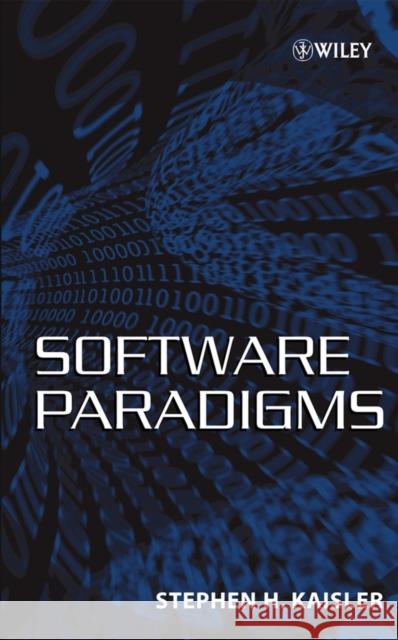
Software Paradigms Stephen H. Kaisler 9780471483472 Wiley-Interscience - książkaWidoczna okładka, to zdjęcie poglądowe, a rzeczywista szata graficzna może różnić się od prezentowanej.

Software Paradigms

ISBN-13: 9780471483472 / Angielski / Twarda / 2005 / 440 str.

Stephen H. Kaisler
cena 733,98 zł
(netto: 699,03 VAT:  5%)

Najniższa cena z 30 dni: 726,47 zł
Termin realizacji zamówienia:
ok. 30 dni roboczych
Bez gwarancji dostawy przed świętami

Darmowa dostawa!

Software Paradigms provides the first complete compilation of software paradigms commonly used to develop large software applications, with coverage ranging from discrete problems to full-scale applications. The book focuses on providing a structure for understanding a hierarchy of software development approaches, and showing the relationships between the different models. Coverage includes paradigms in design patterns, software components, software architectures, and frameworks. Chapters within each of these sections include design issues related to building and using the paradigm as well as numerous real world applications. A practical overview of the hierarchy of development paradigms, Software Paradigms is an excellent teaching tool for undergraduates and graduates, and a comprehensive and reliable reference for software engineers.


Kategorie:
Informatyka, Bazy danych
Kategorie BISAC:
Computers > Computer Engineering
Wydawca:
Wiley-Interscience
Język:
Angielski
ISBN-13:
9780471483472
Rok wydania:
2005
Ilość stron:
440
Waga:
0.87 kg
Wymiary:
24.1 x 16.3 x 2.5
Oprawa:
Twarda
Wolumenów:
01
Dodatkowe informacje:
Bibliografia
Glosariusz/słownik
Wydanie ilustrowane

"...an excellent course reference for someone with significant but varied...software development ideas...a handy reference for identifying the similarities between...software development elements " ( IEEE Software Magazine, January/February 2006)

" useful to some programmers." (CHOICE, October 2005)

"This is a good survey of the various topics quite relevant to the CSQE body of knowledge architecture topic." (Software Quality Professional, September 2005)

" a timely work that helps put recent advances in software architecture and framework development in context with earlier software design concepts." (Computing Reviews.com, July 29, 2005)

" a welcome addition to the literature on software development paradigm." (Computing Reviews.com, May 3, 2005)

ADVICE FOR THE INSTRUCTOR.

ACKNOWLEDGMENTS.

1 Introduction.

1.1 The Meaning of Paradigm.

1.2 Software Solves Problems.

1.3 Designing and Developing Software.

1.4 Understanding Problem Paradigms.

1.5 Overview of Book.

1.6 Conventions.

1.7 Exercises.

2 Paradigm Overview.

2.1 Problem Paradigms.

2.2 A Functional Classification of Problems.

2.3 Programming Languages.

2.4 Design Patterns.

2.5 Components.

2.6 Software Architectures.

2.7 Frameworks.

2.8 Further Reading.

2.9 Exercises.

I DESIGN PATTERNS.

3 Overview of Design Patterns.

3.1 A Brief History of Patterns.

3.2 Why Patterns?

3.3 Pattern Spaces.

3.4 Types of Software Patterns.

3.5 Describing Patterns.

3.6 How Do We Discover Patterns?

3.7 Using Patterns.

3.8 Further Reading.

3.9 Exercises.

4 Software Patterns.

4.1 Singleton.

4.2 The Wrapper Pattern.

4.3 The Abstract Factory Pattern.

4.4 Observer Pattern.

4.5 Exercises.

5 Human Computer Interface Patterns.

5.1 Style Guides.

5.2 An HCI Pattern Language.

5.3 Web Design Patterns.

5.4 Further Reading.

5.5 Exercises.

6 Other Pattern Domains.

6.1 Coplien s Patterns.

6.2 Object–Oriented Patterns.

6.3 Antipatterns.

6.4 Further Reading.

6.5 Exercises.

7 Pattern Design.

7.1 Design Pattern Issues.

7.2 Some Simple Pattern Design Principles.

7.3 Limitations of Design Patterns.

7.4 Further Reading.

7.5 Exercises.

II COMPONENTS.

8 Component Concepts.

8.1 What Are Software Components?

8.2 Why Use Components?

8.3 Component Models.

8.4 Using Components.

8.5 Component Reuse.

8.6 Exercises.

9 Types of Components.

9.1 Event–Based Components.

9.2 Java Events.

9.3 Distributed Components.

9.4 Transaction Processing.

9.5 Further Reading.

9.6 Exercises.

10 Component Technologies.

10.1 CORBA.

10.2 System Object Model.

10.3 Microsoft s COM/DCOM.

10.4 JavaBeans.

10.5 Further Reading.

10.6 Exercises.

11 Component–Based Software Engineering.

11.1 Defining CBSE.

11.2 Problems with CBSE.

11.3 Problems in Using Components.

11.4 Problems with Glue Code.

11.5 Exercises.

III SOFTWARE ARCHITECTURES.

12 Overview of Software Architectures.

12.1 Software Architecture Elements and Description.

12.2 Why Do We Need a Software Architecture?

12.3 Software Architecting Versus Software Engineering.

12.4 Domain–Specific Software Architectures.

12.5 Roles and Benefits.

12.6 Software Architecture Models.

12.7 What To Look For.

12.8 Further Reading.

12.9 Exercises.

13 Data Flow Systems.

13.1 The Data Flow Model.

13.2 Batch Sequential Systems.

13.3 Pipe and Filter Architecture.

13.4 Further Reading.

13.5 Exercises.

14 Call–and–Return Systems.

14.1 Main Program and Subroutines.

14.2 Client Server Systems.

14.3 Object–Oriented Systems.

14.4 Hierarchically Layered Systems.

14.5 Further Reading.

14.6 Exercises.

15 Virtual Machines.

15.1 Interpreters.

15.2 Virtual Machine Examples.

15.3 Rule–Based Systems.

15.4 Advantages and Disadvantages.

15.5 Further Reading.

15.6 Exercises.

16 Independent Component Systems.

16.1 Communicating Sequential Processes.

16.2 Event–Based Systems.

16.3 Event System Issues.

16.4 Broker Systems.

16.5 Further Reading.

16.6 Exercises.

17 Data–Centric Systems.

17.1 Database Systems.

17.2 Blackboard Systems.

17.3 The Linda Model and Language.

17.4 Further Reading.

17.5 Exercises.

18 Concurrent Software Architectures.

18.1 Basic Concepts.

18.2 Parallel Programming.

18.3 Data Parallel Systems.

18.4 Message Passing Systems.

18.5 A Parallel Programming Methodology.

18.6 Further Reading.

18.7 Exercises.

19 Software Architecture Challenges.

19.1 Software Architecture Description.

19.2 Design Issues.

19.3 Analysis of Software Architectures.

19.4 Further Reading.

19.5 Exercises.

IV FRAMEWORKS.

20 Framework Concepts.

20.1 Types of Frameworks.

20.2 Framework Elements.

20.3 Using Frameworks.

20.4 Documenting Frameworks.

20.5 Designing Frameworks.

20.6 Problems with Frameworks.

20.7 Framework Domains.

20.8 Further Reading.

20.9 Exercises.

21 GUI Frameworks.

21.1 Smalltalk–80 Programming Environment.

21.2 MacApp Framework.

21.3 The Taligent Framework.

21.4 Other Frameworks.

21.5 Further Reading.

21.6 Exercises.

22 Development Frameworks.

22.1 Java as a Framework.

22.2 Microsoft s .NET Framework.

22.3 IBM s San Francisco Project.

22.4 POOMA.

22.5 Further Reading.

22.6 Exercises.

23 Challenges in Frameworks.

23.1 Developing Frameworks.

23.2 Application Development Using a Framework.

23.3 Testing Frameworks.

23.4 Issues in Framework Usage.

23.5 Exercises.

BIBLIOGRAPHY.

GLOSSARY.

INDEX.

STEPHEN H. KAISLER, DSc, is currently a Senior Associate with SET Associates supporting the DARPA Information Exploitation Office. He was formerly the information technology advisor to the CIO in the Office of the Sergeant at Arms, United States Senate. Dr. Kaisler is also Adjunct Professor of Engineering in the Department of Computer Science at The George Washington University. He has published three books and numerous technical papers.

The first integrated, hierarchical model of software structures

This book provides the first fully integrated approach to software paradigms commonly used to develop large software applications, with coverage ranging from discrete problems to full–scale applications. The book focuses on providing a structure for understanding a hierarchy of software development paradigms and showing the relationships between the different paradigms.

In order to provide a clear understanding of how these "building blocks" are used to solve today′s complex software design problems, the author assesses the benefits and disadvantages of each paradigm in terms of its contribution to the design process and, where applicable, provides a taxonomy for the paradigm of substructures.

Coverage includes paradigms in the areas of:

  • Design patterns
  • Software components
  • Software architectures
  • Frameworks

Chapters within each paradigm include design issues related to building and using the paradigm and feature numerous real–world applications.

Software Paradigms presents a practical overview of the hierarchy of paradigms, with emphasis on how they build upon each other. It is an excellent teaching tool for undergraduates and graduates, and a comprehensive and reliable reference for software engineers. Challenging questions at the end of each chapter pose research problems that will lead to more detailed investigations of the topics discussed within the chapter.

Kaisler, Stephen H. STEPHEN H. KAISLER, DSc, is currently a Senior Ass... więcej >


Udostępnij

Facebook - konto krainaksiazek.pl


Opinie o Krainaksiazek.pl na Opineo.pl

Partner Mybenefit

Krainaksiazek.pl w programie rzetelna firma Krainaksiaze.pl - płatności przez paypal

Czytaj nas na:

Facebook - krainaksiazek.pl
  • książki na zamówienie
  • granty
  • książka na prezent
  • kontakt
  • pomoc
  • opinie
  • regulamin
  • polityka prywatności

Zobacz:

  • Księgarnia czeska

  • Wydawnictwo Książkowe Klimaty

1997-2025 DolnySlask.com Agencja Internetowa

© 1997-2022 krainaksiazek.pl
     
KONTAKT | REGULAMIN | POLITYKA PRYWATNOŚCI | USTAWIENIA PRYWATNOŚCI
Zobacz: Księgarnia Czeska | Wydawnictwo Książkowe Klimaty | Mapa strony | Lista autorów
KrainaKsiazek.PL - Księgarnia Internetowa

Polityka prywatnosci - link
Krainaksiazek.pl - płatnośc Przelewy24
Przechowalnia Przechowalnia




