• Wyszukiwanie zaawansowane
  • Kategorie
  • Kategorie BISAC
  • Książki na zamówienie
  • Promocje
  • Granty
  • Książka na prezent
  • Opinie
  • Pomoc
  • Załóż konto
  • Zaloguj się

Smart Card Applications: Design Models for Using and Programming Smart Cards » książka


zaloguj się | załóż konto
Logo Krainaksiazek.pl

koszyk

konto

szukaj
topmenu
Księgarnia internetowa
Szukaj
Książki na zamówienie
Promocje
Granty
Książka na prezent
Moje konto
Pomoc
 
 
Wyszukiwanie zaawansowane
Pusty koszyk
Bezpłatna dostawa dla zamówień powyżej 20 złBezpłatna dostawa dla zamówień powyżej 20 zł

Kategorie główne

• Nauka
 [2946600]
• Literatura piękna
 [1856966]

  więcej...
• Turystyka
 [72221]
• Informatyka
 [151456]
• Komiksy
 [35826]
• Encyklopedie
 [23190]
• Dziecięca
 [619653]
• Hobby
 [140543]
• AudioBooki
 [1577]
• Literatura faktu
 [228355]
• Muzyka CD
 [410]
• Słowniki
 [2874]
• Inne
 [445822]
• Kalendarze
 [1744]
• Podręczniki
 [167141]
• Poradniki
 [482898]
• Religia
 [510455]
• Czasopisma
 [526]
• Sport
 [61590]
• Sztuka
 [243598]
• CD, DVD, Video
 [3423]
• Technologie
 [219201]
• Zdrowie
 [101638]
• Książkowe Klimaty
 [124]
• Zabawki
 [2473]
• Puzzle, gry
 [3898]
• Literatura w języku ukraińskim
 [254]
• Art. papiernicze i szkolne
 [8170]
Kategorie szczegółowe BISAC

Smart Card Applications: Design Models for Using and Programming Smart Cards

ISBN-13: 9780470058824 / Angielski / Twarda / 2007 / 236 str.
Wolfgang Rankl; Kenneth Cox
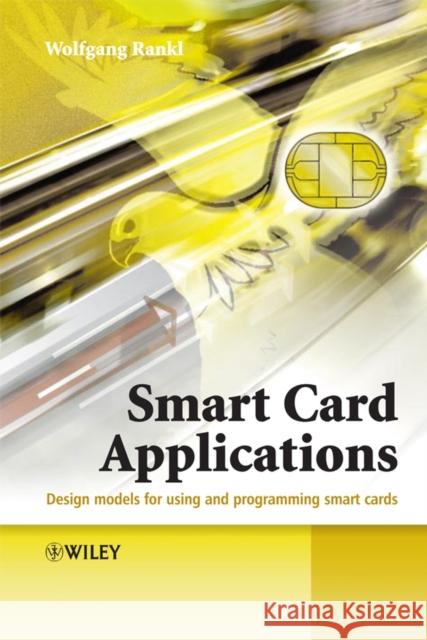
Smart Card Applications: Design Models for Using and Programming Smart Cards Rankl, Wolfgang 9780470058824 John Wiley & Sons - książkaWidoczna okładka, to zdjęcie poglądowe, a rzeczywista szata graficzna może różnić się od prezentowanej.

Smart Card Applications: Design Models for Using and Programming Smart Cards

ISBN-13: 9780470058824 / Angielski / Twarda / 2007 / 236 str.

Wolfgang Rankl; Kenneth Cox
cena 544,95 zł
(netto: 519,00 VAT:  5%)

Najniższa cena z 30 dni: 540,49 zł
Termin realizacji zamówienia:
ok. 30 dni roboczych
Bez gwarancji dostawy przed świętami

Darmowa dostawa!

A practical guide to the specification, design, and programming of smart card systems for working applications. More than 3 billion smartcards are produced every year. Generally defined as any pocket-sized card with embedded integrated circuits or chips, they have a huge number of applications including travel cards, chip and pin cards, pet tags, mobile phone SIMs and pallet trackers. Now with modern Smart Card technology such as Java Card and Basic Card it is possible for everyone to create his or her own applications on a smart card. This book provides generic solutions for programming smart cards, enabling the creation of working applications and systems. Key features:

  • Presents a comprehensive introduction to the topic of smart cards, explaining component elements and the smart card microcontrollers.
  • Sets out information on operating systems with case studies of a range of applications including credit card security, mobile phones and transport payment cards.
  • Gives detailed advice on the monitoring of smart card applications, recognizing potential attacks on security and improving system integrity.
  • Provides modules and examples so that all types of systems can be built up from a small number of individual components.
  • Offers guidelines on avoiding and overcoming design errors.
Ideal for practising engineers and designers looking to implement smart cards in their business, it is also a valuable reference for postgraduate students taking courses on embedded system and smart card design.

Kategorie:
Technologie
Kategorie BISAC:
Technology & Engineering > Electronics - Microelectronics
Wydawca:
John Wiley & Sons
Język:
Angielski
ISBN-13:
9780470058824
Rok wydania:
2007
Ilość stron:
236
Waga:
0.59 kg
Wymiary:
24.87 x 17.3 x 1.93
Oprawa:
Twarda
Wolumenów:
01
Dodatkowe informacje:
Bibliografia
Wydanie ilustrowane

"This book was a interesting read, and certainly provided as much information as is necessary to understand the inner workings of most smart–cards––as well as their world application." ( Computing Reviews, February 1, 2008)

Foreword.

Symbols and Notation.

Abbreviations.

1 Overview of Smart Cards.

1.1 Card Classification.

1.2 Card Formats.

1.3 Card Elements.

1.3.1 Printing and labelling.

1.3.2 Embossing.

1.3.3 Hologram.

1.3.4 Signature panel.

1.3.5 Tactile elements.

1.3.6 Magnetic stripe.

1.3.7 Chip module.

1.3.8 Antenna.

1.4 Smart Card Microcontrollers.

1.4.1 Processor.

1.4.2 Memory.

1.4.3 Supplementary hardware.

1.4.4 Electrical characteristics.

2 Smart Card Operating Systems.

2.1 FileManagement.

2.1.1 File types.

2.1.2 File names.

2.1.3 File structures.

2.1.4 File attributes.

2.1.5 File selection.

2.1.6 Access conditions.

2.1.6.1 State–based access conditions.

2.1.6.2 Rule–based access conditions.

2.1.7 File life cycle.

2.2 Commands.

2.3 Data Transmission.

2.3.1 Answer to Reset (ATR).

2.3.2 Protocol Parameter Selection (PPS).

2.3.3 Transmission protocols.

2.3.3.1 T=0 transmission protocol for contact cards.

2.3.3.2 T=1 transmission protocol for contact cards.

2.3.3.3 USB transmission protocol for contact cards.

2.3.3.4 Contactless transmission protocols.

2.3.4 SecureMessaging.

2.3.5 Logical channels.

2.4 Special Operating System Functions.

2.4.1 Cryptographic functions.

2.4.2 Atomic processes.

2.4.3 Interpreter.

2.4.4 Application management.

3 Application Areas.

3.1 Smart Card Systems.

3.2 Potential Uses.

3.3 Application Types.

3.3.1 Memory–based applications.

3.3.2 File–based applications.

3.3.3 Code–based applications.

4 Basic Patterns.

4.1 Data Protection.

4.1.1 Definition of terms.

4.1.2 General principles.

4.1.3 Recommendations for smart card systems.

4.1.4 Summary.

4.2 Export Control.

4.3 Cryptographic Regulation.

4.4 Standards.

4.4.1 Standards for card bodies.

4.4.2 Standards for operating systems.

4.4.3 Standards for data and data structuring.

4.4.4 Standards for computer interfaces.

4.4.5 Standards for applications.

4.5 Documents for Smart Card Systems.

4.5.1 Specification partitioning.

4.5.1.1 System specification.

4.5.1.2 Background system specification.

4.5.1.3 Smart card specification.

4.5.1.4 Terminal specification.

4.5.2 Elements of a typical card specification.

4.5.2.1 General information.

4.5.2.2 Smart card.

4.5.2.3 Smart card operating system.

4.5.2.4 Application.

4.5.3 Document distribution.

4.5.4 Document version numbering.

5 Architecture Patterns.

5.1 Data.

5.2 Data Coding.

5.3 Files.

5.3.1 Access conditions.

5.3.2 File names.

5.4 Log Files.

5.4.1 Data storage.

5.4.2 Assigning data to log files.

5.4.3 Invoking logging.

5.4.4 Access conditions for log files.

5.4.5 Logged data.

5.4.6 Consistency and authenticity of log data.

5.4.7 Log file size.

5.4.8 Logging process.

5.5 Pairing.

5.6 Protecting Transaction Data.

5.7 Reset–proof Counters.

5.8 Proactivity.

5.9 Authentication Counter.

5.10 Manual Authentication of a Terminal.

5.11 PIN Management.

5.12 One–time Passwords.

5.13 Key Management.

5.14 StateMachines for Command Sequences.

5.15 Speed Optimization.

5.15.1 Computing power.

5.15.2 Communication.

5.15.3 Commands.

5.15.4 Data and files.

6 Implementation Patterns.

6.1 Application Principles.

6.1.1 Programcode.

6.1.2 Commands.

6.1.3 Data.

6.1.4 Security.

6.1.5 Application architecture.

6.1.6 System.

6.2 Testing.

6.3 User Terminal Interface.

6.4 Smart Card Commands.

6.4.1 Command structure.

6.4.2 Interruption of commands.

6.4.3 Command coding.

6.4.4 Parameterization.

6.4.5 Test commands.

6.4.6 Secret commands.

6.5 Java Card.

6.5.1 Data types.

6.5.2 Arithmetic operations.

6.5.3 Control structures.

6.5.4 Methods.

6.5.5 Applets.

7 Operation Patterns.

7.1 Initialization and Personalization.

7.2 Migration.

7.3 Monitoring.

7.3.1 System integrity.

7.3.2 Attack detection.

8 Practical Aspects of Smart Cards.

8.1 Acceptance.

8.2 Tell–tale Signs of Difficult Smart Card Systems.

8.2.1 Inappropriate use of smart cards.

8.2.2 Unclear specifications.

8.2.3 Abundant options.

8.2.4 Piggyback applications.

8.2.5 Economizing on testing.

8.2.6 Downloading applications.

8.2.7 Offline systems.

8.2.8 Intolerant smart cards and terminals.

8.2.9 Strict compatibility requirements.

8.2.10 Excessively stringent security requirements.

8.2.11 Exaggerated future–proofing.

8.3 Prerequisites for Easy Smart Card Systems.

8.3.1 Expert advice.

8.3.2 Foresighted design.

8.3.3 Prototyping.

8.3.4 Single–application smart cards.

8.3.5 Simple structures.

8.3.6 Robust design.

8.3.7 Centralized systems.

8.3.8 Staged deployment.

8.4 In–field Faults.

8.4.1 Fault classification.

8.4.2 Fault impact.

8.4.3 Actions in response to a fault.

8.4.4 Fault search procedure.

8.4.5 Fault remedies.

9 Illustrative Use Cases.

9.1 Monastery Card.

9.2 Access Card.

9.3 Telemetry Module.

9.4 Business Card.

9.5 Theft Protection Card.

9.6 Admission Pass.

9.7 PKI Card.

9.8 SIMCard.

Bibliography.

Index.

Wolfgang Rankl is currently Head of Telecom and Research and Development at Giesecke & Devrient, Germany. He is an experienced author, having written three editions of the book Smart Card Handbook for Wiley (3 rd Edition published 2003), and the German version of this book for Hanser Chipkarten Anwendungen: Entwurfsmuster fur Einsatz und Programmierung con Chipkarten which is due to publish in March this year. He has been dedicated to the development and research of smart card systems since 1990.

A practical guide to the specification, design, and programming of smart card systems for working applications.

More than 1 billion smartcards are produced every year. Generally defined as any pocket–sized card with embedded integrated circuits or chips, they have a huge number of applications including travel cards, chip and pin cards, pet tags, mobile phone SIMs and pallet trackers. Now with modern Smart Card technology such as Basic Card and Java Card it is possible for everyone to create his or her own applications on a smart card.

This book provides generic solutions for programming smart cards, enabling the creation of working applications and systems.

Key features:

  • Presents a comprehensive introduction to the topic of smart cards, explaining component elements and the smart card microcontrollers.
  • Sets out information on operating systems with case studies of a range of applications including credit card security, mobile phones and transport payment cards.
  • Gives detailed advice on the monitoring of smart card applications, recognizing potential attacks on security and improving system integrity.
  • Provides modules and examples so that all types of systems can be built up from a small number of individual components.
  • Offers guidelines on avoiding and overcoming design errors.

Ideal for practising engineers and designers looking to implement smart cards in their business, it is also a valuable reference for postgraduate students taking courses on embedded system and smart card design.

Cox, Kenneth Ken Cox is a retired elementary school principal w... więcej >


Udostępnij

Facebook - konto krainaksiazek.pl


Opinie o Krainaksiazek.pl na Opineo.pl

Partner Mybenefit

Krainaksiazek.pl w programie rzetelna firma Krainaksiaze.pl - płatności przez paypal

Czytaj nas na:

Facebook - krainaksiazek.pl
  • książki na zamówienie
  • granty
  • książka na prezent
  • kontakt
  • pomoc
  • opinie
  • regulamin
  • polityka prywatności

Zobacz:

  • Księgarnia czeska

  • Wydawnictwo Książkowe Klimaty

1997-2025 DolnySlask.com Agencja Internetowa

© 1997-2022 krainaksiazek.pl
     
KONTAKT | REGULAMIN | POLITYKA PRYWATNOŚCI | USTAWIENIA PRYWATNOŚCI
Zobacz: Księgarnia Czeska | Wydawnictwo Książkowe Klimaty | Mapa strony | Lista autorów
KrainaKsiazek.PL - Księgarnia Internetowa

Polityka prywatnosci - link
Krainaksiazek.pl - płatnośc Przelewy24
Przechowalnia Przechowalnia





