• Wyszukiwanie zaawansowane
  • Kategorie
  • Kategorie BISAC
  • Książki na zamówienie
  • Promocje
  • Granty
  • Książka na prezent
  • Opinie
  • Pomoc
  • Załóż konto
  • Zaloguj się

SmallTalk and Object Orientation: An Introduction » książka


zaloguj się | załóż konto
Logo Krainaksiazek.pl

koszyk

konto

szukaj
topmenu
Księgarnia internetowa
Szukaj
Książki na zamówienie
Promocje
Granty
Książka na prezent
Moje konto
Pomoc
 
 
Wyszukiwanie zaawansowane
Pusty koszyk
Bezpłatna dostawa dla zamówień powyżej 20 złBezpłatna dostawa dla zamówień powyżej 20 zł

Kategorie główne

• Nauka
 [2952079]
• Literatura piękna
 [1850969]

  więcej...
• Turystyka
 [71058]
• Informatyka
 [151066]
• Komiksy
 [35579]
• Encyklopedie
 [23181]
• Dziecięca
 [620496]
• Hobby
 [139036]
• AudioBooki
 [1646]
• Literatura faktu
 [228729]
• Muzyka CD
 [379]
• Słowniki
 [2932]
• Inne
 [445708]
• Kalendarze
 [1409]
• Podręczniki
 [164793]
• Poradniki
 [480107]
• Religia
 [510956]
• Czasopisma
 [511]
• Sport
 [61267]
• Sztuka
 [243299]
• CD, DVD, Video
 [3411]
• Technologie
 [219640]
• Zdrowie
 [100984]
• Książkowe Klimaty
 [124]
• Zabawki
 [2281]
• Puzzle, gry
 [3363]
• Literatura w języku ukraińskim
 [258]
• Art. papiernicze i szkolne
 [8020]
Kategorie szczegółowe BISAC

SmallTalk and Object Orientation: An Introduction

ISBN-13: 9783540761150 / Angielski / Miękka / 1997 / 378 str.
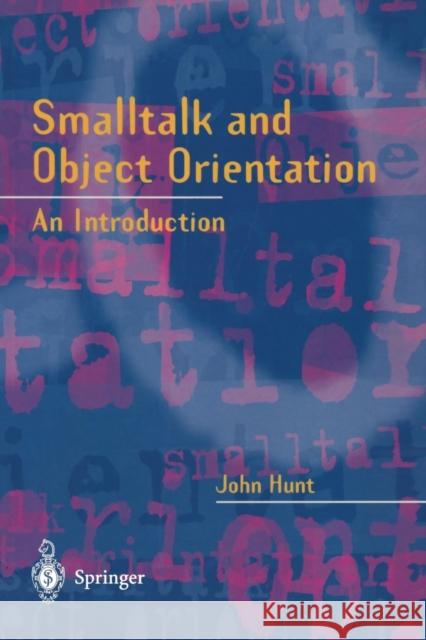
John Hunt; Springer Hunt
SmallTalk and Object Orientation: An Introduction Hunt, John 9783540761150 Springer - książkaWidoczna okładka, to zdjęcie poglądowe, a rzeczywista szata graficzna może różnić się od prezentowanej.

SmallTalk and Object Orientation: An Introduction

ISBN-13: 9783540761150 / Angielski / Miękka / 1997 / 378 str.

John Hunt; Springer Hunt
cena 201,24
(netto: 191,66 VAT:  5%)

Najniższa cena z 30 dni: 192,74
Termin realizacji zamówienia:
ok. 22 dni roboczych
Dostawa w 2026 r.

Darmowa dostawa!

This book was originally written to support an introductory course in Object Orientation through the medium of Smalltalk (and VisualWorks in particular). However, it can be used as a book to teach the reader Smalltalk, to introduce object orientation as well as present object oriented design and analysis. It takes as its basic premise that most Computer Scientists I Software Engineers learn best by doing rather than from theoretical notes. The chapters therefore attempt to introduce concepts by getting you the reader to do things, rather than by extensive theoretical discussions. This means that these chapters take a hands-on approach to the subject and assume that the student/reader has a suitable Small talk environment available to them. The chapters are listed below and are divided into six parts. The reader is advised to work through Parts 1 and 3 thoroughly in order to gain a detailed understanding of object orientation. Part 2 then provides an introduction to the Smalltalk environment and language. Other chapters may then be dipped into as required. For example, if the reader wishes to hone their Smalltalk skills then the chapters in Part 4 would be useful. However, if at that point they wish to get on and discover the delights of graphical user interfaces in Smalltalk, then Part 5 could be read next. Part 6 presents some more advances subjects such as metaclasses and concurrency which are not required for straight forward Small talk development.


Kategorie:
Informatyka, Programowanie
Kategorie BISAC:
Computers > Programming - Object Oriented
Computers > Languages - General
Computers > Software Development & Engineering - General
Wydawca:
Springer
Język:
Angielski
ISBN-13:
9783540761150
Rok wydania:
1997
Wydanie:
Softcover Repri
Ilość stron:
378
Waga:
0.59 kg
Wymiary:
23.52 x 15.6 x 2.21
Oprawa:
Miękka
Wolumenów:
01

1: Introduction to Object Orientation.- 1. Introduction To Object Orientation.- 1.1 Introduction.- 1.2 Programming paradigms.- 1.3 Revolution versus evolution.- 1.4 History /pedigree of object oriented languages.- 1.5 Fundamentals of object orientation.- 1.6 The four catechism of object orientation.- 1.7 Encapsulation.- 1.8 Inheritance.- 1.9 Abstraction.- 1.10 Polymorphism.- 1.11 Summary.- 1.12 Further reading.- 2. Elements of Object Orientation.- 2.1 Introduction.- 2.2 Terminology.- 2.3 Types of hierarchies in object orientation.- 2.4 Why bother?.- 2.5 The move to object technology.- 2.6 Summary.- 2.7 Exercises.- 2.8 Further reading.- 3. Constructing an Object Oriented System.- 3.1 Introduction.- 3.2 The application: windscreen wipe simulation.- 3.3 Where do we start?.- 3.4 Identifying the objects.- 3.5 Identifying the services/methods.- 3.6 Refining the objects.- 3.7 Bringing it all together.- 3.8 Summary.- 3.9 Exercises.- 3.10 Further reading.- 2: The Smalltalk Language.- 4. An Introduction to Smalltalk.- 4.1 Introduction.- 4.2 What is Smalltalk.- 4.3 Objects in Smalltalk.- 4.4 History.- 4.5 The Smalltalk environment.- 4.6 Further reading.- 5. A Little Smalltalk.- 5.1 Introduction.- 5.2 The Workspace.- 5.3 Inspectors.- 5.4 Notifiers.- 5.5 Error processing.- 5.6 Some Smalltalk.- 5.7 Working with Smalltalk.- 5.8 Summary.- 5.9 Further reading.- 6. Smalltalk Building Blocks.- 6.1 Introduction.- 6.2 The basics of the language.- 6.3 Classes.- 6.4 Method definitions.- 7. Smalltalk Constructs.- 7.1 Introduction.- 7.2 Numbers and operators.- 7.3 Characters and strings.- 7.4 Assignments.- 7.5 Variables.- 7.6 Messages and message selectors.- 7.7 Summary.- 7.8 Further reading.- 8. An Example Smalltalk Class.- 8.1 Introduction.- 8.2 The class Person.- 8.3 Defining methods.- 8.4 Creating an instance.- 9. Control and Iteration.- 9.1 Introduction.- 9.2 Cascading.- 9.3 Blocks.- 9.4 Control structures.- 9.5 Summary.- 9.6 Further Reading.- 10. The Collection Classes.- 10.1 Introduction.- 10.2 The Collection class hierarchy.- 10.3 Choosing a Collection class.- 10.4 The Collection class.- 10.5 Bag.- 10.6 Set.- 10.7 OrderedCollection.- 10.8 Stack and queue classes in Smalltalk.- 10.9 Summary.- 10.10 Further reading.- 11. Further Collection Classes.- 11.1 Introduction.- 11.2 SortedCollection.- 11.3 List.- 11.4 Intervals.- 11.5 Array.- 11.6 Multi dimensional arrays.- 11.7 Dictionaries.- 11.8 Strings.- 11.9 Iterating over collections.- 11.10 Inserting into a collection.- 11.11 Conversion.- 12. An Object Oriented Organizer.- 12.1 Introduction.- 12.2 The Organizer.- 12.3 The class definition.- 12.4 The initialize-release protocol.- 12.5 A class side method.- 12.6 The private-updating protocol.- 12.7 The accessing protocol.- 12.8 The Financial Manager project.- 13. Streams and Files.- 13.1 Introduction.- 13.2 Streams.- 13.3 ASCII files.- 13.4 The Binary Object Streaming Service.- 13.5 Using files with the Financial Manager.- 13.6 Summary.- 14. The Magnitude Class Hierarchy.- 14.1 Introduction.- 14.2 The class Magnitude.- 14.3 The class Date.- 14.4 The class Time.- 14.5 The class Character.- 14.6 Further reading.- 15. Some More Tools of the Trade.- 15.1 Introduction.- 15.2 Errors and breakpoints.- 15.3 File in/file outs.- 15.4 Change list.- 15.5 Working with projects.- 15.6 Summary.- 3: Object Oriented Design.- 16. Object Oriented Analysis and Design.- 16.1 Introduction.- 16.2 The Unified Modeling Language.- 16.3 Object oriented design methods.- 16.4 Object Oriented Analysis.- 16.5 The Booch method.- 16.6 The Object Modeling Technique.- 16.7 The Objectory method.- 16.8 The Fusion method.- 16.9 Summary.- 17. The Unified Modeling Language.- 17.1 Introduction.- 17.2 The UML infrastructure.- 17.3 Use case diagrams.- 17.4 The object model.- 17.5 Packages.- 18. UML: Dynamic Modeling and Deployment.- 18.1 Introduction.- 18.2 Dynamic modeling facilities.- 18.3 Deployment diagrams.- 18.4 Summary.- 19. The Object Modeling Technique.- 19.1 Introduction.- 19.2 The OMT methodology.- 19.3 Analysis phase.- 20. More Object Modeling Technique.- 20.1 Introduction.- 20.2 Dynamic models.- 20.3 Design phase.- 20.4 Implementation phase.- 20.5 Summary.- 21. Frameworks and Patterns for Object Oriented Design.- 21.1 Introduction.- 21.2 Patterns and frameworks.- 21.3 An introduction to HotDraw.- 21.4 Where do you start?.- 21.5 BoxDrawFigure.- 21.6 Summary.- 4: Testing and Style.- 22. Testing Object Oriented Systems.- 22.1 Introduction.- 22.2 Why is testing object oriented systems hard?.- 22.3 Inheritance.- 22.4 Abstract superclasses.- 22.5 Encapsulation.- 22.6 Polymorphism.- 22.7 Additional Smalltalk specific features.- 22.8 Summary.- 22.9 Further reading.- 23. Method and Class Testing.- 23.1 Introduction.- 23.2 Object integration testing.- 23.3 System testing.- 23.4 Self testing.- 23.5 Summary.- 23.6 Further reading.- 24. Smalltalk Style Guidelines.- 24.1 Introduction.- 24.2 Variables.- 24.3 Classes.- 24.4 Methods.- 24.5 Naming message protocols.- 24.6 Further reading.- 5: Graphical Interfaces in Smalltalk.- 25. The Perform and Dependency Mechanisms.- 25.1 Introduction.- 25.2 The Perform mechanism.- 25.3 The Dependency mechanism.- 25.4 Summary.- 26. The Model-View-Controller Architecture.- 26.1 Introduction.- 26.2 The MVC architecture principles.- 26.3 The MVC with the statement model.- 26.4 Views and subviews.- 26.5 The controller hierarchy.- 26.6 Summary.- 26.7 Further reading.- 27. Graphical User Interface Construction Tools.- 27.1 Introduction.- 27.2 What is a user interface builder?.- 27.3 VisualWorks window painting tools.- 27.4 Window specification and creation.- 27.5 Application models versus domain models.- 27.6 Defining a window’s functionality.- 27.7 Initialization.- 27.8 Resource Finder.- 27.9 ValueHolders.- 27.10 The on ChangeSend: to: message.- 27.11 Visual reuse.- 27.12 Method of working with the UI builder.- 27.13 Summary.- 28. A Visual Organizer.- 28.1 Introduction.- 28.2 VisualOrganizer class.- 28.3 The AddressBook class.- 28.4 Summary.- 28.5 The visual Financial Manager application.- 29. Using a View Within a Window.- 29.1 Introduction.- 29.2 The custom view widget.- 29.3 The structure of the application.- 29.4 The interactions between objects.- 29.5 The classes involved.- 29.6 Add a delete widget option.- 29.7 Summary.- 29.8 Further reading.- 6: Further Smalltalk.- 30. Memory Management and Garbage Collection.- 30.1 Introduction.- 30.2 Why have automatic memory management?.- 30.3 VisualWorks memory management.- 30.4 Garbage collection and memory compaction.- 30.5 Placing objects in PermSpace.- 31. Concurrency in Smalltalk.- 31.1 Introduction.- 31.2 Concurrent processes.- 31.3 Processes in Smalltalk.- 31.4 A concurrent Smalltalk example.- 31.5 Further reading.- 32. The Metaclass Framework.- 32.1 Introduction.- 32.2 What are classes?.- 32.3 Classes and metaclasses.- 32.4 ClassDescription and Behavior.- 32.5 The metaclass concept goes recursive!.- 32.6 Further reading.- 7: The Future.- 33. The Future for Object Technology.- 33.1 Introduction.- 33.2 The Smalltalk language.- 33.3 Object oriented development toolkits.- 33.4 The internet and objects.- 33.5 Object oriented databases.- 33.6 Smalltalk as a training environment.- 33.7 Object technology: the next five years.- Appendix A: The Smalltalk Language Syntax.

Hunt, John Hunt-University of Wales, UK... więcej >


Udostępnij

Facebook - konto krainaksiazek.pl


Opinie o Krainaksiazek.pl na Opineo.pl

Partner Mybenefit

Krainaksiazek.pl w programie rzetelna firma Krainaksiaze.pl - płatności przez paypal

Czytaj nas na:

Facebook - krainaksiazek.pl
  • książki na zamówienie
  • granty
  • książka na prezent
  • kontakt
  • pomoc
  • opinie
  • regulamin
  • polityka prywatności

Zobacz:

  • Księgarnia czeska

  • Wydawnictwo Książkowe Klimaty

1997-2025 DolnySlask.com Agencja Internetowa

© 1997-2022 krainaksiazek.pl
     
KONTAKT | REGULAMIN | POLITYKA PRYWATNOŚCI | USTAWIENIA PRYWATNOŚCI
Zobacz: Księgarnia Czeska | Wydawnictwo Książkowe Klimaty | Mapa strony | Lista autorów
KrainaKsiazek.PL - Księgarnia Internetowa

Polityka prywatnosci - link
Krainaksiazek.pl - płatnośc Przelewy24
Przechowalnia Przechowalnia





