


ISBN-13: 9781493938087 / Angielski / Twarda / 2016 / 346 str.
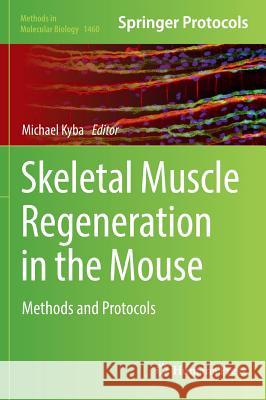
Chapters address the three major areas of study: provoking regeneration by inducing damage to muscle, analyzing theprogenitor cells of skeletal muscle, and quantifying overall muscle function.
Part I Injury
Models
1. Eccentric
Contraction-Induced Muscle Injury: Reproducible, Quantitative, Physiological Models
to Impair Skeletal Muscle’s Capacity to Generate Force
Jarrod A. Call and Dawn
A. Lowe
2. Volumetric
Muscle Loss
Beth E. Pollot and
Benjamin T. Corona
3. Freeze Injury of the Tibialis Anterior
Muscle
Gengyun Le, Dawn A. Lowe, and Michael
Kyba
4. Synergist Ablation
as a Rodent Model to Study Satellite Cell Dynamics in Adult Skeletal Muscle
Tyler J. Kirby, John J. McCarthy,
Charlotte A. Peterson, and Christopher S. Fry
5. Inducing
and Evaluating Skeletal Muscle Injury by Notexin and Barium Chloride
Matthew T.
Tierney and Alessandra Sacco
6. Cardiotoxin Induced Injury and
Skeletal Muscle Regeneration
Glynnis A. Garry, Marie Lue
Antony, and Daniel J. Garry
7. Fibrosis-Inducing Strategies in Regenerating Dystrophic and Normal Skeletal
Muscle
Patrizia
Pessina and Pura Muñoz-Cánoves
Part II Evaluating Progenitor Cells
8. Isolation, Cryosection, and Immunostaining
of Skeletal Muscle
Huascar P. Ortuste Quiroga,
Katsumasa Goto, and Peter S. Zammit
9. Isolation of Mouse Periocular Tissue
for Histological and Immunostaining Analyses of the Extraocular Muscles and
their Satellite Cells
Pascal
Stuelsatz and Zipora Yablonka-Reuveni
10. Skeletal Muscle Tissue Clearing
for LacZ and Fluorescent Reporters, and Immunofluorescence Staining
Mayank Verma,
Bhavani Sai Rohit Murkonda, Yoko Asakura, and Atsushi Asakura
11. Isolation, Culture, Functional
Assays and Immunofluorescence of Myofiber-Associated Satellite Cells
Thomas O.
Vogler, Katherine E. Gadek, Adam B. Cadwallader, Tiffany L. Elston, and Bradley
B. Olwin
12. Transplantation-Based Quantitative
Assays for Satellite Cell Self-Renewal and Differentiation
Robert W. Arpke
and Michael Kyba
13. Non-Invasive Tracking of Quiescent
and Activated MuSC Engraftment Dynamics In Vivo
Andrew T.V. Ho
and Helen M. Blau
14.
Myogenic Progenitors from Mouse Pluripotent
Stem Cells for Muscle Regeneration
Alessandro
Magli, Tania Incitti, and Rita C.R. Perlingeiro
15. Assaying Human Myogenic Progenitor
Cell Activity by Reconstitution of Muscle Fibers and Satellite Cells in Immunodeficient
Mice
Maura H. Parker
16. Methods for Mitochondria and Mitophagy
Flux Analyses in Stem Cells of Resting and Regenerating Skeletal Muscle
Laura
García-Prat, Marta Martínez-Vicente, and Pura Muñoz-Cánoves
17. Identification, Isolation, and
Characterization of Mesenchymal Progenitors in Mouse and Human Skeletal Muscle
Akiyoshi Uezumi, Takehiro Kasai, and
Kunihiro Tsuchida
18. FACS Fractionation and Differentiation of Skeletal-Muscle
Resident Multipotent Tie2+ Progenitors
Arpita A. Biswas and David J.
Goldhamer
Part III Muscle Functional Assays
19. In Vitro Assays to Determine
Skeletal Muscle Physiologic Function
Justin E. Sperringer and Robert W. Grange
20. In Vivo Assessment of Muscle
Contractility in Animal Studies
Shama R. Iyer, Ana P. Valencia, Erick
O. Hernández-Ochoa, and Richard M. Lovering
21. Functional Measurement of
Respiratory Muscle Motor Behaviors Using Transdiaphragmatic Pressure
Sarah M. Greising, Carlos B.
Mantilla, and Gary C. Sieck
22. Assessment of the Contractile Properties
of Permeabilized Skeletal Muscle Fibers
Dennis R.
Claflin, Stuart M. Roche, Jonathan P. Gumucio, Christopher L. Mendias, and
Susan V. Brooks
23. Analysis of Aerobic Respiration
in Intact Skeletal Muscle Tissue by Microplate-Based Respirometry
Jonathan
Shintaku and Denis C. Guttridge
Michael Kyba, Ph.D.
Associate Professor and Lillehei Endowed Scholar, Lillehei Heart Institute NHH4.126, University of Minnesota, SE
Minneapolis, MN 55455, USA
This volume focuses on the cell biology and physiology of skeletal muscle regeneration. This Book is a collection of classic and cutting edge protocols optimized for mice, but in most cases adaptable to rat or other mammalian models, that will allow an investigator to develop and implement a research study on skeletal muscle regeneration. Chapters address the three major areas of study: provoking regeneration by inducing damage to muscle, analyzing the progenitor cells of skeletal muscle, and quantifying overall muscle function. Subjects discussed include: inducing skeletal muscle injury by eccentric contraction; volumetric muscle loss; single myofiber isolation and culture; satellite cell transplantation; muscle clearing for whole mount immunostaining; luciferase tracking of muscle stem cells; mitochondrial and mitophagy flux analysis; in vivo assessment of muscle contractility; force measurements on single isolated myofibers; and analysis of aerobic respiration in intact skeletal muscle tissue by microplate respirometry. Written in the highly successful Methods in Molecular Biology series format, chapters include introductions to each respective topic, lists of the necessary materials and reagents, step-by-step, readily reproducible laboratory protocols, and tips on troubleshooting and avoiding known pitfalls.

Cutting edge and practical, Skeletal Muscle Regeneration in the Mouse: Methods and Protocols is an essential laboratory reference for research in skeletal muscle growth, damage, repair, degeneration, and regenerative therapy in the mouse model system.
1997-2026 DolnySlask.com Agencja Internetowa











