• Wyszukiwanie zaawansowane
  • Kategorie
  • Kategorie BISAC
  • Książki na zamówienie
  • Promocje
  • Granty
  • Książka na prezent
  • Opinie
  • Pomoc
  • Załóż konto
  • Zaloguj się

Self-Similar Processes in Telecommunications » książka


zaloguj się | załóż konto
Logo Krainaksiazek.pl

koszyk

konto

szukaj
topmenu
Księgarnia internetowa
Szukaj
Książki na zamówienie
Promocje
Granty
Książka na prezent
Moje konto
Pomoc
 
 
Wyszukiwanie zaawansowane
Pusty koszyk
Bezpłatna dostawa dla zamówień powyżej 20 złBezpłatna dostawa dla zamówień powyżej 20 zł

Kategorie główne

• Nauka
 [2946600]
• Literatura piękna
 [1856966]

  więcej...
• Turystyka
 [72221]
• Informatyka
 [151456]
• Komiksy
 [35826]
• Encyklopedie
 [23190]
• Dziecięca
 [619653]
• Hobby
 [140543]
• AudioBooki
 [1577]
• Literatura faktu
 [228355]
• Muzyka CD
 [410]
• Słowniki
 [2874]
• Inne
 [445822]
• Kalendarze
 [1744]
• Podręczniki
 [167141]
• Poradniki
 [482898]
• Religia
 [510455]
• Czasopisma
 [526]
• Sport
 [61590]
• Sztuka
 [243598]
• CD, DVD, Video
 [3423]
• Technologie
 [219201]
• Zdrowie
 [101638]
• Książkowe Klimaty
 [124]
• Zabawki
 [2473]
• Puzzle, gry
 [3898]
• Literatura w języku ukraińskim
 [254]
• Art. papiernicze i szkolne
 [8170]
Kategorie szczegółowe BISAC

Self-Similar Processes in Telecommunications

ISBN-13: 9780470014868 / Angielski / Twarda / 2007 / 334 str.
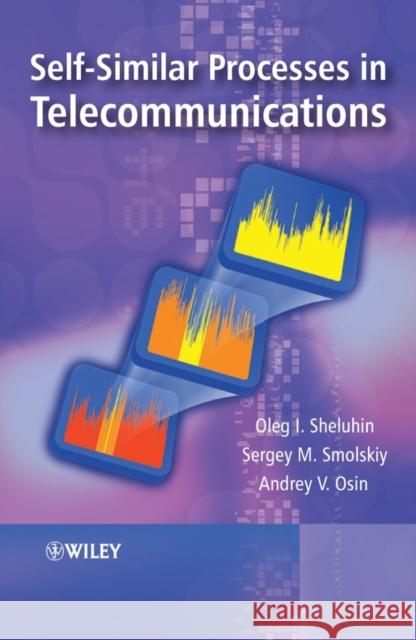
Oleg Sheluhin; Sergey Smolskiy; Andrey V. Osin
Self-Similar Processes in Telecommunications Oleg Sheluhin Sergey Smolskiy Andrey V. Osin 9780470014868 John Wiley & Sons - książkaWidoczna okładka, to zdjęcie poglądowe, a rzeczywista szata graficzna może różnić się od prezentowanej.

Self-Similar Processes in Telecommunications

ISBN-13: 9780470014868 / Angielski / Twarda / 2007 / 334 str.

Oleg Sheluhin; Sergey Smolskiy; Andrey V. Osin
cena 708,31 zł
(netto: 674,58 VAT:  5%)

Najniższa cena z 30 dni: 701,06 zł
Termin realizacji zamówienia:
ok. 30 dni roboczych
Bez gwarancji dostawy przed świętami

Darmowa dostawa!

For the first time the problems of voice services self-similarity are discussed systematically and in detail with specific examples and illustrations. Self-Similar Processes in Telecommunications considers the self-similar (fractal and multifractal) models of telecommunication traffic and efficiency based on the assumption that its traffic has fractal or multifractal properties (is self-similar). The theoretical aspects of the most well-known traffic models demonstrating self-similar properties are discussed in detail and the comparative analysis of the different models' efficiency for self-similar traffic is presented. This book demonstrates how to use self-similar processes for designing new telecommunications systems and optimizing existing networks so as to achieve maximum efficiency and serviceability. The approach is rooted in theory, describing the algorithms (the logical arithmetical or computational procedures that define how a task is performed) for modeling these self-similar processes. However, the language and ideas are essentially accessible for those who have a general knowledge of the subject area and the advice is highly practical: all models, problems and solutions are illustrated throughout using numerous real-world examples.

  • Adopts a detailed, theoretical, yet broad-based and practical mathematical approach for designing and operating numerous types of telecommunications systems and networks so as to achieve maximum efficiency
  • Places the subject in context, describing the current algorithms that make up the fractal or self-similar processes while pointing to the future development of the technology
  • Offers a comparative analysis of the different types of self-similar process usage within the context of local area networks, wide area networks and in the modeling of video traffic and mobile communications networks
  • Describes how mathematical models are used as a basis for building numerous types of network, including voice, audio, data, video, multimedia services and IP (Internet Protocol) telephony
The book will appeal to the wide range of specialists dealing with the design and exploitation of telecommunication systems. It will be useful for the post-graduate students, lecturers and researchers connected with communication networks disciplines.

Kategorie:
Technologie
Kategorie BISAC:
Technology & Engineering > Telecommunications
Wydawca:
John Wiley & Sons
Język:
Angielski
ISBN-13:
9780470014868
Rok wydania:
2007
Ilość stron:
334
Waga:
0.77 kg
Wymiary:
24.61 x 17.4 x 2.44
Oprawa:
Twarda
Wolumenów:
01
Dodatkowe informacje:
Bibliografia
Wydanie ilustrowane


Foreword.

About the authors.

Acknowledgements.

1 Principal Concepts of Fractal Theory and Self–Similar Processes.

1.1 Fractals and Multifractals.

1.1.1 Fractal Dimension of a Set.

1.1.2 Multifractals.

1.1.3 Fractal Dimension D0 and Informational Dimension D1.

1.1.4 Legendre Transform.

1.2 Self–Similar Processes.

1.2.1 Definitions and Properties of Self–Similar Processes.

1.2.2 Multifractal Processes.

1.2.3 Long–Range and Short–Range Dependence.

1.2.4 Slowly Decaying Variance.

1.3 Heavy Tails .

1.3.1 Distribution with Heavy Tails (DHT).

1.3.2 Heavy Tails Estimation.

1.4 Hurst Exponent Estimation.

1.4.1 Time Domain Methods of Hurst Exponent Estimation.

1.4.2 Frequency Domain Methods of Hurst Exponent.

Estimation.

1.5 Hurst Exponent Estimation Problems.

1.5.1 Estimation Problems.

1.5.2 Nonstationarity Problems.

1.5.3 Computational Problems.

1.6 Self–Similarity Origins in Telecommunication Traffic.

1.6.1 User s Behaviour.

1.6.2 Data Generation Data Structure and Its Search.

1.6.3 Traffic Aggregation.

1.6.4 Means of Network Control.

1.6.5 Control Mechanisms based on Feedback.

1.6.6 Network Development.

References.

2 Simulation Methods for Fractal Processes.

2.1 Fractional Brownian Motion.

2.1.1 RMD Algorithm for FBM Generation.

2.1.2 SRA Algorithm for FBM Generation.

2.2 Fractional Gaussian Noise.

2.2.1 FFT Algorithm for FGN Synthesis.

2.2.2 Advantages and Shortcomings of FBM/FGN Models.

in Network Applications.

2.3 Regression Models of Traffic.

2.3.1 Linear Autoregressive (AR) Processes.

2.3.2 Processes of Moving Average (MA).

2.3.3 Autoregressive Models of Moving Average, ARMAðp; qÞ.

2.3.4 Fractional Autoregressive Integrated Moving Average.

(FARIMA) Process.

2.3.5 Parametric Estimation Methods.

2.3.6 FARIMAðp,d,qÞ Process Synthesis.

2.4 Fractal Point Process.

2.4.1 Statistical Characteristics of the Point Process.

2.4.2 Fractal Structure of FPP.

2.4.3 Methods of FPP Formation.

2.5 Fractional Levy Motion and its Application to Network.

Traffic Modelling.

2.5.1 Fractional Levy Motion and Its Properties.

2.5.2 Algorithm of Fractional Levy Motion Modelling.

2.5.3 Fractal Traffic Formation Based on FLM.

2.6 Models of Multifractal Network Traffic.

2.6.1 Multiplicative Cascades.

2.6.2 Modified Estimation Method of Multifractal Functions.

2.6.3 Generation of Traffic the Multifractal Model.

2.7 LRD Traffic Modelling with the Help of Wavelets.

2.8 M/G/1Model.

2.8.1 M/G/1Model and Pareto Distribution.

2.8.2 M/G/1Model and Log–Normal Distribution.

References.

3 Self–Similarity of Real Time Traffic.

3.1 Self–Similarity of Real Time Traffic Preliminaries.

3.2 Statistical Characteristics of Telecommunication Real Time Traffic.

3.2.1 Measurement Organization.

3.2.2 Pattern of TN Traffic.

3.3 Voice Traffic Characteristics.

3.3.1 Voice Traffic Characteristics at the Call Layer.

3.3.2 Voice Traffic Characteristics at the Packet Layer.

3.4 Multifractal Analysis of Voice Traffic.

3.4.1 Basics.

3.4.2 Algorithm for the Partition Function SmðqÞ Calculation.

3.4.3 Multifractal Properties of Multiplexed Voice Traffic.

3.4.4 Multifractal Properties of Two–Component Voice Traffic.

3.5 Mathematical Models of VoIP Traffic.

3.5.1 Problem Statement.

3.5.2 Voice Traffic Models at the Call Layer.

3.5.3 Estimation of Semi–Markovian Model Parameters and the Modelling.

Results of the Voice Traffic at the Call Layer.

3.5.4 Mathematical Models of Voice Traffic at the Packets Layer.

3.6 Simulation of the Voice Traffic.

3.6.1 Simulation Structure.

3.6.2 Parameters Choice of Pareto Distributions for Voice.

Traffic Source in ns2.

3.6.3 Results of Separate Sources Modelling.

3.6.4 Results of Traffic Multiplexing for the Separate.

ON/OFF Sources.

3.7 Long–Range Dependence for the VBR–Video.

3.7.1 Distinguished Characteristics of Video Traffic.

3.7.2 Video Conferences.

3.7.3 Video Broadcasting.

3.7.4 MPEG Video Traffic.

3.7.5 Nonstationarity of VBR Video Traffic.

3.8 Self–Similarity Analysis of Video Traffic.

3.8.1 Video Broadcasting Wavelet Analysis.

3.8.2 Numerical Results.

3.8.3 Multifractal Analysis.

3.9 Models and Modelling of Video Sequences.

3.9.1 Nonstationarity Types for VBR Video Traffic.

3.9.2 Model of the Video Traffic Scene Changing Based on the.

Shifting Level Process.

3.9.3 Video Traffic Models in the Limits of the Separate Scene.

3.9.4 Fractal Autoregressive Models of p–Order.

3.9.5 MPEG Data Modelling Using I, P and B Frames Statistics.

3.9.6 ON/OFF Model of the Video Sequences.

3.9.7 Self–Similar Norros Model.

3.9.8 Hurst Exponent Dependence on N.

References.

4 Self–Similarity of Telecommunication Networks Traffic.

4.1 Problem Statement.

4.2 Self–Similarity and Heavy Tails in Lan Traffic.

4.2.1 Experimental Investigations of Ethernet Traffic Self–Similar.

Structure.

4.2.2 Estimation of Testing Results.

4.3 Self–Similarity of WAN Traffic.

4.3.1 WAN Traffic at the Application Level.

4.3.2 Some Limiting Results for Aggregated WAN Traffic.

4.3.3 The Statistical Analysis of WAN Traffic at the.

Application Level.

4.3.4 Multifractal Analysis of WAN Traffic.

4.4 Self–Similarity of Internet Traffic.

4.4.1 Results of Experimental Studies.

4.4.2 Stationarity Analysis of IP Traffic.

4.4.3 Nonstationarity of Internet Traffic.

4.4.4 Scaling Analysis.

4.5 Multilevel ON/OFF Model of Internet Traffic.

4.5.1 Problem Statement.

4.5.2 Estimation of Parameters and Model Parameterization.

4.5.3 Parallel Buffer Structure for Active Queue Control.

References.

5 Queuing and Performance Evaluation of Telecommunication.

Networks under Traffic Self–Similarity Conditions.

5.1 Traffic Fractality Influence Estimate on Telecommunication.

Networks Queuing.

5.1.1 Monofractal Traffic.

5.1.2 Communication System Model and the Packet Loss Probability.

Estimate for the Asymptotic Self–Similar Traffic Described by.

Pareto Distribution.

5.1.3 Queuing Model with Fractal Levy Motion.

5.1.4 Estimate of the Effect of Traffic Multifractality Effect on Queuing.

5.2 Estimate of Voice Traffic Self–Similarity Effects on the iP Networks.

Input Parameter Optimization.

5.2.1 Problem Statement.

5.2.2 Simulation Structure.

5.2.3 Estimate of the Traffic Self–Similarity Influence on QoS.

5.2.4 TN input Parameter Optimization for Given QoS Characteristics.

5.2.5 Conclusions.

5.3 Telecomminication Network Parameters Optimization Using the Tikhonov.

Regularization Approach.

5.3.1 Problem Statement.

5.3.2 Telecommunication Network Parameter Optimization on the Basis of.

the Minimization of the Discrepancy Functional of QoS Parameters.

5.3.3 Optimization Results.

5.3.4 TN Parameter Optimization on the Basis of Tikhonov.

Functional Minimization.

5.3.5 Regularization Results.

5.3.6 Conclusions.

5.4 Estimation of the Voice Traffic Self–Similarity Influence on QoS.

with Frame Relay Networks.

5.4.1 Pocket Delay at Transmission through the Frame Relay Network.

5.4.2 Frame Relay Router Modelling.

5.4.3 Simulation Results.

5.5 Bandwidth Prediction in Telecommunication Networks.

5.6 Congestion Control of Self–Similar Traffic.

5.6.1 Unimodal Ratio Loading/Productivity.

5.6.2 Selecting Aggressiveness Control (SAC) Scheme.

References.

Appendix A List of Symbols.

Appendix B List of Acronyms.

Index.

Oleg I. Sheluhin is Head of Department of the Radio Engineering and Systems department of Moscow State Technical University of Service (MSTUS). He specializes in the areas of statistical radio engineering, radio systems theory and information systems simulation.

Sergey M. Smolskiy is Head of the Department of Radio Receivers  in the Moscow Power Engineering Institute (MPEI). He has extensive experience in the field of telecommunications and is an active member of IEEE. His recent research topics include low distance radar systems and radio measuring systems.

Andrey V. Osin is currently Assistant Professor in the Department of Radio Engineering and Radio Systems at MSTUC. His PhD thesis focused on imitation modeling of self–similar processes in telecommunications and he has since published widely on the subject in numerous articles and conference journals.

For the first time the problems of voice services self–similarity are discussed systematically and in detail with specific examples and illustrations.

Self–Similar Processes in Telecommunications considers the self–similar (fractal and multifractal) models of telecommunication traffic and efficiency based on the assumption that its traffic has fractal or multifractal properties (is self–similar). The theoretical aspects of the most well–known traffic models demonstrating self–similar properties are discussed in detail and the comparative analysis of the different models efficiency for self–similar traffic is presented.

This book demonstrates how to use self–similar processes for designing new telecommunications systems and optimizing existing networks so as to achieve maximum efficiency and serviceability. The approach is rooted in theory, describing the algorithms (the logical arithmetical or computational procedures that define how a task is performed) for modeling these self–similar processes. However, the language and ideas are essentially accessible for those who have a general knowledge of the subject area and the advice is highly practical: all models, problems and solutions are illustrated throughout using numerous real–world examples.

Adopts a detailed, theoretical, yet broad–based and practical mathematical approach for designing and operating numerous types of telecommunications systems and networks so as to achieve maximum efficiency

  • Places the subject in context, describing the current algorithms that make up the fractal or self–similar processes while pointing to the future development of the technology
  • Offers a comparative analysis of the different types of self–similar process usage within the context of local area networks, wide area networks and in the modeling of video traffic and mobile communications networks
  • Describes how mathematical models are used as a basis for building numerous types of network, including voice, audio, data, video, multimedia services and IP (Internet Protocol) telephony


The book will appeal to the wide range of specialists dealing with the design and exploitation of telecommunication systems. It will be useful for the post–graduate students, lecturers and researchers connected with communication networks disciplines.


Udostępnij

Facebook - konto krainaksiazek.pl


Opinie o Krainaksiazek.pl na Opineo.pl

Partner Mybenefit

Krainaksiazek.pl w programie rzetelna firma Krainaksiaze.pl - płatności przez paypal

Czytaj nas na:

Facebook - krainaksiazek.pl
  • książki na zamówienie
  • granty
  • książka na prezent
  • kontakt
  • pomoc
  • opinie
  • regulamin
  • polityka prywatności

Zobacz:

  • Księgarnia czeska

  • Wydawnictwo Książkowe Klimaty

1997-2025 DolnySlask.com Agencja Internetowa

© 1997-2022 krainaksiazek.pl
     
KONTAKT | REGULAMIN | POLITYKA PRYWATNOŚCI | USTAWIENIA PRYWATNOŚCI
Zobacz: Księgarnia Czeska | Wydawnictwo Książkowe Klimaty | Mapa strony | Lista autorów
KrainaKsiazek.PL - Księgarnia Internetowa

Polityka prywatnosci - link
Krainaksiazek.pl - płatnośc Przelewy24
Przechowalnia Przechowalnia





