• Wyszukiwanie zaawansowane
  • Kategorie
  • Kategorie BISAC
  • Książki na zamówienie
  • Promocje
  • Granty
  • Książka na prezent
  • Opinie
  • Pomoc
  • Załóż konto
  • Zaloguj się

Self-Organizing Natural Intelligence: Issues of Knowing, Meaning, and Complexity » książka


zaloguj się | załóż konto
Logo Krainaksiazek.pl

koszyk

konto

szukaj
topmenu
Księgarnia internetowa
Szukaj
Książki na zamówienie
Promocje
Granty
Książka na prezent
Moje konto
Pomoc
 
 
Wyszukiwanie zaawansowane
Pusty koszyk
Bezpłatna dostawa dla zamówień powyżej 20 złBezpłatna dostawa dla zamówień powyżej 20 zł

Kategorie główne

• Nauka
 [2946912]
• Literatura piękna
 [1852311]

  więcej...
• Turystyka
 [71421]
• Informatyka
 [150889]
• Komiksy
 [35717]
• Encyklopedie
 [23177]
• Dziecięca
 [617324]
• Hobby
 [138808]
• AudioBooki
 [1671]
• Literatura faktu
 [228371]
• Muzyka CD
 [400]
• Słowniki
 [2841]
• Inne
 [445428]
• Kalendarze
 [1545]
• Podręczniki
 [166819]
• Poradniki
 [480180]
• Religia
 [510412]
• Czasopisma
 [525]
• Sport
 [61271]
• Sztuka
 [242929]
• CD, DVD, Video
 [3371]
• Technologie
 [219258]
• Zdrowie
 [100961]
• Książkowe Klimaty
 [124]
• Zabawki
 [2341]
• Puzzle, gry
 [3766]
• Literatura w języku ukraińskim
 [255]
• Art. papiernicze i szkolne
 [7810]
Kategorie szczegółowe BISAC

Self-Organizing Natural Intelligence: Issues of Knowing, Meaning, and Complexity

ISBN-13: 9781402052750 / Angielski / Twarda / 2006 / 359 str.
Myrna Estep
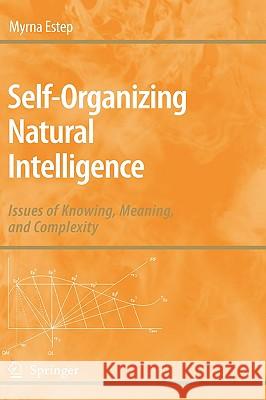
Self-Organizing Natural Intelligence: Issues of Knowing, Meaning, and Complexity Estep, Myrna 9781402052750 Springer - książkaWidoczna okładka, to zdjęcie poglądowe, a rzeczywista szata graficzna może różnić się od prezentowanej.

Self-Organizing Natural Intelligence: Issues of Knowing, Meaning, and Complexity

ISBN-13: 9781402052750 / Angielski / Twarda / 2006 / 359 str.

Myrna Estep
cena 402,53
(netto: 383,36 VAT:  5%)

Najniższa cena z 30 dni: 385,52
Termin realizacji zamówienia:
ok. 22 dni roboczych
Bez gwarancji dostawy przed świętami

Darmowa dostawa!
inne wydania

Self-Organizing Natural Intelligence brings new scientific methods to intelligence research that is currently under the influence of largely classical 19th century single causal theory and method. This out-dated classical approach has resulted in the single-capacity g-theory, a "central processor," top-down, genetically determined linguistic view of intelligence that is directly contradicted by empirical facts of human and animal studies of intelligence. This book proposes, utilizes, and demonstrates the research superiority of a highly developed multidisciplinary theory models approach to intelligence. With conceptual tools, concepts and mathematical methods more suited to continuous, dynamic phenomena of living things, the entire scope of natural intelligence based upon empirical studies of actual human and animal experience is addressed. Results show that human and animal intelligence is largely self-organizing and emergent across a spectrum of major categories of kinds of natural intelligence, not limited to a single "top down" capacity as current proponents of the single-capacity g-theory and IQ approach support. Contrary to the single-capacity verbal theory of intelligence, this work argues and shows evidence for three major categories of natural intelligence. Overwhelming empirical evidence is given to show that our understanding of cognition itself must be broadened to include nonverbal immediate awareness as a category of natural intelligence that is embedded within sensory and somatosensory-motor processes that make possible yet another category of intelligence, knowing how. While most current theories of intelligence assume that the mind is entirely computational, and also assume that sensation is cognitively "neutral," having no intentionality, here empirical evidence is presented from numerous clinical studies showing that certain primitive sensory processes are not cognitively neutral, nor do they require a representational language interface in order to be accessible to cognitive (intelligence) processes. This volume describes a rigorous treatment and exhaustive classification of natural intelligence while also demonstrating a more adequate scientific and mathematical approach than current statistical and psychometric approaches shoring up the out-dated and misused IQ hypothetical construct.


Kategorie:
Nauka, Psychologia
Kategorie BISAC:
Computers > Computer Science
Philosophy > Epistemology
Science > Fizyka matematyczna
Wydawca:
Springer
Język:
Angielski
ISBN-13:
9781402052750
Rok wydania:
2006
Wydanie:
2006
Ilość stron:
359
Waga:
1.60 kg
Wymiary:
23.5 x 15.5
Oprawa:
Twarda
Wolumenów:
01
Dodatkowe informacje:
Bibliografia
Wydanie ilustrowane

Dedication. Introduction. List of Abbreviations. List of Figures and Tables. Acknowledgements. 1. The Problem of Intelligence. 1.1 Some of the Basic Issues. 1.2. The Faulty Sciences of Intelligence. 1.2.1 The Anti-Theory Bias. 1.2.2 Invalid Reductionism. 1.2.3 Neglect of Emerging Intelligence. 1.2.4 Neglect of Theory Construction and Concept Formation. 1.2.5 Unexamined Assumptions, Concepts, and Fallacies. 1.2.6 A Bankrupt Theory of Knowing in the Sciences of Intelligence. 1.2.7 A Missing Distinction between Rule-governed and Rule-bound Intelligence. 1.2.8 Neglect of Multiple Signs and Disclosure of Intelligence. 1.2.9 Mechanical 'Hard-Wired' and Natural Intelligence: Absent the Difference. 1.3 Requirements for a New Science of Intelligence. 1.3.1 A Broader Theory of Knowing. 1.3.2 A Broader Theory of Signs of Intelligence. 1.3.3 Methods of Nonlinear Science: The Emergence of Self-Organizing Dynamical Intelligence. 1.4 Summary. 2. The Universe of Intelligence. 2.1 Carving the Problem Space. 2.1.1 Rational Inquiry and Ideology: The Differences. 2.1.2 Careless Carving. 2.2 Classical Origins of Fabric of Intelligence Theory: Cut on Biases. 2.2.1 Plato and Aristotle's Conflicting Theoretical Stage. 2.2.2 Anthropocentrism, Language, Gender, Race, Size, Wealth, and Place. 2.2.3 The Fabric of Concepts Defining Intelligence Since Darwin. 2.3 Today's IQ Tests: Circularity, Bias, and American Eugenics. 2.3.1 The Economic Argument. 2.3.2 Reification and the Eugenics Argument. 2.3.3 A Static Hierarchy: g the Controller. 2.3.4 Biological Determinism Revisited. 2.4 Summary. 3. The Genesis of Intelligence: Innate and Emergence Arguments. 3.1 Categorization, Classification, Concepts and Representation. 3.1.1 Reality and the Influence of Representationalism. 3.2 The Continuing Problem with Universais (Concepts): Some History. 3.2.1 Realists, Conceptualists, and Nominalists on Universais. 3.2.2 Theories of Knowledge and the Scope ofIntelligence. 3.2.3 Today's Representationalist Myths: Cognitive Maps in the Brain. 3.3 The Innate Versus Emergence Arguments. 3.3.1 The Genetically Encoded Syntax Argument. 3.3.2 Nonverbal Communication: Beyond Alphanumeric Symbols and Vocalizations. 3.3.3 Evolutionary Argument against Innatists. 3.3.4 Cognitivism, Mechanism, and 'Innateness': How the Mind Does Not Work. 3.4 Summary. 4. The Intelligence of Doing: Sensorimotor Domains and Knowing How. 4.1 The Intelligence of Doing. 4.1.1 A Two-Pronged Approach to Intelligence Inquiry. 4.1.2 Cognition, Consciousness, Awareness. 4.2 The Science of Awareness. 4.2.1 Cortical Structures and Information: Neural Bases of Awareness and Intelligent Doing. 4.2.2 How Concepts (Universals) Get Formed: A Global Map Theory. 4.2.3 Primitive Awareness. 4.2.4 Experimental Evidence of Immediate Awareness. 4.2.5 Primitives of the Preattentive Phase of Awareness. 4.3. Primitive Intelligence of Moving and Touching. 4.3.1 Multiple Spaces of the Senses, Images and Probing. 4.3.2 Smoothness and Timing in Intelligent Doing. 4.4 Summary. 5. Universals, Mathematical Thought and Awareness. 5.1 On the Origins and Nature of Mathematical Thought. 5.1.1 A Postmodern View: The Body Shapes Development and Content of Mathematics. 5.1.2 The Language Causal Argument: Language Shapes the Development and Content of Mathematics. 5.1.3 Thinking in Patterns and Images. 5.1.4 The Realism Argument: Reality and Reason Shape the Development and Content of Mathematics. 5.2 Problems with Representation Theories Revisited. 5.2.1 Classification and the Nature of Sui Generis Objects of Immediate Awareness. 5.3 Phenomenal Experience and Mathematics. 5.3.1 Perception and Mathematical Objects. 5.3.2 The Reality of Sets and Concepts. 5.3.3 Intersubjective Requirements of Mathematical Thought. 5.4 Summary. 6. Intelligence as Self-Organizing Emerging Complexity. 6.1 Categories of Natural Intelligence. 6.2 Self-Or

Myrna Lynne Estep holds the B.A., M.S., and Ph.D. degrees from Indiana University, Bloomington, where she also taught and where much of the research for this book was originally done. She has also held faculty positions at the University of Zimbabwe; a branch of the University of Texas; and held various professional positions with the U.S. Government. She is the author of numerous scientific and technological papers, two books, co-editor of another, and has conducted studies in social and political theory affecting women, minorities, and the poor. Her biography appears in numerous reference books including The Directory of American Scholars; various editions of the Marquis Who's Who and Who’s Who in Science and Engineering. She was elected a member of the Honor Society of Phi Kappa Phi in 1992, and is an active researcher and writer in the behavioral sciences and artificial intelligence. Along with her husband, philosopher-scientist Richard Schoenig, she spends much of her time in West Texas and in the high San Juan Mountains of southwest Colorado.

Self-Organizing Natural Intelligence brings new scientific methods to intelligence research that is currently under the influence of largely classical 19th century single causal theory and method. This out-dated classical approach has resulted in the single-capacity g-theory, a "central processor," top-down, genetically determined linguistic view of intelligence that is directly contradicted by empirical facts of human and animal studies of intelligence.

This book proposes, utilizes, and demonstrates the research superiority of a highly developed multidisciplinary theory models approach to intelligence. With conceptual tools, concepts and mathematical methods more suited to continuous, dynamic phenomena of living things, the entire scope of natural intelligence based upon empirical studies of actual human and animal experience is addressed. Results show that human and animal intelligence is largely self-organizing and emergent across a spectrum of major categories of kinds of natural intelligence, not limited to a single "top down" capacity as current proponents of the single-capacity g-theory and IQ approach support.

Contrary to the single-capacity verbal theory of intelligence, this work argues and shows evidence for three major categories of natural intelligence. Overwhelming empirical evidence is given to show that our understanding of cognition itself must be broadened to include nonverbal immediate awareness as a category of natural intelligence that is embedded within sensory and somatosensory-motor processes that make possible yet another category of intelligence, knowing how.

While most current theories of intelligence assume that the mind is entirely computational, and also assume that sensation is cognitively "neutral," having no intentionality, here empirical evidence is presented from numerous clinical studies showing that certain primitive sensory processes are not cognitively neutral, nor do they require a representational language interface in order to be accessible to cognitive (intelligence) processes.

This volume describes a rigorous treatment and exhaustive classification of natural intelligence while also demonstrating a more adequate scientific and mathematical approach than current statistical and psychometric approaches shoring up the out-dated and misused IQ hypothetical construct.

  

ABOUT THE AUTHOR:

Myrna Lynne Estep holds the B.A., M.S., and Ph.D. degrees from Indiana University, Bloomington, where she also taught and where much of the research for this book was originally done. She has also held faculty positions at the University of Zimbabwe; a branch of the University of Texas; and held various professional positions with the U.S. Government. She is the author of numerous scientific and technological papers, two books, co-editor of another, and has conducted studies in social and political theory affecting women, minorities, and the poor. Her biography appears in numerous reference books including The Directory of American Scholars; various editions of the Marquis Who's Who and Who’s Who in Science and Engineering. She was elected a member of the Honor Society of Phi Kappa Phi in 1992, and is an active researcher and writer in the behavioral sciences and artificial intelligence. Along with her husband, philosopher-scientist Richard Schoenig, she spends much of her time in West Texas and in the high San Juan Mountains of southwest Colorado.

Estep, Myrna Myrna Lynne Estep holds the B.A., M.S., and Ph.D. ... więcej >


Udostępnij

Facebook - konto krainaksiazek.pl


Opinie o Krainaksiazek.pl na Opineo.pl

Partner Mybenefit

Krainaksiazek.pl w programie rzetelna firma Krainaksiaze.pl - płatności przez paypal

Czytaj nas na:

Facebook - krainaksiazek.pl
  • książki na zamówienie
  • granty
  • książka na prezent
  • kontakt
  • pomoc
  • opinie
  • regulamin
  • polityka prywatności

Zobacz:

  • Księgarnia czeska

  • Wydawnictwo Książkowe Klimaty

1997-2025 DolnySlask.com Agencja Internetowa

© 1997-2022 krainaksiazek.pl
     
KONTAKT | REGULAMIN | POLITYKA PRYWATNOŚCI | USTAWIENIA PRYWATNOŚCI
Zobacz: Księgarnia Czeska | Wydawnictwo Książkowe Klimaty | Mapa strony | Lista autorów
KrainaKsiazek.PL - Księgarnia Internetowa

Polityka prywatnosci - link
Krainaksiazek.pl - płatnośc Przelewy24
Przechowalnia Przechowalnia





