• Wyszukiwanie zaawansowane
  • Kategorie
  • Kategorie BISAC
  • Książki na zamówienie
  • Promocje
  • Granty
  • Książka na prezent
  • Opinie
  • Pomoc
  • Załóż konto
  • Zaloguj się

Selenium Supplementation in Horticultural Crops » książka


zaloguj się | załóż konto
Logo Krainaksiazek.pl

koszyk

konto

szukaj
topmenu
Księgarnia internetowa
Szukaj
Książki na zamówienie
Promocje
Granty
Książka na prezent
Moje konto
Pomoc
 
 
Wyszukiwanie zaawansowane
Pusty koszyk
Bezpłatna dostawa dla zamówień powyżej 20 złBezpłatna dostawa dla zamówień powyżej 20 zł

Kategorie główne

• Nauka
 [2946912]
• Literatura piękna
 [1852311]

  więcej...
• Turystyka
 [71421]
• Informatyka
 [150889]
• Komiksy
 [35717]
• Encyklopedie
 [23177]
• Dziecięca
 [617324]
• Hobby
 [138808]
• AudioBooki
 [1671]
• Literatura faktu
 [228371]
• Muzyka CD
 [400]
• Słowniki
 [2841]
• Inne
 [445428]
• Kalendarze
 [1545]
• Podręczniki
 [166819]
• Poradniki
 [480180]
• Religia
 [510412]
• Czasopisma
 [525]
• Sport
 [61271]
• Sztuka
 [242929]
• CD, DVD, Video
 [3371]
• Technologie
 [219258]
• Zdrowie
 [100961]
• Książkowe Klimaty
 [124]
• Zabawki
 [2341]
• Puzzle, gry
 [3766]
• Literatura w języku ukraińskim
 [255]
• Art. papiernicze i szkolne
 [7810]
Kategorie szczegółowe BISAC

Selenium Supplementation in Horticultural Crops

ISBN-13: 9783030704889 / Angielski / Miękka / 2022
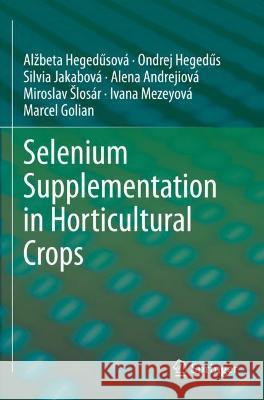
Alžbeta Hegedűsová;Ondrej Hegedűs;Silvia Jakabová
Selenium Supplementation in Horticultural Crops Alžbeta Hegedűsová, Ondrej Hegedűs, Silvia Jakabová 9783030704889 Springer International Publishing - książkaWidoczna okładka, to zdjęcie poglądowe, a rzeczywista szata graficzna może różnić się od prezentowanej.

Selenium Supplementation in Horticultural Crops

ISBN-13: 9783030704889 / Angielski / Miękka / 2022

Alžbeta Hegedűsová;Ondrej Hegedűs;Silvia Jakabová
cena 563,56
(netto: 536,72 VAT:  5%)

Najniższa cena z 30 dni: 539,74
Termin realizacji zamówienia:
ok. 22 dni roboczych
Bez gwarancji dostawy przed świętami

Darmowa dostawa!
inne wydania

Selenium plays a significant role in preventing certain types of cancer and cardiovascular diseases. The level of Selenium in the human body depends on its concentration in food. In turn, the content in vegetable crops is a function of the soil-plant system. There are many countries in the world with low Selenium content in the soil. The average daily human intake is thus limited through food chain.  Analysis of Selenium status suggests that fortification of the soil substrate with Sodium Selenate, and foliar application to agricultural crops are both effective means of Selenium enrichment. Our intention for this publication is to present the possibilities of augmenting Selenium content by biofortification of soils and plants through differentiated nutrition. In the first part of the monograph, the results of Selenium supplementation in model vegetation experiments are presented. The next part of the monograph presents the results of foliar supplementation of Selenium in field conditions. This book is an outstanding reference source for plant breeders and researchers engaged in biofortification of horticulture crops. It is also beneficial to agricultural companies and other stakeholders.

Kategorie:
Nauka, Biologia i przyroda
Kategorie BISAC:
Technology & Engineering > Agriculture - General
Business & Economics > Industries - Agribusiness
Science > Botanika
Wydawca:
Springer International Publishing
Język:
Angielski
ISBN-13:
9783030704889
Rok wydania:
2022
Waga:
0.27 kg
Wymiary:
23.5 x 15.5
Oprawa:
Miękka
Dodatkowe informacje:
Wydanie ilustrowane

1       INTRODUCTION

2       THE ROLE OF SELENIUM IN HUMAN NUTRITION

2.1      Selenium as an essential element

2.1.1           Symptoms of selenium deficiency in human body

2.1.2           Selenium presence and transport in human organism

2.1.3           Biochemical function of selenium in the human body

2.2      Occurrence of selenium in nature and its potential sources

2.2.1           Selenium occurrence in soil (selenium content in soils of the Slovak Republic, selenium forms in soil, soil properties affecting selenium mobility and uptake)

2.2.2           Selenium occurrence in water

2.2.3           Selenium occurrence in air

2.3     Entering selenium into the food chain

2.3.1           Selenium uptake and transport in the plant (biosynthesis of selenocysteine)

2.3.2           Incorporation of selenium into proteins

2.3.3           Distribution of selenium in the plant

2.3.4           Transformation of selenium in the plant

2.3.5           Selenium content in food of plant origin

     2.4      Options of selenium supplementation in food chain

        2.4.1        Possibilities of selenium biofortification of horticultural crops


3       METHODS FOR DETERMINATION OF SELENIUM IN FOODSTUFFS

3.1      Methods for the determination of inorganic selenium compounds (Inductively Coupled Plasma Mass Spectrometry (ICP-MS), Atomic Absorption Spectrometry (AAS), Atomic Fluorescence Spectrometry (HG-AFS), Nuclear Magnetic Resonance Imaging (NMRI), Neutron activation analysis, Electroanalytical methods, Fluorometry, Separation techniques, Our analyses were performed by ET-AAS method with Zeeman background correction)

3.2      Methods for the determination of organic selenium compounds (High Performance Liquid Chromatography (HPLC), Gas Chromatography (GC), Electrophoresis, Autoradiography)

4       SELENIUM UPTAKE BY SELECTED VEGETABLE

SPECIES AFTER FORTIFICATION OF THE GROWING SUBSTRATE

4.1     Garden pea (Pisum sativum L.)

4.1.1           Pot experiments in the Phytochamber

4.1.1.1      Correlation of Se content in soil and in the pea plant

4.1.1.2      Transfer factor and transfer index (Selenium use efficiency by plant, Selenium balance in pea plants)

4.1.2           Pot experiments in outdoor conditions

4.1.2.1      Correlation of Se content in soil and pea plant (Monitoring of phytotoxic effect of selenium)

4.1.2.2      Transfer factor and transfer index (Selenium use efficiency by plant, Selenium balance in pea plants)

4.2      Cabbage (Brassica oleracea var. capitata L.)

4.2.1           Field trials with soil fortification and foliar application of selenium

4.3      Selenium accumulation in various vegetable species after soil biofortification

5       SELENIUM UPTAKE BY SELECTED VEGETABLE

SPECIES AFTER FOLIAR APPLICATION

5.1      Garden pea (Pisum sativum L

5.1.1           Selenium content

5.1.2           Selected qualitative parameters after foliar treatment with selenium (total polyphenol content, chlorophylls content, antioxidant activity)

5.2      Broccoli (Brassica oleracea L. var. italica)

5.2.1           Selenium content

5.2.2           Selected qualitative parameters after foliar treatment with selenium (total polyphenol content, antioxidant activity, vitamin C content, chlorophylls content, carotenoids content, sulforaphane content)

5.2.3           Effect of foliar application of selenium on quantitative parameters (yield, average weight (AW) of florets)

5.3      Basil (Ocimum spp.)

5.3.1           Selenium content

5.3.2           Selected qualitative parameters after foliar treatment with selenium (total polyphenol content, essential oils content, chlorophylls content, antioxidant activity)

5.3.3           Effect of foliar application of selenium on quantitative parameters (yield)

5.4      Tomato (Lycopersicon esculentum Mill.)

5.4.1           Selenium content

5.4.2           Selected qualitative parameters after foliar treatment with selenium (total carotenoids content, vitamin C content, total polyphenol content, antioxidant activity)

5.4.3           Effect of foliar application of selenium on quantitative parameters (refractometric dry mater, yield)

5.5      Oyster mushrooms (Pleurotus ostreatus)

5.5.1           Selenium content

5.5.2           Selected qualitative parameters after foliar treatment with selenium (total polyphenol content, total glucan content, antioxidant activity)

6         CHANGES OF SELENIUM CONTENT IN EDIBILITIES DURING THE PROCESSING

7       CONCLUSION

Prof. RNDr. Alžbeta Hegedűsová, PhD. is a full professor at the Department of Vegetable Production at the Slovak University of Agriculture. In her professional career, as she worked at the Constantine the Philosopher University in Nitra (Department of Chemistry) and at the Slovak University of Agriculture, she has been project leader and co-worker in 40 research and educational projects. Her research activities have been focused on the research of toxic effects of inorganic contaminants in the soil-plant system to verify the possibilities of their intake elimination by horticultural crops with the use of phytoremediation techniques. Another field of research interest has been devoted to the solution of insufficiency of bioactive substances via differentiation of mineral nutrition (especially Selenium) in the horticultural crops leading to increase the level of the substances in the agricultural products. The topic has been elaborated in original research studies published in  35 papers foreign and Slovak journals within the Web of Science and Scopus databases, 60 papers in the foreign and Slovak journals, 110 proceedings in the foreign and Slovak proceeding books and conferences. She is a co-author of 3 university textbooks, 5 monographs and 7 students textbooks. She has been a supervisor of 8 doctoral theses.

Selenium plays a significant role in preventing certain types of cancer and cardiovascular diseases. The level of Selenium in the human body depends on its concentration in food. In turn, the content in vegetable crops is a function of the soil-plant system. There are many countries in the world with low Selenium content in the soil. The average daily human intake is thus limited through food chain.  Analysis of Selenium status suggests that fortification of the soil substrate with Sodium Selenate, and foliar application to agricultural crops are both effective means of Selenium enrichment. Our intention for this publication is to present the possibilities of augmenting Selenium content by biofortification of soils and plants through differentiated nutrition. In the first part of the monograph, the results of Selenium supplementation in model vegetation experiments are presented. The next part of the monograph presents the results of foliar supplementation of Selenium in field conditions. This book is an outstanding reference source for plant breeders and researchers engaged in biofortification of horticulture crops. It is also beneficial to agricultural companies and other stakeholders.



Udostępnij

Facebook - konto krainaksiazek.pl


Opinie o Krainaksiazek.pl na Opineo.pl

Partner Mybenefit

Krainaksiazek.pl w programie rzetelna firma Krainaksiaze.pl - płatności przez paypal

Czytaj nas na:

Facebook - krainaksiazek.pl
  • książki na zamówienie
  • granty
  • książka na prezent
  • kontakt
  • pomoc
  • opinie
  • regulamin
  • polityka prywatności

Zobacz:

  • Księgarnia czeska

  • Wydawnictwo Książkowe Klimaty

1997-2025 DolnySlask.com Agencja Internetowa

© 1997-2022 krainaksiazek.pl
     
KONTAKT | REGULAMIN | POLITYKA PRYWATNOŚCI | USTAWIENIA PRYWATNOŚCI
Zobacz: Księgarnia Czeska | Wydawnictwo Książkowe Klimaty | Mapa strony | Lista autorów
KrainaKsiazek.PL - Księgarnia Internetowa

Polityka prywatnosci - link
Krainaksiazek.pl - płatnośc Przelewy24
Przechowalnia Przechowalnia





