• Wyszukiwanie zaawansowane
  • Kategorie
  • Kategorie BISAC
  • Książki na zamówienie
  • Promocje
  • Granty
  • Książka na prezent
  • Opinie
  • Pomoc
  • Załóż konto
  • Zaloguj się

Selection Bias and Covariate Imbalances in Randomized Clinical Trials » książka

zaloguj się | załóż konto
Logo Krainaksiazek.pl

koszyk

konto

szukaj
topmenu
Księgarnia internetowa
Szukaj
Książki na zamówienie
Promocje
Granty
Książka na prezent
Moje konto
Pomoc
 
 
Wyszukiwanie zaawansowane
Pusty koszyk
Bezpłatna dostawa dla zamówień powyżej 20 złBezpłatna dostawa dla zamówień powyżej 20 zł

Kategorie główne

• Nauka
 [2950560]
• Literatura piękna
 [1849509]

  więcej...
• Turystyka
 [71097]
• Informatyka
 [151150]
• Komiksy
 [35848]
• Encyklopedie
 [23178]
• Dziecięca
 [617388]
• Hobby
 [139064]
• AudioBooki
 [1657]
• Literatura faktu
 [228597]
• Muzyka CD
 [383]
• Słowniki
 [2855]
• Inne
 [445295]
• Kalendarze
 [1464]
• Podręczniki
 [167547]
• Poradniki
 [480102]
• Religia
 [510749]
• Czasopisma
 [516]
• Sport
 [61293]
• Sztuka
 [243352]
• CD, DVD, Video
 [3414]
• Technologie
 [219456]
• Zdrowie
 [101002]
• Książkowe Klimaty
 [124]
• Zabawki
 [2311]
• Puzzle, gry
 [3459]
• Literatura w języku ukraińskim
 [254]
• Art. papiernicze i szkolne
 [8079]
Kategorie szczegółowe BISAC

Selection Bias and Covariate Imbalances in Randomized Clinical Trials

ISBN-13: 9780470863626 / Angielski / Twarda / 2005 / 224 str.
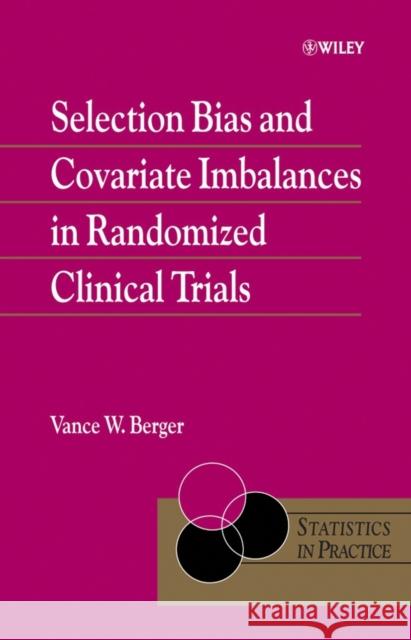
Vance W. Berger
Selection Bias and Covariate Imbalances in Randomized Clinical Trials Vance W. Berger 9780470863626 John Wiley & Sons - książkaWidoczna okładka, to zdjęcie poglądowe, a rzeczywista szata graficzna może różnić się od prezentowanej.

Selection Bias and Covariate Imbalances in Randomized Clinical Trials

ISBN-13: 9780470863626 / Angielski / Twarda / 2005 / 224 str.

Vance W. Berger
cena 373,03
(netto: 355,27 VAT:  5%)

Najniższa cena z 30 dni: 370,73
Termin realizacji zamówienia:
ok. 30 dni roboczych
Dostawa w 2026 r.

Darmowa dostawa!

Selection bias can, and does, occur, even in randomized clinical trials. Steps need to be taken in order to ensure that this does not compromise the integrity of clinical trials; hence "Selection Bias and Covariate Imbalances in Randomized Clinical Trials" offers a comprehensive treatment of the subject and the methodology involved. This book:

  • Provides an overview of the hierarchy of study designs, and justifies the position of randomised trials at the top of this hierarchy.
  • Discusses the strengths and defects of randomisation, and provides real evidence to justify concern regarding its defects.
  • Outlays the damaging consequences that selection bias causes when it does occur.
  • Considers courses of action that can be taken to manage/ contain the problem.
  • Presents methods that can be used to detect selection bias in randomised trials, and methods to correct for selection bias.
  • Concludes by providing a comprehensive plan for managing baseline imbalances and selection bias in randomised trials, and proposing open problems for future research.
Illustrated with case studies, this book introduces groundbreaking ideas and research that will be invaluable to researchers and practitioners who design and analyse clinical trials. It will also be of interest to graduate students within the field of biostatistics.

Kategorie:
Nauka, Matematyka
Kategorie BISAC:
Medical > Research
Mathematics > Prawdopodobieństwo i statystyka
Wydawca:
John Wiley & Sons
Seria wydawnicza:
Statistics in Practice
Język:
Angielski
ISBN-13:
9780470863626
Rok wydania:
2005
Numer serii:
000022326
Ilość stron:
224
Waga:
0.44 kg
Wymiary:
23.52 x 15.44 x 1.75
Oprawa:
Twarda
Wolumenów:
01
Dodatkowe informacje:
Bibliografia
Wydanie ilustrowane

"…the author presents a provocative discussion of randomization and TORSB." ( Computational Statistics, January 2008)

"…recommended to all practitioners and researchers in the field of clinical trials…" (Biometrics, December 2005)

" … informative and interesting to read" (Phamaceutical Statistics Volume 5:2)

Preface.

Part I: Is There a Problem with Reliability in Medical Studies?

1 An Evolution of Comparative Methodology.

1.1 Single–subject studies.

1.2 Case series and cohort studies.

1.3 Historical controls.

1.4 Parallel control groups.

1.5 Matched studies.

1.6 Randomization.

1.7 Advance randomization.

1.8 Allocation concealment.

1.9 Residual selection bias.

2 Susceptibility of Randomized Trials to Subversion and Selection Bias.

2.1 Can randomized trials be subverted?

2.2 If randomized trials are subverted, do they cease to be randomized trials?

2.3 What is masking?

2.4 What is allocation concealment?

2.5 A double standard.

2.6 What if allocation concealment could be ensured?

3 Evidence of Selection Bias in Randomized Trials.

3.1 The burden of proof regarding the existence of selection bias in randomized trials.

3.2 Indirect population–level evidence that selection bias exists in randomized trials.

3.3 Direct trial–level evidence that selection bias exists in randomized trials.

3.3.1 Heparin for myocardial infarction.

3.3.2 University Group Diabetes Program.

3.3.3 Talc and mustine for pleural effusions.

3.3.4 Tonsillectomy for recurrent throat infection in children.

3.3.5 Oxytocin and amniotomy for induction of labor.

3.3.6 Western Washington Intracoronary Streptokinase Trial.

3.3.7 RSV immune globulin in infants and young children with respiratory syncytial virus.

3.3.8 A trial to assess episiotomy.

3.3.9 Canadian National Breast Cancer Screening Study.

3.3.10 Surgical trial.

3.3.11 Lifestyle Heart Trial.

3.3.12 Coronary Artery Surgery Study.

3.3.13 Etanercept for children with juvenile rheumatoid arthritis.

3.3.14 Edinburgh Randomized Trial of Breast–Cancer Screening.

3.3.15 Captopril Prevention Project.

3.3.16 G¨oteborg (Swedish) Mammography Trial.

3.3.17 HIP Mammography Trial.

3.3.18 Hypertension Detection and Follow–Up Program.

3.3.19 Randomized trial to prevent vertical transmission of HIV–1.

3.3.20 Effectiveness trial of a diagnostic test.

3.3.21 South African trial of high–dose chemotherapy for metastatic breast cancer.

3.3.22 Randomized study of a culturally sensitive AIDS education program.

3.3.23 Runaway Youth Study.

3.3.24 Cluster randomized trial of palliative care.

3.3.25 Randomized trial of methadone with or without heroin.

3.3.26 Randomized NINDS trial of tissue plasminogen activator for acute ischemic stroke.

3.3.27 Norwegian Timolol Trial.

3.3.28 Laparoscopic versus open appendectomy.

3.3.29 The Losartan Intervention for Endpoint Reduction in Hypertension (LIFE) Study.

3.3.30 The Heart Outcomes Prevention Evaluation (HOPE) Study.

3.4 In search of better evidence.

4 Impact of Selection Bias in Randomized Trials.

4.1 Quantifying the prediction of future allocations: balanced blocks.

4.2 Quantifying prediction of future allocations: unbalanced blocks.

4.3 Quantifying covariate imbalance resulting from selection bias.

4.4 Quantifying the bias resulting from covariate imbalance.

Part II: Actions to be Taken to Improve the Reliability of Medical Studies.

5 Preventing Selection Bias in Randomized Trials.

5.1 Minimizing the Impact of Selection Bias.

5.2 Biased Selection of Investigators.

5.3 Minimizing the prediction of future allocations.

5.3.1 The trade–off between selection bias and chronological bias.

5.3.2 Notation.

5.3.3 Varying the block sizes.

5.3.4 The maximal procedure.

5.3.5 Extensions.

6 Detecting Selection Bias in Randomized Trials.

6.1 Baseline Imbalances in Observed Covariates.

6.2 Testing for selection bias without baseline analyses.

6.3 The selection covariate.

6.4 The role of the reverse propensity score in third–order residual selection bias.

6.5 Using the reverse propensity score To Test for selection bias: the Berger–Exner test and graph.

6.6 Using the screening log to test for selection bias.

6.7 The Ivanova–Barrier–Berger (IBB) Detection Method.

6.8 Interpreting negative tests of selection bias.

6.9 When should one test for selection bias?

6.10 Who should test for selection bias?

7 Adjusting for Selection Bias in Randomized Trials.

7.1 Methods proposed for addressing non–random baseline imbalances.

7.2 Selection bias arising from a complete lack of allocation concealment.

7.3 Selection bias arising from imperfect allocation concealment.

7.3.1 The RPS approach to adjusting for selection bias.

7.3.2 The Ivanova–Barrier–Berger (IBB) method for correcting selection bias.

8 Managing Selection Bias in Randomized Trials.

8.1 Action points during the design phase of the trial.

8.2 Action points during the conduct of the trial.

8.3 Action points during the analysis of trial data.

8.4 Action points by party.

References.

Author Index.

Subject Index.

Baseline data in clinical trials consists of information regarding patients that is measured at the outset, prior to randomization (or treatment with study medications). In studies where important baseline factors appear well balanced, it can be reasonably concluded that any differences in outcome between the intervention and control groups are a real effect of treatment. The common assumption that any baseline differences in a randomized study are necessarily random is, however, misplaced. Selection bias can, and does, occur – even in randomized clinical trials. Steps need to be taken in order to ensure that this does not compromise the integrity of clinical trials; hence Selection Bias and Covariate Imbalances in Randomized Clinical Trials offers the first comprehensive treatment of the subject and the methodology involved.

  • Provides an overview of the hierarchy of study designs, and justifies the position of randomized trials at the top of this hierarchy.
  • Discusses the strengths and defects of randomization, and provides real evidence to justify concern regarding its defects.
  • Outlays the damaging consequences that selection bias causes when it does occur.
  • Considers courses of action that can be taken to manage/contain the problem.
  • Presents methods that can be used to detect selection bias in randomized trials, and methods to correct for selection bias.
  • Concludes by providing a comprehensive plan for managing baseline imbalances and selection bias in randomized trials, and proposing open problems for future research.

Selection Bias and Covariate Imbalances in Randomized Clinical Trials provides an in–depth overview of a key aspect in the design and analysis of clinical trials, featuring modern and novel approaches to the methodology described. Illustrated with case studies, this book introduces groundbreaking ideas and research that will be invaluable to researchers and practitioners who design and analyse clinical trials. It will also be of interest to graduate students within the field of biostatistics.


Udostępnij

Facebook - konto krainaksiazek.pl


Opinie o Krainaksiazek.pl na Opineo.pl

Partner Mybenefit

Krainaksiazek.pl w programie rzetelna firma Krainaksiaze.pl - płatności przez paypal

Czytaj nas na:

Facebook - krainaksiazek.pl
  • książki na zamówienie
  • granty
  • książka na prezent
  • kontakt
  • pomoc
  • opinie
  • regulamin
  • polityka prywatności

Zobacz:

  • Księgarnia czeska

  • Wydawnictwo Książkowe Klimaty

1997-2025 DolnySlask.com Agencja Internetowa

© 1997-2022 krainaksiazek.pl
     
KONTAKT | REGULAMIN | POLITYKA PRYWATNOŚCI | USTAWIENIA PRYWATNOŚCI
Zobacz: Księgarnia Czeska | Wydawnictwo Książkowe Klimaty | Mapa strony | Lista autorów
KrainaKsiazek.PL - Księgarnia Internetowa

Polityka prywatnosci - link
Krainaksiazek.pl - płatnośc Przelewy24
Przechowalnia Przechowalnia






