• Wyszukiwanie zaawansowane
  • Kategorie
  • Kategorie BISAC
  • Książki na zamówienie
  • Promocje
  • Granty
  • Książka na prezent
  • Opinie
  • Pomoc
  • Załóż konto
  • Zaloguj się

Seismic Analysis of Structures » książka


zaloguj się | załóż konto
Logo Krainaksiazek.pl

koszyk

konto

szukaj
topmenu
Księgarnia internetowa
Szukaj
Książki na zamówienie
Promocje
Granty
Książka na prezent
Moje konto
Pomoc
 
 
Wyszukiwanie zaawansowane
Pusty koszyk
Bezpłatna dostawa dla zamówień powyżej 40 złBezpłatna dostawa dla zamówień powyżej 40 zł

Kategorie główne

• Nauka
 [2952531]
• Literatura piękna
 [1815254]

  więcej...
• Turystyka
 [52246]
• Informatyka
 [151406]
• Komiksy
 [36554]
• Encyklopedie
 [23115]
• Dziecięca
 [612095]
• Hobby
 [104900]
• AudioBooki
 [1784]
• Literatura faktu
 [191556]
• Muzyka CD
 [380]
• Słowniki
 [2946]
• Inne
 [442645]
• Kalendarze
 [1505]
• Podręczniki
 [166084]
• Poradniki
 [422936]
• Religia
 [506774]
• Czasopisma
 [518]
• Sport
 [60387]
• Sztuka
 [242639]
• CD, DVD, Video
 [3428]
• Technologie
 [219359]
• Zdrowie
 [98539]
• Książkowe Klimaty
 [124]
• Zabawki
 [2509]
• Puzzle, gry
 [3809]
• Literatura w języku ukraińskim
 [261]
• Art. papiernicze i szkolne
 [8058]
Kategorie szczegółowe BISAC

Seismic Analysis of Structures

ISBN-13: 9780470824610 / Angielski / Twarda / 2010 / 464 str.
T. K. Datta;¬Abar;¬Abar
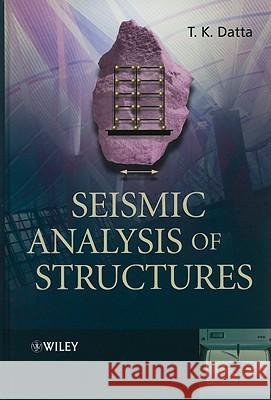
Seismic Analysis of Structures T. K. Datta   9780470824610  - książkaWidoczna okładka, to zdjęcie poglądowe, a rzeczywista szata graficzna może różnić się od prezentowanej.

Seismic Analysis of Structures

ISBN-13: 9780470824610 / Angielski / Twarda / 2010 / 464 str.

T. K. Datta;¬Abar;¬Abar
cena 837,60
(netto: 797,71 VAT:  5%)

Najniższa cena z 30 dni: 801,66
Termin realizacji zamówienia:
ok. 16-18 dni roboczych.

Darmowa dostawa!

In this book, Tushard Kanti Datta provides a comprehensive treatment of seismic analysis of structure which can be used for a complete course on the topic.

While numerous books have been written on earthquakes, earthquake resistance design, and seismic analysis and design of structures, none have been tailored for advanced students and practitioners, and those who would like to have most of the important aspects of seismic analysis in one place. With this book, readers will gain proficiencies in the following: fundamentals of seismology that all structural engineers must know; various forms of seismic inputs; different types of seismic analysis like, time and frequency domain analyses, spectral analysis of structures for random ground motion, response spectrum method of analysis; equivalent lateral load analysis as given in earthquake codes; inelastic response analysis and the concept of ductility; ground response analysis and seismic soil structure interaction; seismic reliability analysis of structures; and control of seismic response of structures.

  • Provides comprehensive coverage, from seismology to seismic control
  • Contains useful empirical equations often required in the seismic analysis of structures
  • Outlines explicit steps for seismic analysis of MDOF systems with multi support excitations
  • Works through solved problems to illustrate different concepts
  • Makes use of MATLAB, SAP2000 and ABAQUAS in solving example problems of the book
  • Provides numerous exercise problems to aid understanding of the subject
As one of the first books to present such a comprehensive treatment of the topic, Seismic Analysis of Structures is ideal for postgraduates and researchers in Earthquake Engineering, Structural Dynamics, and Geotechnical Earthquake Engineering. Developed for classroom use, the book can also be used for advanced undergraduate students planning for a career or further study in the subject area. The book will also better equip structural engineering consultants and practicing engineers in the use of standard software for seismic analysis of buildings, bridges, dams, and towers.Lecture materials for instructors available at
www.wiley.com/go/dattaseismic

Kategorie:
Technologie
Kategorie BISAC:
Technology & Engineering > Civil - General
Technology & Engineering > Structural
Język:
Angielski
ISBN-13:
9780470824610
Rok wydania:
2010
Ilość stron:
464
Waga:
0.95 kg
Wymiary:
24.89 x 17.27 x 3.05
Oprawa:
Twarda
Wolumenów:
01
Dodatkowe informacje:
Bibliografia
Wydanie ilustrowane

Preface.

1 Seismology.

1.1 Introduction.

1.2 Seismic Waves.

1.3 Earthquake Measurement Parameters.

1.4 Measurement of an Earthquake.

1.5 Modification of Earthquakes Due to the Nature of the Soil.

1.6 Seismic Hazard Analysis.

2 Seismic Inputs for Structures.

2.1 Introduction.

2.2 Time History Records.

2.3 Frequency Contents of Ground Motion.

2.4 Power Spectral Density Function of Ground Motion.

2.5 Response Spectrum of Earthquake.

2.6 Generation of Synthetic Accelerograms.

2.7 Prediction of Seismic Input Parameters.

3 Response Analysis for Specified Ground Motions.

3.1 Introduction.

3.2 Equation of Motion for a Single Degree of Freedom (SDOF) System.

3.3 Equations of Motion for a Multi–Degrees of Freedom (MDOF) System.

3.4 Response Analysis for Single Degree of Freedom (SDOF) System.

3.5 Response Analysis for Multi–Degrees of Freedom (MDOF) Systems.

4 Frequency Domain Spectral Analysis.

4.1 Introduction.

4.2 Stationary Random Process.

4.3 Fourier Series and Fourier Integral.

4.4 Auto Correlation and Cross Correlation Functions.

4.5 Power Spectral Density Function (Sxx) and Cross Power Spectral Density Function (Sxy).

4.6 Power Spectral Density Function (PSDF) Matrix.

4.7 PSDFs and Cross PSDFs of the Derivatives of the Process.

4.8 Single Input Single Output System (SISO).

4.9 MDOF System with Single–Point and Multi–Point Excitations.

4.10 PSDF Matrix of Member End Forces.

4.11 Modal Spectral Analysis.

4.12 Spectral Analysis Using the State–Space Formulation.

4.13 Steps for Developing a Program for Spectral Analysis in MATLABfor Multi–Support Excitation.

5 Response Spectrum Method of Analysis.

5.1 Introduction.

5.2 Concept of Equivalent Lateral Force and Response Spectrum Method of Analysis.

5.3 Response Spectrum Analysis for Single–Point Excitation.

5.4 Response Spectrum Analysis for Multi–Support Excitations.

5.5 Cascaded Analysis of Secondary Systems using Response Spectrum Method.

5.6 Approximate Modal Response Spectrum Method of Analysis.

5.7 Seismic Coefficient Method.

5.8 Comparison of Some Code Provisions Prescribed by Different Earthquake Codes.

6 Inelastic Seismic Response of Structures.

6.1 Introduction.

6.2 Non–Linear Analysis of Structures for Earthquake Forces.

6.3 Inelastic Earthquake Analysis of Multi–Storey Building Frames.

6.4 Pushover Analysis.

6.5 Concepts of Ductility and Inelastic Response Spectrum.

6.6 Ductility in a Multi–Storey Structure.

7 Seismic Soil Structure Interaction.

7.1 Introduction.

7.2 Wave Propagation through Soil.

7.3 One–Dimensional Wave Propagation and Ground Response Analysis.

7.4 2D or 3D Response Analysis in the Time Domain.

7.5 Dynamic Soil Structure Interaction.

7.5.1 Bounded Problem and Idealization of Realistic Problems.

7.6 Soil Pile Structure Interaction.

7.7 Seismic Analysis of Buried Structures.

8 Seismic Reliability Analysis of Structures.

8.1 Introduction.

8.2 Uncertainties.

8.3 Formulation of the Reliability Problem.

8.4 Methods of Finding Probabilities of Failure.

8.5 Seismic Reliability Analysis.

9 Seismic Control of Structures.

9.1 Introduction.

9.2 Base Isolation.

9.3 Base Isolators and their Characteristics.

9.4 Analysis of Base Isolated Buildings.

9.5 Design of Base Isolated Buildings.

9.6 Tuned Mass Damper.

9.7 Viscoelastic Dampers.

9.8 Active Structural Control.

9.9 Active Control Algorithms.

9.10 Semi–Active Control.

Exercise Problems.

References.

Index.

Tushar Kanti Datta, Indian Institute of Technology, New Delhi, India
Dr. T. K. Datta is an Emeritus Professor of Civil Engineering at the Indian Institute of Technology (IIT), New Delhi. He has over 30 years of teaching and research experience at IIT, New Delhi and Mumbai. During his academic career, he has guided 30 doctoral students, acted as principal investigator of several important research projects, and consulted on over 150 industrial projects. Datta has published 100 international journal papers and about equal number of papers in conference proceedings. Areas of specialization include Structural Dynamics, Earthquake Engineering, Offshore Structures, Wind Engineering, and Structural Control. He has been teaching Earthquake Engineering and Structural Dynamics for many years both at undergraduate and postgraduate levels. Datta is a fellow of National Academy of Engineering India, and is on the editorial board of many international journals. He is a member of the dynamics core group of the Engineering Mechanics Division of ASCE. For his research work in the area of Structural Dynamics and Earthquake Engineering, he received "15th Khwarzimi International Award" and "Jaikrishna Gold Medal".

While numerous books have been written on earthquakes, earthquake resistance design, and seismic analysis and design of structures, none have been tailored for advanced students and practitioners, and those who would like to have most of the important aspects of seismic analysis in one place. With this book, readers will gain proficiencies in the following: fundamentals of seismology that all structural engineers must know; various forms of seismic inputs; different types of seismic analysis like, time and frequency domain analyses, spectral analysis of structures for random ground motion, response spectrum method of analysis; equivalent lateral load analysis as given in earthquake codes; inelastic response analysis and the concept of ductility; ground response analysis and seismic soil structure interaction; seismic reliability analysis of structures; and control of seismic response of structures.

  • Provides comprehensive coverage, from seismology to seismic control
  • Contains useful empirical equations often required in the seismic analysis of structures
  • Outlines explicit steps for seismic analysis of MDOF systems with multi support excitations
  • Works through solved problems to illustrate different concepts
  • Makes use of MATLAB, SAP2000 and ABAQUAS in solving example problems of the book
  • Provides numerous exercise problems to aid understanding of the subject

As one of the first books to present such a comprehensive treatment of the topic, Seismic Analysis of Structures is ideal for postgraduates and researchers in Earthquake Engineering, Structural Dynamics, and Geotechnical Earthquake Engineering. Developed for classroom use, the book can also be used for advanced undergraduate students planning for a career or further study in the subject area. The book will also better equip structural engineering consultants and practicing engineers in the use of standard software for seismic analysis of buildings, bridges, dams, and towers.

Lecture materials for instructors available at
www.wiley.com/go/dattaseismic


Udostępnij

Facebook - konto krainaksiazek.pl


Opinie o Krainaksiazek.pl na Opineo.pl

Partner Mybenefit

Krainaksiazek.pl w programie rzetelna firma Krainaksiaze.pl - płatności przez paypal

Czytaj nas na:

Facebook - krainaksiazek.pl
  • książki na zamówienie
  • granty
  • książka na prezent
  • kontakt
  • pomoc
  • opinie
  • regulamin
  • polityka prywatności

Zobacz:

  • Księgarnia czeska

  • Wydawnictwo Książkowe Klimaty

1997-2026 DolnySlask.com Agencja Internetowa

© 1997-2022 krainaksiazek.pl
     
KONTAKT | REGULAMIN | POLITYKA PRYWATNOŚCI | USTAWIENIA PRYWATNOŚCI
Zobacz: Księgarnia Czeska | Wydawnictwo Książkowe Klimaty | Mapa strony | Lista autorów
KrainaKsiazek.PL - Księgarnia Internetowa

Polityka prywatnosci - link
Krainaksiazek.pl - płatnośc Przelewy24
Przechowalnia Przechowalnia






